Pack A: 4 apples for £2. Pack B: 6 apples for £3. Which is better value?
Find cost per apple.
Pack A = £0.50 each, Pack B = £0.50 each → same value.

Best value involves comparing prices to decide which option gives the most for the least cost. In GCSE Maths, this often requires calculating unit prices and making fair comparisons between different quantities using unit conversions.
Best value questions ask you to compare prices fairly.
The safest method is to work out the cost per 1 unit, such as cost per item, per kg, per 100 g or per litre.
Once both options are converted to the same unit, you can compare them directly. The lowest unit cost gives the best value.
The option that gives the lowest cost for the same amount.
The price for one unit, such as one item, one kg or one litre.
Comparing options only after converting them to the same unit.
A deal such as “3 for £5” or “20% extra free”.
For each one of something.
How good a deal is compared with what you get.
Use the same unit before deciding.
Divide price by quantity.
The smaller cost per unit is better value.
Convert g to kg or ml to litres if needed.
Useful for packs of sweets, pens or tickets.
Useful for food and smaller packs.
Useful for large masses.
Useful for drinks and liquids.
Best value means finding which option costs less for the same amount. You should not just look at the total price, because a larger price may still be better value if you get more for it.
Always convert each option to the same unit before comparing.
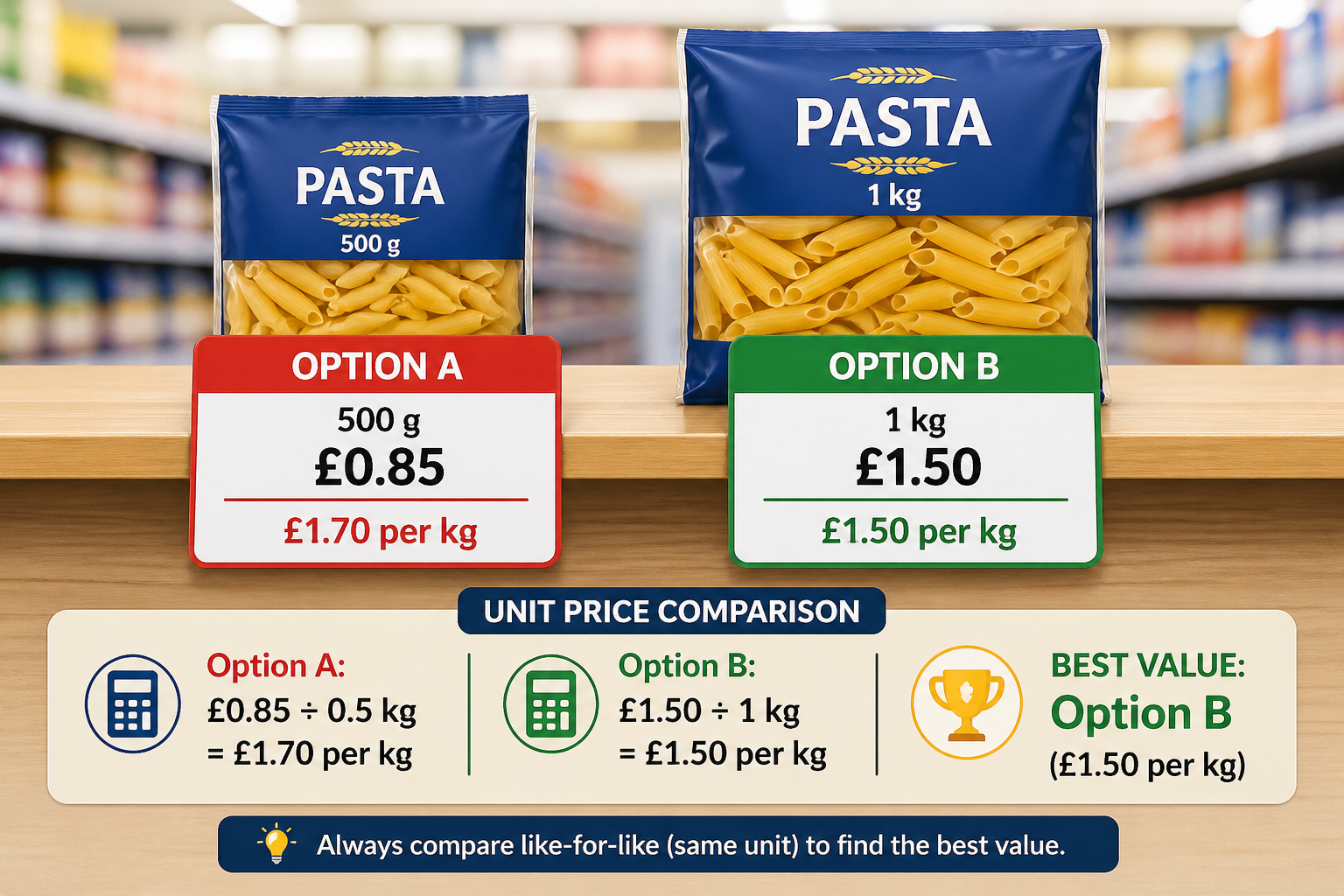
You might be comparing:
Convert both options to the same unit, for example:
Divide the cost by the quantity to find the cost per unit.
\(1000\text{ g} = 1\text{ kg}\)
\(1000\text{ ml} = 1\text{ litre}\)
\(100\text{ p} = £1\)
Make the units match before comparing.
Exam-style questions inspired by Edexcel GCSE Mathematics, focusing on comparing prices to determine the best value.
A 500 g bag of rice costs £1.80. A 1 kg bag costs £3.20. Which offers the best value?
A pack of 6 bottles of water costs £2.40. A pack of 10 bottles costs £3.50. Which pack is the best value?
A 750 g box of cereal costs £2.70. A 1.2 kg box costs £4.20. Determine which is the best value.
A 2-litre bottle of juice costs £3.60. A 1.5-litre bottle costs £2.55. Which is the better buy?
A car travels 420 miles using 35 litres of fuel. Another car travels 360 miles using 27 litres. Which car offers better fuel efficiency?
Exam-style questions based on the AQA GCSE Mathematics specification, emphasising unit rates and real-life decision-making.
A 12-pack of pencils costs £3.60. A 20-pack costs £5.00. Which offers the best value?
A 250 g jar of coffee costs £3.25. A 400 g jar costs £4.80. Which is the best value?
A phone contract costs £18 per month for 5 GB of data. Another costs £25 per month for 10 GB. Which offers the best value per gigabyte?
A 3-metre roll of ribbon costs £2.40. A 5-metre roll costs £3.75. Which is the better buy?
Explain how unit pricing helps determine the best value.
Exam-style questions aligned with OCR GCSE Mathematics, focusing on reasoning, unit comparison, and multi-step best-value problems.
A 6-pack of yoghurt costs £2.10. A 10-pack costs £3.80. Which is the best value?
A gym charges £45 for 6 sessions or £80 for 12 sessions. Which option offers the best value per session?
A 1.5 kg bag of dog food costs £4.50. A 4 kg bag costs £11.20. Which is the best value?
A printer uses two types of ink cartridges. Cartridge A prints 400 pages for £12, and Cartridge B prints 650 pages for £18. Which offers the best value?
Describe the steps required to determine which of two products offers the best value.
Make sure both options are in the same unit.
Work out the cost per unit for each option.
Compare the unit costs carefully.
State clearly which option is best value and why.
Choosing the lower total price without comparing amount.
Comparing grams with kilograms or ml with litres directly.
Using the wrong quantity when working out unit cost.
Not writing a final sentence saying which one is best value.
These are common mistakes students make when solving best value problems in GCSE Maths.
A student chooses the cheaper product without considering the quantity.
Best value depends on unit cost, not total price. Always compare price per unit, such as price per kg or per item.
A student compares 500g with 1kg without converting.
All quantities must be in the same unit before comparing. For example, convert 1kg to 1000g to make a fair comparison.
A student rounds unit prices before finishing the calculation.
Avoid rounding until the final answer. Early rounding can lead to incorrect comparisons between options.
A student chooses the larger pack without checking the cost per unit.
A larger pack is not always better value. Always calculate the unit price to decide which option is cheaper.
A student compares grams with kilograms or millilitres with litres without converting.
Make sure all measurements use the same unit before comparing. Common conversions include 1kg = 1000g and 1L = 1000mL.
Practise comparing prices to determine the best value for money.
Compare simple prices using unit cost.
Pack A: 4 apples for £2. Pack B: 6 apples for £3. Which is better value?
A pack of 5 pens costs £10. What is the cost per pen?
Pack A: 6 yoghurts for £3. Pack B: 10 yoghurts for £4. Which is better value?
A 2 kg bag of rice costs £4. What is the cost per kg?
Which is better value: 500 g for £2 or 1 kg for £3?
A bottle contains 750 ml and costs £3. What is the cost per 250 ml?
Pack A: 3 for £1.50. Pack B: 5 for £2. Which is better value?
A 6-pack costs £3. What is the cost per item?
A student says the larger pack is always better value. Why is this wrong?
A 1 litre bottle costs £2. What is the cost per 100 ml?
Solve best value problems involving unit conversions and multi-step comparisons.
Pack A: 750 g for £2.40. Pack B: 1.2 kg for £3.60. Which is better value?
A 300 g bar costs £1.80. Find the cost per 100 g.
Option A: 2 for £3. Option B: 5 for £7. Which is better value?
A 1.5 litre drink costs £3. What is the cost per litre?
Which is better value: 400 g for £1.20 or 1 kg for £3?
A 2.5 kg bag costs £5. Find the cost per 500 g.
A student compares £4 for 8 items and £5 for 12 items and chooses £4 as cheaper. What is the mistake?
A 900 ml bottle costs £2.70. Find the cost per litre.
Which is better value: 3 for £2 or 7 for £5?
A 1.8 kg bag costs £4.50. Find the cost per kg.
Practise comparing prices, calculating unit costs and choosing the best value deals.