Find 50% of 80.
50% means half.
Half of 80 is 40.

Percentages represent values out of 100 and are widely used in financial maths, including discounts, profit and interest. GCSE questions often test percentage calculations in real-life contexts.
A percentage means “out of 100”.
It is a way of expressing part of a whole using 100 as the standard.
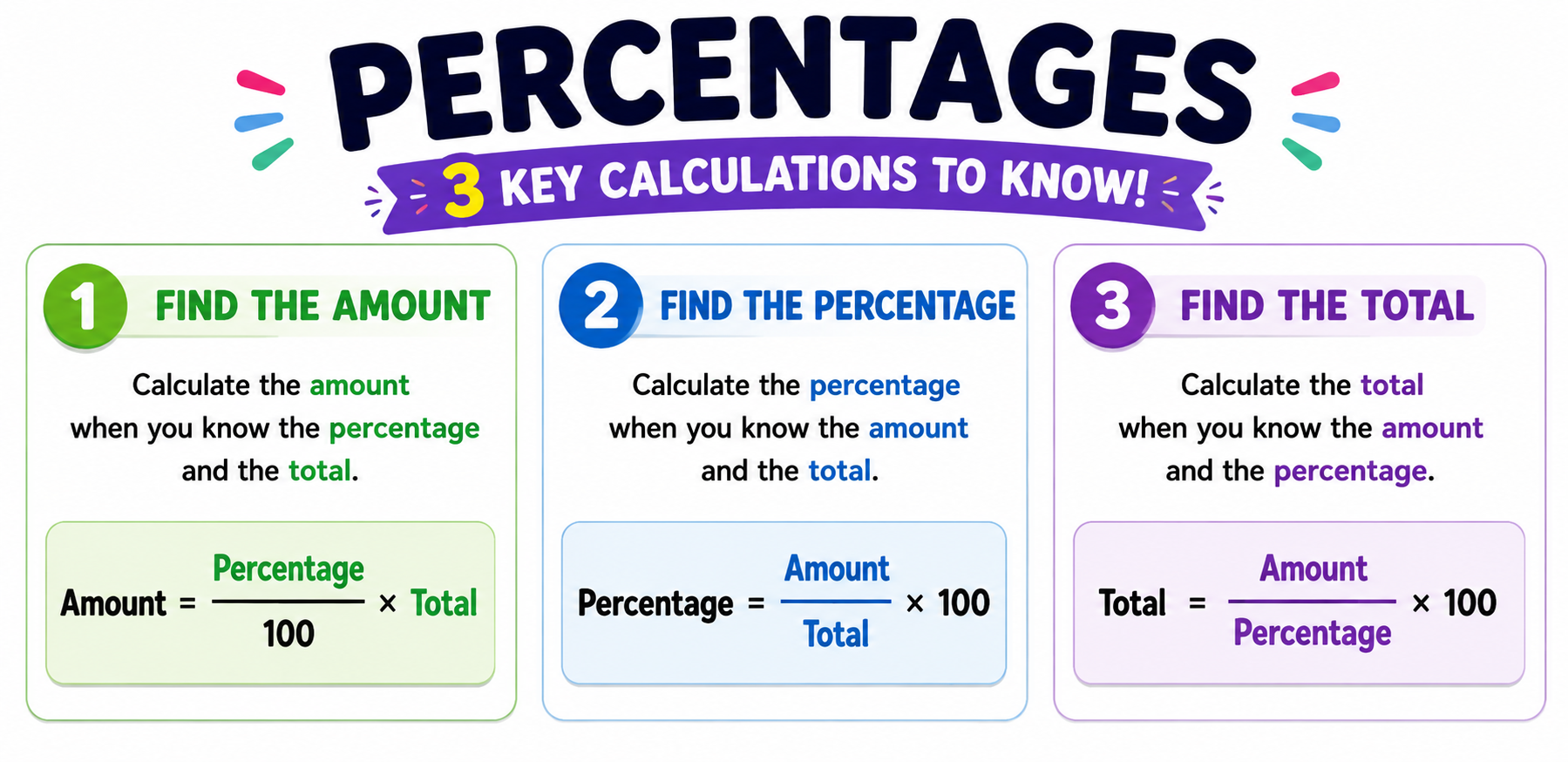
Percentages are used in discounts, interest, profit, loss, exam results, data and real-life comparisons.
You need to be confident converting and calculating with them.
A number written out of 100.
The symbol % meaning “per hundred”.
A part of a quantity found using a percentage.
How much a value goes up as a percentage.
How much a value goes down as a percentage.
A number used to increase or decrease by a percentage in one step.
Divide by 100.
Multiply by 100.
Convert the percentage to a decimal and multiply.
Increase: \(1 + \text{decimal}\), Decrease: \(1 - \text{decimal}\)
| Percentage | Decimal | Fraction |
|---|---|---|
| 50% | 0.5 | \(\frac{1}{2}\) |
| 25% | 0.25 | \(\frac{1}{4}\) |
| 75% | 0.75 | \(\frac{3}{4}\) |
| 10% | 0.1 | \(\frac{1}{10}\) |
| 20% | 0.2 | \(\frac{1}{5}\) |
A percentage means 'out of 100'.
Divide by 100 (move decimal left).
Multiply by 100 (move decimal right).
Write over 100 and simplify.
Convert the percentage to a decimal, then multiply.
Break percentages into easier parts.
Divide by 10.
Half of 10%.
Divide by 100.
15% = 10% + 5%.
Multipliers are used for percentage change.
Multiply by 1.10
Multiply by 0.80
Exam-style questions inspired by Edexcel GCSE Mathematics.
Write 35% as a decimal.
Write 0.62 as a percentage.
Find \( 25\% \) of \( 240 \).
Increase \( 80 \) by \( 15\% \).
Decrease \( 450 \) by \( 20\% \).
Exam-style questions based on the AQA GCSE Mathematics specification, focusing on percentage reasoning and real-life applications.
Express \( \frac{3}{5} \) as a percentage.
A jacket costs £60. In a sale, the price is reduced by 25%. Work out the sale price.
A student's score increased from 50 to 65. Find the percentage increase.
A value decreases from 200 to 150. Find the percentage decrease.
A student says that increasing a number by 10% and then decreasing it by 10% returns it to its original value.
Tick one box. Yes ☐ No ☐
Give a reason for your answer.
Exam-style questions aligned with OCR GCSE Mathematics, emphasising problem-solving, reverse percentages, and financial mathematics.
After a 20% increase, a price becomes £72. Work out the original price.
A shop reduces the price of a television from £500 to £425. Find the percentage reduction.
£800 is invested at an annual simple interest rate of 5%. Calculate the total amount after 3 years.
A population of 12,000 increases by 3% per year. Calculate the population after one year.
Explain the difference between a 50% increase and a 50% decrease of the same value.
Check whether you need a conversion, amount, increase or decrease.
Use the original amount for percentage change questions.
Convert percentages carefully to decimals before multiplying.
Use multipliers when the question involves repeated or direct percentage change.
Moving the decimal point the wrong way.
Dividing by the new amount instead of the original amount.
Using 1.15 for a 15% decrease instead of 0.85.
Not simplifying after writing the percentage over 100.
These are common mistakes students make when working with percentages in GCSE Maths.
A student treats a percentage as a whole number without considering its meaning.
A percentage represents a fraction out of 100. For example, \(25\% = \frac{25}{100} = 0.25\).
A student divides by 10 instead of 100 when converting a percentage to a decimal.
To convert a percentage to a decimal, divide by 100. For example, \(35\% = 0.35\).
A student uses the new amount instead of the original amount when calculating percentage change.
Percentage calculations are usually based on the original amount. Always identify the correct starting value.
A student uses the wrong multiplier, such as \(0.8\) for an increase.
For increases, use multipliers greater than 1 (e.g. 20% increase → \(1.20\)). For decreases, use multipliers less than 1 (e.g. 20% decrease → \(0.80\)).
A student converts a percentage to a fraction but leaves it unsimplified.
Always simplify fractions where possible. For example, \(50\% = \frac{50}{100} = \frac{1}{2}\).
Practise calculating percentages of quantities and solving related problems.
Find percentages of amounts and simple increases/decreases.
Find 50% of 80.
Find 10% of 70.
Find 25% of 200.
Find 20% of 90.
Increase 60 by 10%.
Decrease 50 by 20%.
What is 5% of 200?
Find 1% of 300.
A student says 10% of 50 is 500. What is wrong?
Find 15% of 40.
Work with multipliers and reverse percentages.
Increase 80 by 15%.
Decrease 120 by 25%.
A price increases by 20%. What multiplier is used?
A price decreases by 30%. What multiplier is used?
After a 10% increase, a price is £110. What was the original price?
After a 20% increase, a price is £60. Find the original price.
After a 25% decrease, a value is 75. What was the original?
After a 10% decrease, a value is 45. Find the original.
A student uses ×1.2 to decrease by 20%. What is wrong?
Find 12% of 250.
Practise finding the amount, percentage or total.
Percentage means ‘out of 100’.
Convert the percentage to a decimal or fraction and multiply.
It is the amount added expressed as a percentage of the original value.