Exchange rate: £1 = €1.20. How many euros is £10?
Multiply by 1.20.
£10 × 1.20 = €12.

Currency conversion involves changing values between different currencies using exchange rates. This is a real-life application of ratio and unit conversions, and requires careful multiplication or division depending on the context.
Currency conversion means changing an amount of money from one currency into another.
To do this, you use an exchange rate.
In GCSE questions, you may need to convert from pounds to euros, dollars to pounds, or compare prices in different currencies.
A type of money used in a country, such as pounds, euros or dollars.
The rate used to convert one currency into another.
Change from one unit or currency to another.
Money from another country.
The same amount of money expressed in a different currency.
Usually to 2 decimal places because money is normally written to the nearest cent or penny.
Example: £1 = €1.20, so pounds to euros means multiply by 1.20.
If you want euros back to pounds, divide by 1.20.
The direction of the exchange rate matters.
Usually to 2 decimal places unless told otherwise.
Pounds to euros: multiply by 1.20
Go back by dividing by 1.20
Use the rate as given
Use the inverse operation
Currency conversion means changing money from one currency into another using an exchange rate.
Always read the exchange rate carefully before deciding whether to multiply or divide.
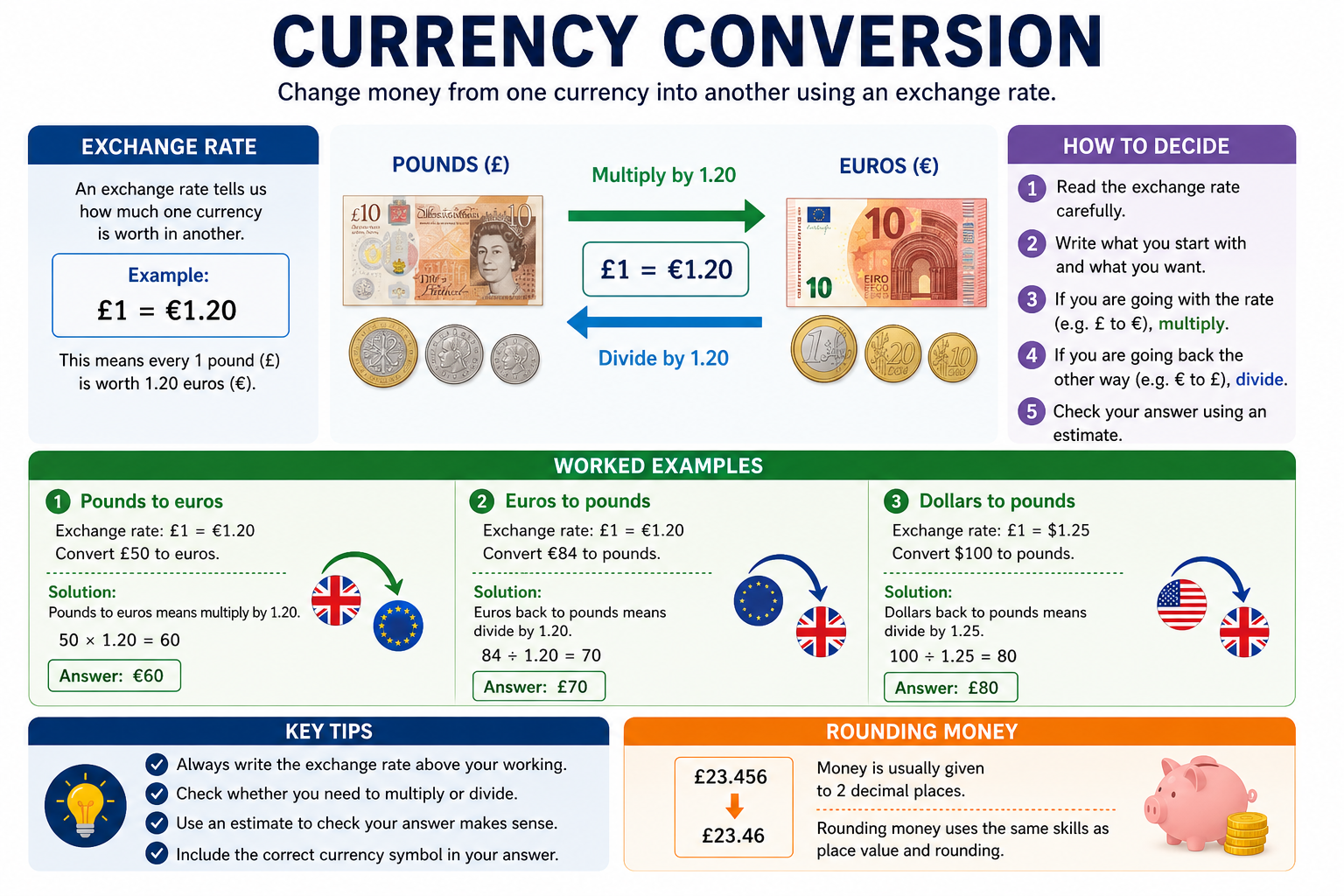
If the rate says £1 = €1.20, then pounds to euros uses multiplication.
Euros to pounds uses division.
Write what you start with and what you want to end with.
Use rough mental maths to check whether your answer makes sense.
Money is usually given to 2 decimal places.
Exam-style questions inspired by Edexcel GCSE Mathematics, focusing on converting between currencies using given exchange rates.
The exchange rate is £1 = €1.20. Convert £50 into euros.
The exchange rate is £1 = $1.35. Convert £80 into US dollars.
The exchange rate is £1 = €1.25. Convert €100 into pounds.
A camera costs $540. The exchange rate is £1 = $1.50. Find the cost in pounds.
The exchange rate is £1 = €1.18. How many euros can be bought with £250?
Exam-style questions based on the AQA GCSE Mathematics specification, emphasising multi-step conversions and real-life contexts.
The exchange rate is £1 = €1.20. A hotel costs €360. Find the cost in pounds.
The exchange rate is £1 = $1.25. A tablet costs $375. Calculate the price in pounds.
£1 = €1.15. A traveller converts £400 into euros and spends €275. How many euros remain?
The exchange rate is £1 = €1.20. After returning from holiday, Maria converts €90 back into pounds. How much does she receive?
Explain why the amount received when converting money back is often less than the original amount.
Exam-style questions aligned with OCR GCSE Mathematics, focusing on reasoning, proportional thinking, and financial decision-making.
The exchange rate is £1 = $1.40. How many dollars will you receive for £65?
The exchange rate is £1 = €1.25. How many pounds are equivalent to €250?
A flight costs €480. The exchange rate is £1 = €1.20. Find the cost in pounds.
Two exchange bureaux offer the following rates: Bureau A: £1 = €1.18, Bureau B: £1 = €1.22. Which offers the better value for converting £500 into euros?
Describe the steps required to convert from one currency to another using an exchange rate.
Read the exchange rate very carefully.
Decide which currency you start with and which one you want.
Multiply or divide correctly.
Round your answer appropriately and include the currency symbol.
Using the exchange rate the wrong way round.
Multiplying when you should divide, or dividing when you should multiply.
Not rounding to sensible money values.
Forgetting whether the answer is in pounds, euros or dollars.
These are common mistakes students make when solving currency conversion problems in GCSE Maths.
A student multiplies by the exchange rate when they should divide.
Decide whether to multiply or divide based on the direction of conversion. If converting to a stronger currency, you usually divide; if converting to a weaker currency, you multiply.
A student uses the exchange rate in the wrong direction.
Always read the exchange rate carefully. For example, if \(1\text{ GBP} = 1.2\text{ EUR}\), then converting GBP to EUR means multiplying, but converting EUR to GBP means dividing.
A student writes the answer without a currency symbol.
Always include the correct currency symbol (e.g. £, €, $) in your final answer, as marks may be awarded for this.
A student rounds intermediate values before completing the calculation.
Do not round until the final answer. Early rounding can lead to inaccurate results.
A student gives an answer with too many decimal places.
Money should usually be given to 2 decimal places (e.g. £12.45). Always check the required level of accuracy.
Practise converting between currencies using exchange rates.
Convert between currencies using basic exchange rates.
Exchange rate: £1 = €1.20. How many euros is £10?
Exchange rate: £1 = €1.50. Convert £8 to euros.
Exchange rate: £1 = €1.25. Convert €25 to pounds.
Exchange rate: £1 = $2. Convert £7 to dollars.
Exchange rate: £1 = €1.10. Convert €11 to pounds.
Exchange rate: £1 = $1.50. Convert £20 to dollars.
A student multiplies €30 by 1.20 to convert to pounds. What is wrong?
Exchange rate: £1 = €1.40. Convert €28 to pounds.
Exchange rate: £1 = $1.25. Convert £16 to dollars.
Exchange rate: £1 = €2. Convert £6.50 to euros.
Solve multi-step currency conversion problems and reverse calculations.
Exchange rate: £1 = €1.25. A jacket costs €62.50. How much is this in pounds?
Exchange rate: £1 = $1.20. A phone costs $240. Find the cost in pounds.
Exchange rate: £1 = €1.50. A tourist exchanges £200. They pay a £5 fee. How many euros do they get?
Exchange rate: £1 = €1.20. A person receives €96. How many pounds did they exchange?
Exchange rate: £1 = $1.40. A hotel costs $350. How much is this in pounds?
Exchange rate: £1 = €1.60. A person exchanges £75. How many euros do they get?
A student converts €120 to pounds by multiplying by 1.20. What is wrong?
Exchange rate: £1 = $1.25. A person has $100. How many pounds is this?
Exchange rate: £1 = €1.10. Which calculation converts €55 to pounds?
Exchange rate: £1 = €1.25. A person buys an item costing €75 and pays in pounds. How much do they pay?
Practise converting between currencies, finding exchange rates and solving real-life holiday money problems.