Convert 3 m into cm.
1 m = 100 cm.
3 × 100 = 300 cm.

Unit conversion involves changing measurements between different units such as length, mass and time. Accuracy is essential and links closely to area, volume and speed calculations.
Unit conversion means changing a measurement from one unit to another without changing the actual size or amount.
For example, \(2.5 \text{ m}\) and \(250 \text{ cm}\) describe exactly the same length.
The number changes, but the actual length stays the same.
A standard measurement such as cm, m, kg or litres.
Change a measurement from one unit to another.
A system of units based mainly on powers of 10.
A measurement of distance, such as mm, cm, m or km.
A measurement such as g or kg.
How much liquid a container can hold, such as mL or litres.
Square units such as \( \text{cm}^2 \) or \( \text{m}^2 \).
Cubic units such as \( \text{cm}^3 \) or \( \text{m}^3 \).
10 mm = 1 cm, 100 cm = 1 m, 1000 m = 1 km.
1000 g = 1 kg.
1000 mL = 1 litre.
Smaller unit: multiply. Bigger unit: divide.
Different measurements use different rules.
mm, cm, m, km
g, kg
mL, litres
cm², m², cm³, m³
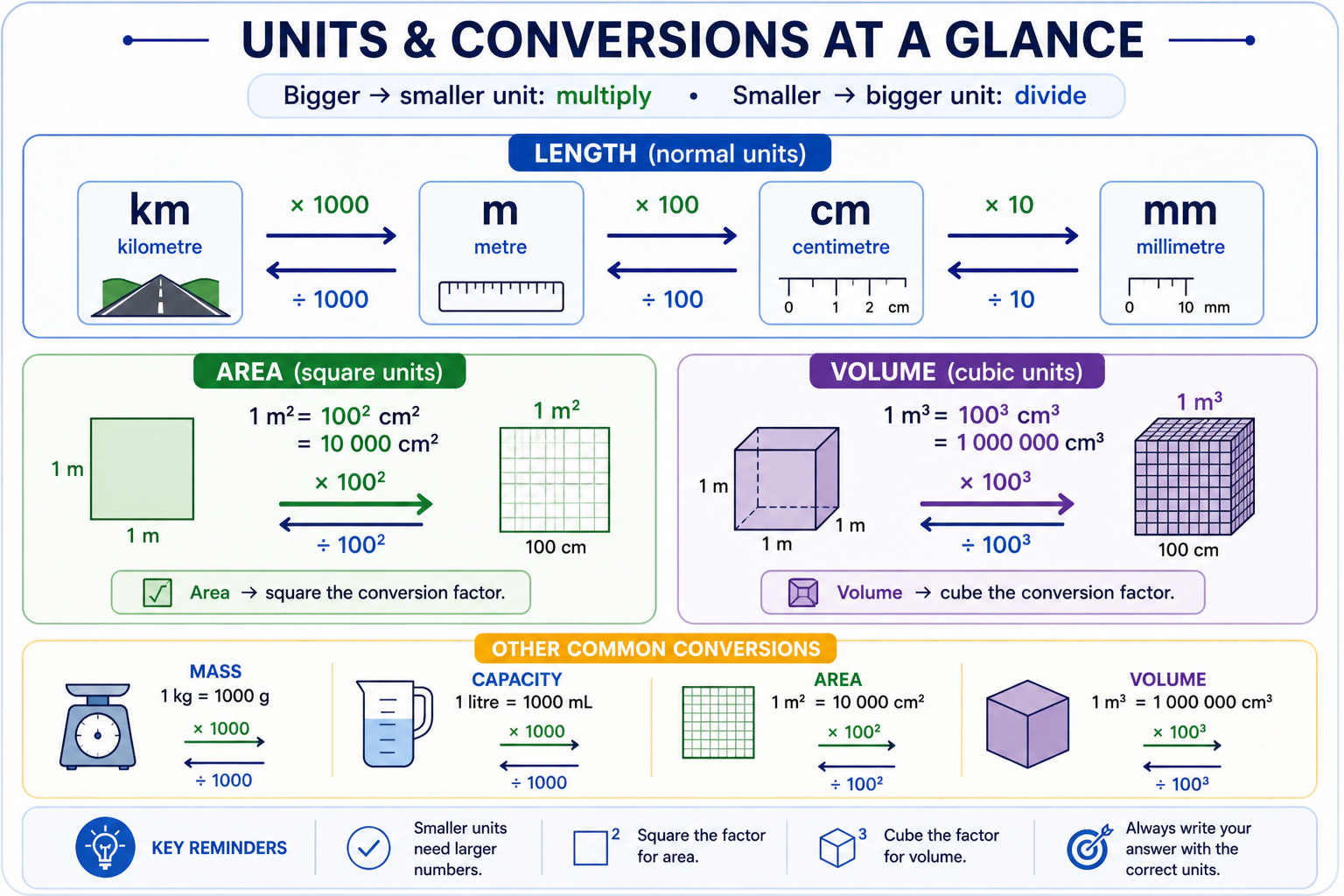
Square the conversion.
Cube the conversion.
Same units before adding
Convert lengths first
Convert before formula
Match time and distance
Exam-style questions focusing on basic metric unit conversions.
Convert 7 m to cm.
Give your answer in centimetres.
Convert 4500 g to kg.
Give your answer in kilograms.
Exam-style questions focusing on capacity, area conversions and mixed units.
Convert 2.8 litres to mL.
Give your answer in millilitres.
Convert 5 m² to cm².
Give your answer in square centimetres.
A rectangle is 2 m by 60 cm.
Find its area in cm².
Exam-style questions focusing on volume conversions and conversion reasoning.
Convert 0.03 m³ to cm³.
Give your answer in cubic centimetres.
A student converts 3 m² to cm² by multiplying by 100.
Explain the mistake.
A cube has side length 1 m.
Explain why 1 m³ equals 1,000,000 cm³.
Check what type of unit is being converted.
Decide whether the new unit is bigger or smaller.
Use squared or cubed scale factors for area and volume.
Make sure all units match before using a formula.
Multiplying instead of dividing, or dividing instead of multiplying.
Using \( \times 100 \) instead of \( \times 10000 \).
Using \( \times 100 \) instead of \( \times 1000000 \).
Leaving dimensions in different units before calculating area or volume.
These are common mistakes students make when converting units in GCSE Maths.
A student multiplies or divides by the wrong number.
Learn key conversions (e.g. 1 km = 1000 m, 1 kg = 1000 g) and apply the correct factor carefully.
A student applies the operation in the wrong direction.
When converting to a smaller unit, multiply. When converting to a larger unit, divide.
A student converts area or volume using the linear factor.
For area, square the conversion factor (e.g. \(1\text{ m}^2 = 10{,}000\text{ cm}^2\)). For volume, cube it (e.g. \(1\text{ m}^3 = 1{,}000{,}000\text{ cm}^3\)).
A student uses different units in the same formula.
Convert all values into the same unit before performing any calculations.
A student gives a number without units or uses the wrong unit.
Always include the correct unit in your final answer, matching what the question requires.
Practise converting between metric and imperial units.
Convert between common metric units and simple real-life contexts.
Convert 3 m into cm.
Convert 250 cm into metres.
Convert 4 kg into grams.
Convert 750 g into kilograms.
Convert 2.5 litres into millilitres.
Convert 600 ml into litres.
Convert 5 km into metres.
Convert 1200 m into kilometres.
Which is the largest unit?
Convert 45 mm into cm.
Convert compound units and work with metric–imperial conversions.
Convert 72 km/h into m/s.
Convert 15 m/s into km/h.
1 mile ≈ 1.6 km. Convert 8 miles into km.
Convert 5000 cm² into m².
Convert 2 m³ into cm³.
A car travels 150 km in 2 hours. Find its speed in km/h.
Convert 3 tonnes into kilograms.
Convert 2500 ml into litres.
Which conversion is correct?
A runner completes 400 m in 50 seconds. Find their speed in m/s.
Practise converting between metric units of length, mass, capacity and area.
They ensure answers are consistent.
You square the conversion factor.
You cube the conversion factor.