A value increases by 10%. What is the multiplier?
Add 10% to 1.
Multiplier = 1 + 0.10 = 1.10.

Growth and decay describe how quantities change over time using multipliers. This is a form of percentage change that is often applied repeatedly using powers in population, finance and real-world situations.
An increase in value over time.
A decrease in value over time.
The number you multiply by to apply percentage change.
The same percentage increase or decrease applied again and again.
Repeated multiplication by a growth multiplier.
Repeated multiplication by a decay multiplier.
Use multiplier \(1 + \frac{p}{100}\).
Use multiplier \(1 - \frac{p}{100}\).
Multiply once by the multiplier.
Use powers: \( (\text{multiplier})^n \).
Multiplier \(= 1.10\).
Multiplier \(= 1.25\).
Multiplier \(= 0.90\).
Multiplier \(= 0.70\).
Growth and decay questions are repeated percentage change problems.
The value increases each time.
The value decreases each time.
The percentage is applied more than once.
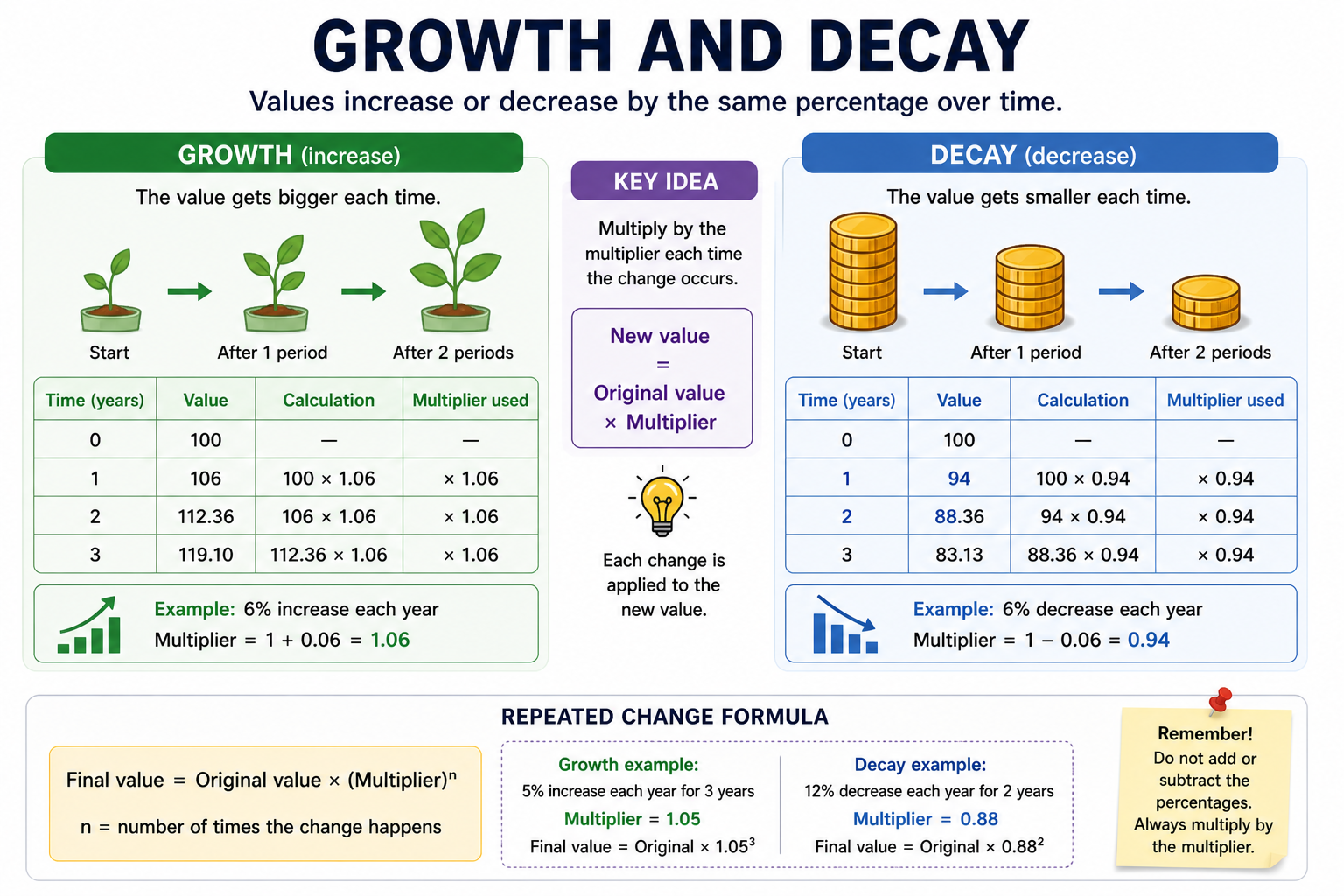
Instead of working out percentages each time, use a multiplier.
Add to 100% then convert to decimal.
Example: 6% increase → \(1.06\)
Subtract from 100% then convert to decimal.
Example: 6% decrease → \(0.94\)
If the change happens multiple times, use powers.
Each percentage is applied to a new value, not the original.
Repeated percentage change is multiplicative, not additive.
Exam-style questions inspired by Edexcel GCSE Mathematics, focusing on percentage growth and decay in real-life contexts.
A town has a population of 24,000. The population increases by 5% each year. Calculate the population after 1 year.
A car worth £18,000 depreciates by 12% each year. Find its value after 1 year.
A salary of £28,000 increases by 3% per year. Calculate the new salary after one year.
A laptop costing £1,200 depreciates by 15%. Calculate its value after the depreciation.
The value of an investment increases from £500 to £575. Calculate the percentage increase.
Exam-style questions based on the AQA GCSE Mathematics specification, emphasising compound growth and decay using multipliers.
A population of bacteria grows by 8% per hour. If the initial population is 500, calculate the population after 2 hours.
A car worth £15,000 depreciates by 10% each year. Calculate its value after 2 years.
An investment of £800 grows by 4% per year. Find its value after 3 years.
The price of a television decreases from £650 to £520. Calculate the percentage decrease.
A house increases in value by 6% per year. If its current value is £200,000, calculate its value after 2 years.
Exam-style questions aligned with OCR GCSE Mathematics, focusing on reasoning, compound measures, and interpreting growth and decay.
A radioactive substance decays by 5% each year. If the initial mass is 200 g, calculate the mass after 3 years.
A bank account earns 2.5% compound interest per year. If £1,000 is invested, calculate its value after 2 years.
A machine loses 20% of its value each year. If it is initially worth £5,000, calculate its value after 2 years.
The number of visitors to a website increases from 12,000 to 15,000. Calculate the percentage increase.
Explain the difference between simple growth and compound growth.
Decide if the question is growth or decay.
Write the percentage multiplier correctly.
Use powers if the change happens repeatedly.
Check whether your final answer is sensible.
Using \(0.06\) instead of \(1.06\) for 6% growth.
Using \(0.12\) instead of \(0.88\) for 12% decay.
Forgetting that repeated change needs \((\text{multiplier})^n\).
Rounding too early can change the final answer.
These are common mistakes students make when working with growth and decay in GCSE Maths.
A student uses \(0.15\) instead of \(1.15\) for 15% growth.
For growth, add 1 to the percentage as a decimal. For example, 15% growth means multiplying by \(1.15\), not \(0.15\).
A student uses \(0.20\) instead of \(0.80\) for 20% decay.
For decay, subtract the percentage from 1. For example, 20% decay means multiplying by \(0.80\), not \(0.20\).
A student adds the percentage repeatedly instead of applying a multiplier.
Growth and decay are multiplicative processes. You must multiply by the multiplier each time, not add the percentage.
A student applies the multiplier once instead of repeatedly.
For repeated change, use powers. For example, \(\text{value} = \text{initial} \times (\text{multiplier})^n\).
A student rounds values during intermediate steps.
Avoid rounding until the final answer, as early rounding can lead to inaccurate results.
Practise solving problems involving exponential growth and decay.
Use multipliers to calculate growth and decay.
A value increases by 10%. What is the multiplier?
A price of £50 increases by 20%. Find the new price.
A value decreases by 15%. What is the multiplier?
A car worth £2000 decreases by 10%. Find its value after the decrease.
A population increases by 5% each year. Which multiplier is used?
A value of 100 increases by 10% twice. Find the final value.
A student adds 10% twice instead of multiplying. What is wrong?
A value of 500 decreases by 20%. Find the new value.
Which multiplier represents a 25% decrease?
A value of 80 increases by 25%. Find the new value.
Solve exponential growth and decay problems over multiple periods.
A value grows by 5% each year. Starting at 100, what is the value after 3 years?
A population of 200 grows by 10% each year. Find the population after 2 years.
A car loses 20% of its value each year. Starting at £10,000, what is its value after 2 years?
A value decreases by 10% each year. Starting at 500, find the value after 3 years.
Which formula represents exponential growth?
A bacteria culture doubles every hour. Starting at 50, how many after 4 hours?
A student calculates 100 × 1.1 × 2 for 2 years of growth. What is wrong?
A value grows by 20% each year. Starting at 150, find the value after 2 years.
A value halves every year. Which multiplier is used?
A value of 100 halves each year. Find the value after 3 years.
Practise percentage growth and decay using multipliers, repeated change and real-life compound problems.