
Preparing for GCSE Maths can feel overwhelming. There are many topics to revise, and students often waste time trying to cover everything equally. The problem is that not every skill has the same impact on exam performance.
The 80/20 rule, also known as the Pareto Principle, is a useful way to make revision more focused. The idea is simple: a small number of important skills often produce a large share of the results.
For GCSE Maths, this means students should spend more time on the core topics that appear regularly and support many other areas of the exam. With just 30 minutes a day, a student can make real progress if the revision is targeted and consistent.
What Is the 80/20 Rule?
The 80/20 rule suggests that around 80% of results often come from around 20% of effort. It is not an exact formula, but it is a helpful principle for revision.
In GCSE Maths, it means focusing first on the topics and skills that appear most often, cause the most marks to be lost, or are needed across several areas of the exam.
Instead of asking, “How can I revise everything?” a better question is:
Which topics will make the biggest difference to my grade?
Why This Works for GCSE Maths
GCSE Maths is built on foundations. If a student improves core skills such as fractions, percentages, algebra, ratio and equation solving, many other topics become easier.
For example, weak fraction skills can affect probability, ratio, algebra and geometry. Weak algebra can make graphs, formulae, sequences and higher-level problem solving much harder.
This is why targeted revision works. Strengthening the most important foundations gives students more confidence across the whole paper.
The Highest-Impact GCSE Maths Areas
The exact focus will depend on the student’s current level, but these areas are usually high-value for most GCSE Maths students:
- Number: fractions, decimals, percentages, rounding, estimation and standard form
- Algebra: simplifying expressions, expanding brackets, solving equations and rearranging formulae
- Ratio and proportion: sharing in a ratio, scaling, percentage change and direct proportion
- Geometry and measures: angles, area, perimeter, volume, Pythagoras and trigonometry
- Graphs: coordinates, linear graphs, gradients and interpreting graphs
- Statistics and probability: averages, charts, probability scales and data interpretation
A good starting point is to strengthen Number and Algebra, because these two areas support so many other topics.
The 30-Minute Daily Revision Routine
A short daily session can be more effective than a long revision session once a week. The key is to make the session focused and active.
- 5 minutes: Warm-up fluency
Practise quick skills such as mental arithmetic, times tables, fractions, percentages or simple algebra. - 15 minutes: Focus topic
Choose one topic and work through examples or practice questions. Keep the focus narrow, such as solving linear equations or percentage change. - 5 minutes: Error log
Write down any mistake, explain why it happened, and record the correct method. - 5 minutes: Spaced review
Return to one old mistake or question from a previous session and try it again.
This routine works because it combines practice, correction and review. Students are not just completing questions — they are learning from them.
Example Weekly Plan
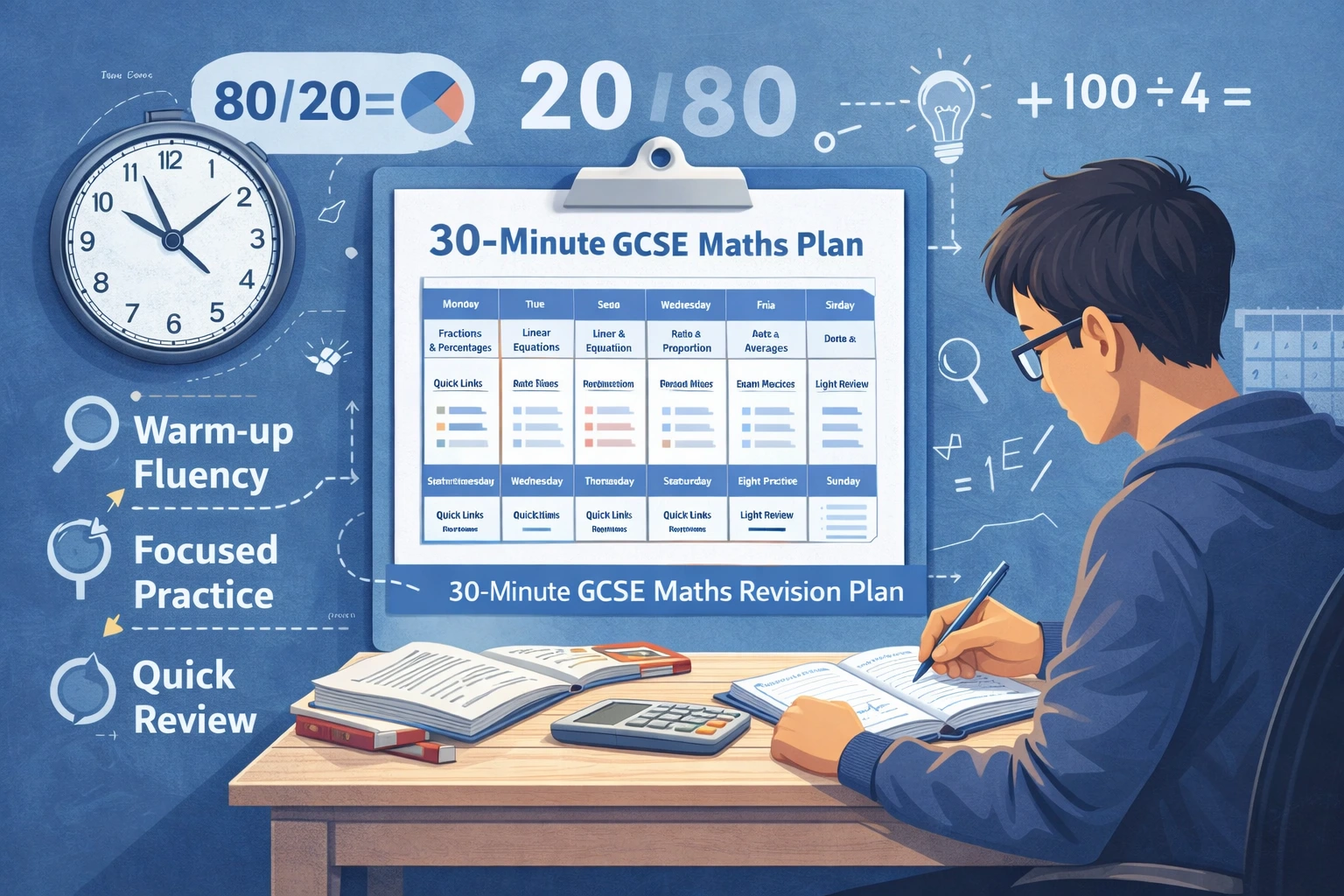
Here is a simple weekly structure using the 80/20 approach:
| Day | Focus | Practice Link |
|---|---|---|
| Monday | Fractions and percentages | Number topics |
| Tuesday | Linear equations | Solving linear equations |
| Wednesday | Ratio and proportion | Ratio and proportion |
| Thursday | Area, perimeter and volume | Geometry and measures |
| Friday | Averages and data | Statistics |
| Saturday | Mixed exam-style practice | GCSE Maths topics |
| Sunday | Light review and rest | Review error log |
How to Make the Revision Stick
The biggest mistake students make is rereading notes and thinking they are revising. GCSE Maths improves through active practice.
To make learning stick, students should:
- answer questions rather than only reading examples
- use active recall to test methods from memory
- review mistakes instead of ignoring them
- repeat weak topics over several days
- mix topic practice with exam-style questions
The error log is especially important. If a student keeps making the same mistake, that mistake needs to become the next revision target.
Common Mistakes to Avoid
The 80/20 rule is powerful, but it only works if revision stays focused. Students should avoid:
- jumping randomly between too many topics
- spending all their time on topics they already find easy
- watching tutorials without doing practice questions
- ignoring mistakes after marking answers
- leaving exam-style questions until the final weeks
The aim is not to rush through everything. The aim is to improve the skills that will make the biggest difference.
Who Is This Plan For?
This 30-minute plan is useful for students who feel overwhelmed, students balancing several GCSE subjects, and students who need a clear daily routine.
It can work for both Foundation and Higher students. Foundation students may focus more on number, ratio, percentages and core algebra. Higher students may use the same structure but include more advanced topics such as quadratic equations, trigonometry and functions.
Getting Extra Support
Some students know they need to revise but are not sure where to start. Others work hard but keep losing marks because of repeated mistakes or weak foundations.
In these cases, targeted support can help identify the highest-impact topics and create a realistic revision plan.
You can browse all GCSE Maths topics here: GCSE Maths topics.
If you would like personalised help, you can book a free GCSE Maths intro session to create a revision plan based on your current level and target grade.
Conclusion
The 80/20 rule shows that effective revision is not about studying for hours every day. It is about choosing the right topics, practising actively, and reviewing mistakes consistently.
With just 30 minutes a day, students can build stronger foundations, reduce stress, and improve their GCSE Maths performance. Small daily sessions, done properly, can lead to big progress over time.