Solve: \(x^2 = 25\)
Remember that both positive and negative numbers can square to 25.
\(x^2 = 25\), so \(x = \pm 5\). Therefore, \(x = -5\) or \(x = 5\).

Quadratic equations involve squared terms and can be solved using methods such as factorising. These equations are a key part of higher GCSE Maths.
A quadratic equation is an equation where the highest power of \(x\) is 2.
The general form is:
Solving a quadratic means finding the value or values of \(x\) that make the equation true.
These values are called the roots or solutions.
An equation where the highest power of the variable is 2.
A value of \(x\) that makes the quadratic equal to 0.
Writing the quadratic as a product of two brackets.
A formula that can be used to solve any quadratic equation.
The part \(b^2 - 4ac\), which tells you how many real solutions there are.
The curved graph shape made by a quadratic function.
Solving a quadratic means finding the values of \(x\) that make the equation equal to zero.
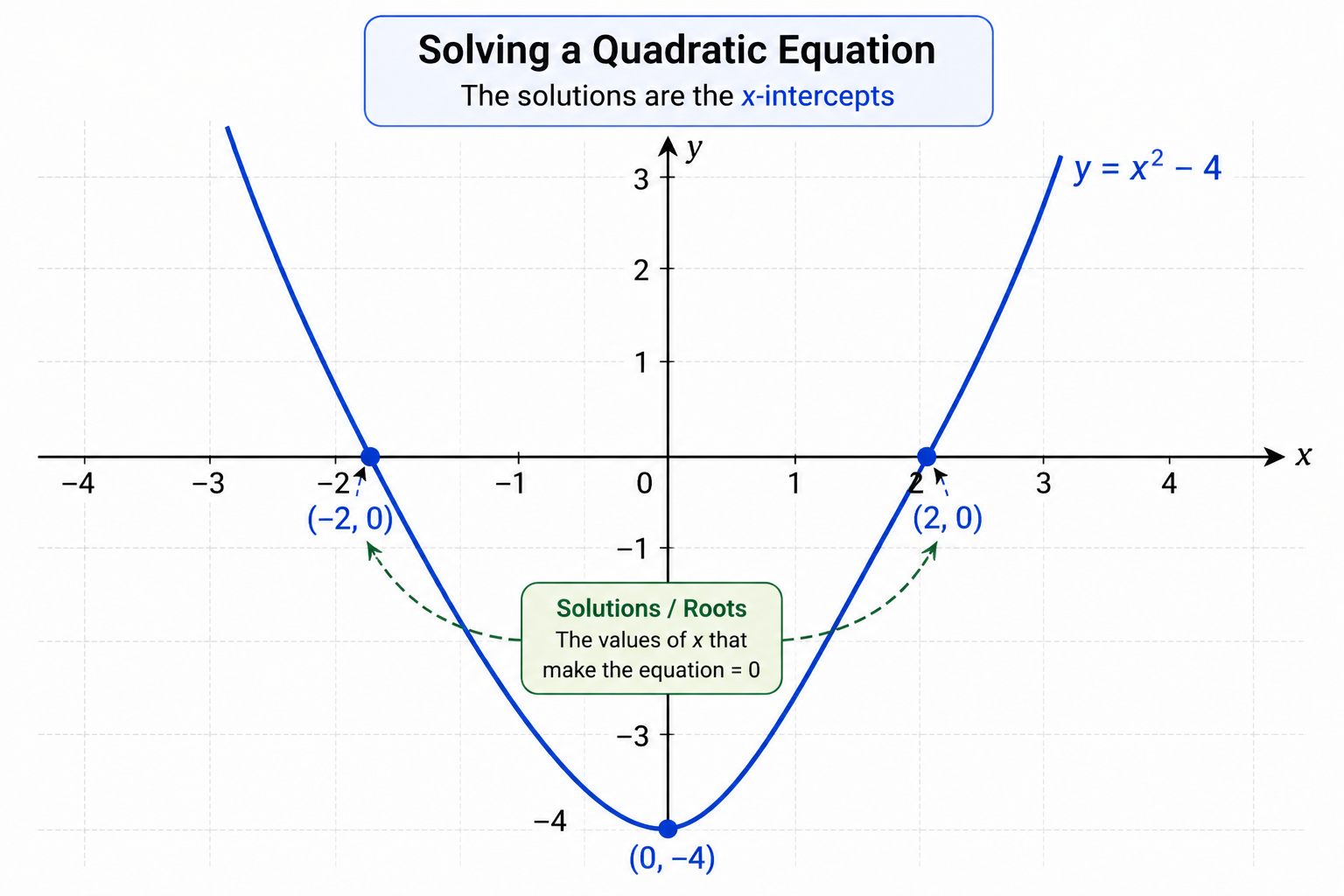
Write the quadratic in standard form before choosing a method.
Factorising is usually the quickest method when the quadratic splits into brackets.
The quadratic formula works for any quadratic equation.
The discriminant tells you how many real solutions the quadratic has.
Two real solutions.
One repeated solution.
No real solutions.
Graph crosses the x-axis twice.
Graph touches the x-axis once.
Graph does not cross the x-axis.
Exam-style questions inspired by Edexcel GCSE Mathematics, focusing on solving quadratic equations using factorisation and interpretation.
Solve \( x^2 + 5x + 6 = 0 \).
Solve \( x^2 - 9 = 0 \).
Solve \( x^2 - 4x - 12 = 0 \).
Solve \( 2x^2 + 7x + 3 = 0 \).
The area of a rectangle is 24 cm². Its length is \( x+2 \) cm and its width is \( x \) cm. Form and solve a quadratic equation to find the value of \( x \).
Exam-style questions based on the AQA GCSE Mathematics specification, focusing on solving quadratics by completing the square and using the quadratic formula.
Solve \( x^2 + 6x + 5 = 0 \) by factorising.
Solve \( x^2 + 4x - 1 = 0 \) correct to 2 decimal places.
Solve \( x^2 + 8x + 3 = 0 \) using the quadratic formula.
Solve \( (x - 3)^2 = 16 \).
Show that the solutions of \( x^2 - 2x - 8 = 0 \) are \( x = 4 \) and \( x = -2 \).
Exam-style questions aligned with OCR GCSE Mathematics, emphasising reasoning, algebraic manipulation, and interpreting solutions.
Solve \( 3x^2 - 12x = 0 \).
Solve \( 2x^2 - 5x - 3 = 0 \).
Find the values of \( k \) for which \( x^2 + kx + 9 = 0 \) has equal roots.
The equation \( x^2 - px + 12 = 0 \) has roots 3 and 4. Find the value of \( p \).
Explain why the equation \( x^2 + 4x + 5 = 0 \) has no real solutions.
Write the equation in the form \(ax^2 + bx + c = 0\).
Choose the best method: factorise, formula or graph.
Solve carefully and show your working clearly.
Check both answers and watch signs carefully.
Wrong pair of numbers or wrong signs in the brackets.
Substituting the wrong values for \(a\), \(b\), or \(c\).
Forgetting what the result tells you about the number of roots.
Forgetting that a quadratic often has two solutions.
These are common mistakes students make when solving quadratic equations in GCSE Maths.
A student tries to solve without rearranging the equation.
Always rewrite the equation in the form \(ax^2 + bx + c = 0\) before solving.
A student picks numbers that do not multiply and add correctly.
When factorising, choose two numbers that multiply to \(ac\) and add to \(b\). Check both conditions.
A student finds only one value of x.
Each bracket gives a solution. For example, \((x - 2)(x + 3) = 0\) gives \(x = 2\) and \(x = -3\).
A student substitutes incorrect values for a, b or c.
Carefully identify a, b and c from the standard form before substituting into the quadratic formula.
A student makes sign mistakes during calculation.
Pay close attention to signs, especially when substituting into \(-b\) and when squaring \(b\).
A student writes only one answer from the quadratic formula.
The \(\pm\) sign gives two solutions. Always calculate both the positive and negative cases.
Practise solving quadratic equations using different methods.
Solve simple quadratic equations by factorising or using square roots.
Solve: \(x^2 = 25\)
Solve: \(x^2 = 49\). Give both answers separated by a comma.
Solve: \(x^2 - 9 = 0\)
Solve: \(x^2 - 16 = 0\). Give both answers separated by a comma.
Solve: \((x + 2)(x + 5) = 0\)
Solve: \((x - 3)(x + 4) = 0\). Give both answers separated by a comma.
Solve: \(x^2 + 5x + 6 = 0\)
Solve: \(x^2 - 7x + 12 = 0\). Give both answers separated by a comma.
A student solves \(x^2 = 36\) and writes only \(x = 6\). What did they forget?
Solve: \(x^2 + 2x - 8 = 0\). Give both answers separated by a comma.
Solve quadratics by factorising, rearranging and using the quadratic formula.
Solve: \(2x^2 + 7x + 3 = 0\)
Solve: \(3x^2 + 10x + 8 = 0\). Give both answers separated by a comma.
Solve: \(x^2 - 5x = 0\)
Solve: \(2x^2 - 8x = 0\). Give both answers separated by a comma.
Solve: \(x^2 - 4x - 12 = 0\)
Solve: \(x^2 + 6x + 5 = 0\). Give both answers separated by a comma.
A student solves \(x^2 - 5x = 0\) by dividing both sides by x and gets \(x = 5\). What did they miss?
Solve: \(x^2 = 3x + 10\). Give both answers separated by a comma.
Which formula is used to solve \(ax^2 + bx + c = 0\)?
Solve: \(x^2 - 2x - 15 = 0\). Give both answers separated by a comma.
Practise solving quadratic equations by factorising and using the quadratic formula.
An equation with a squared term, usually in the form ax² + bx + c = 0.
By factorising, completing the square or using the quadratic formula.
Substitute answers back into the original equation.