Which ratio uses opposite and hypotenuse?
Use SOHCAHTOA.
SOH means sin = opposite ÷ hypotenuse.

Trigonometry uses sine, cosine and tangent to find missing sides and angles in right-angled triangles. It links closely to Pythagoras’ theorem and coordinates.
Trigonometry is used in right-angled triangles to connect angles with side lengths.
The three main trig ratios are sine, cosine and tangent.
Most exam mistakes happen because students choose the wrong sides, not because the calculation itself is hard.
The longest side, opposite the right angle.
The side directly opposite the chosen angle.
The side next to the chosen angle that is not the hypotenuse.
\(\sin \theta = \frac{\text{opposite}}{\text{hypotenuse}}\)
\(\cos \theta = \frac{\text{adjacent}}{\text{hypotenuse}}\)
\(\tan \theta = \frac{\text{opposite}}{\text{adjacent}}\)
Used to find an angle, for example \(\sin^{-1}\), \(\cos^{-1}\), and \(\tan^{-1}\).
The reference angle used to identify the opposite and adjacent sides.
Trigonometry here only works in right-angled triangles.
Always identify the longest side before anything else.
Opposite and adjacent depend on which angle you choose.
Pick the trig ratio that uses the two sides involved.
\( \sin \theta = \frac{\text{opposite}}{\text{hypotenuse}} \)
\( \cos \theta = \frac{\text{adjacent}}{\text{hypotenuse}} \)
\( \tan \theta = \frac{\text{opposite}}{\text{adjacent}} \)
Use \( \sin^{-1} \), \( \cos^{-1} \), or \( \tan^{-1} \) to find angles.
Trigonometry only works in right-angled triangles.
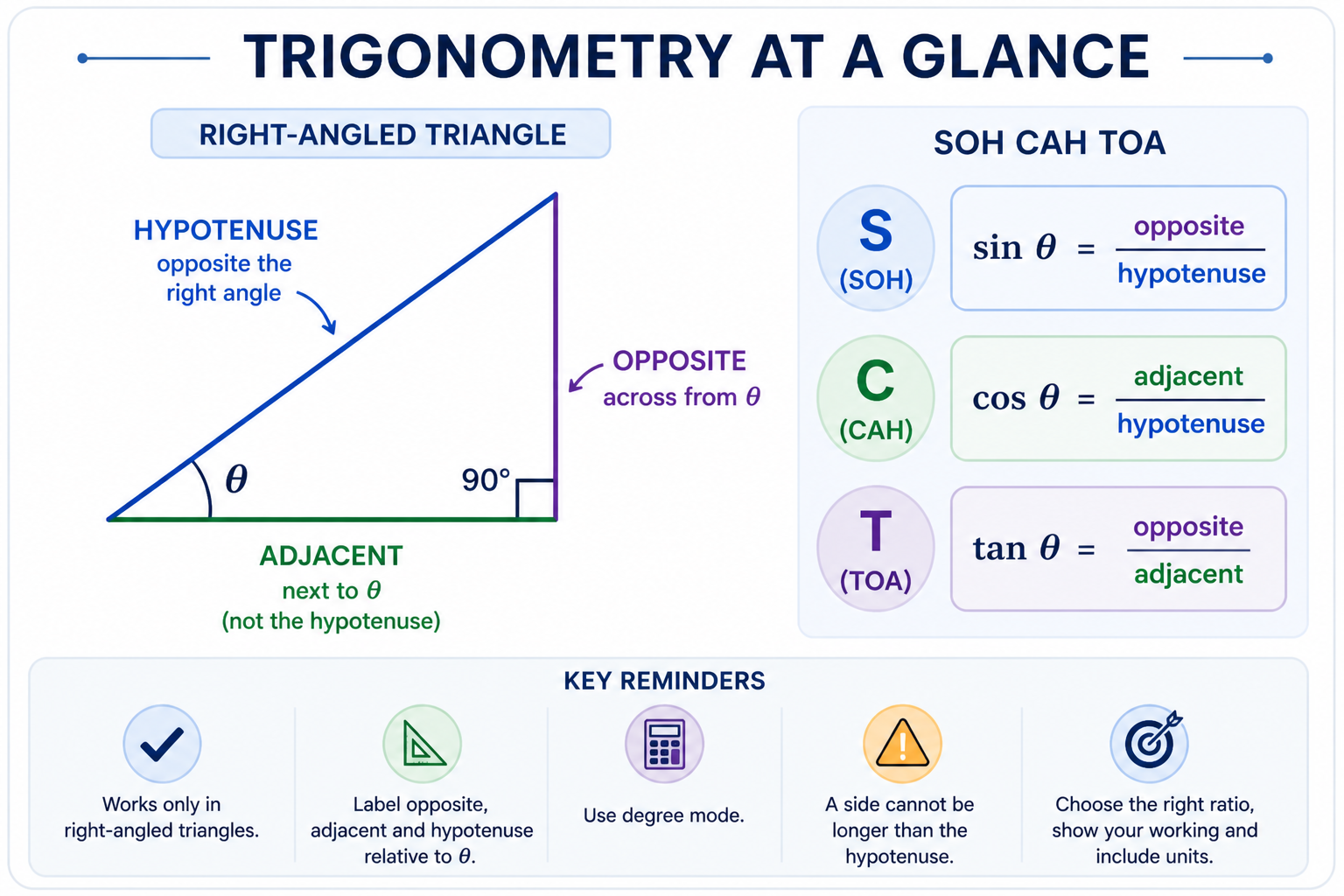
These depend on the chosen angle.
Opposite / Hypotenuse
Adjacent / Hypotenuse
Opposite / Adjacent
Use inverse trig functions.
Always use degrees.
\(\sin^{-1}, \cos^{-1}, \tan^{-1}\)
Round at the end only.
Side cannot exceed hypotenuse.
Exam-style questions focusing on identifying the correct trigonometric ratio.
The right-angled triangle shows the opposite side and hypotenuse.
Which trigonometric ratio uses opposite and hypotenuse?
The right-angled triangle shows the adjacent side and hypotenuse.
Which trigonometric ratio uses adjacent and hypotenuse?
Exam-style questions focusing on calculating missing sides using sine and cosine.
In the right-angled triangle, θ = 30° and the hypotenuse is 14 cm.
Find the opposite side x.
In the right-angled triangle, θ = 60° and the hypotenuse is 20 cm.
Find the adjacent side x.
Exam-style questions focusing on choosing the correct ratio and finding angles.
A student wants to use tangent, but the only known side is the hypotenuse.
Explain why tangent cannot be used.
In the right-angled triangle, the opposite side is 9 cm and the hypotenuse is 15 cm.
Find the angle θ.
In a right-angled triangle, the opposite side is 12 cm and the adjacent side is 16 cm.
Write down the trigonometric equation needed to find θ.
Check that the triangle is right-angled.
Mark the chosen angle and identify opposite, adjacent and hypotenuse.
Choose sine, cosine or tangent from the sides involved.
Rearrange carefully or use inverse trig for angles.
Mixing up opposite and adjacent.
Choosing sine when cosine or tangent is needed.
Using \(\sin\) instead of \(\sin^{-1}\) when finding an angle.
Calculator set to radians instead of degrees.
These are common mistakes students make when using trigonometry in GCSE Maths.
A student labels sides incorrectly in the triangle.
Always identify sides relative to the given angle: opposite is across from the angle, adjacent is next to it, and hypotenuse is the longest side.
A student keeps the same labels when the reference angle changes.
Opposite and adjacent depend on the chosen angle. If the angle changes, the labels must be reassigned.
A student chooses sine, cosine or tangent incorrectly.
Use SOHCAHTOA: \(\sin = \frac{\text{opp}}{\text{hyp}}\), \(\cos = \frac{\text{adj}}{\text{hyp}}\), \(\tan = \frac{\text{opp}}{\text{adj}}\). Match the ratio to the sides you are using.
A student uses sin, cos or tan when finding an angle.
When finding an angle, use inverse functions: \(\sin^{-1}\), \(\cos^{-1}\), or \(\tan^{-1}\).
A student gets an incorrect answer due to radians mode.
Ensure your calculator is set to degrees (DEG mode) for GCSE questions unless stated otherwise.
Practise solving problems using trigonometric ratios.
Use sine, cosine and tangent to find missing sides in right-angled triangles.
Which ratio uses opposite and hypotenuse?
Find x to 1 decimal place.
Find x to 1 decimal place.
Find x to 1 decimal place.
Which ratio uses opposite and adjacent?
Find x to 1 decimal place.
Which side is always opposite the right angle?
In SOHCAHTOA, what does CAH mean?
Find x to 1 decimal place.
Which trigonometric ratio should you use when you know the adjacent side and need the opposite side?
Find missing angles and solve multi-step trigonometry problems.
Find angle x to 1 decimal place.
Find angle x to 1 decimal place.
A ladder is 5 m long and makes an angle of 70° with the ground. How high up the wall does it reach? Give your answer to 1 decimal place.
Find x to 1 decimal place.
Find angle x when opposite = 8 cm and hypotenuse = 13 cm. Give your answer to 1 decimal place.
Which calculation finds angle x if adjacent = 6 and hypotenuse = 10?
A ramp rises 1.5 m over a horizontal distance of 6 m. Find the angle the ramp makes with the ground to 1 decimal place.
A student uses sine with adjacent and hypotenuse. What is wrong?
Find x to 1 decimal place if tan x = 3/4.
A triangle has angle 25° and hypotenuse 14 cm. Which calculation finds the opposite side?
Practise using sine, cosine and tangent in right-angled triangles.
Ratios used to find sides or angles in right-angled triangles.
It helps remember trig ratios.
When you have angles and sides in triangles.