Find the volume of the cube.
Volume of cube = side³.
4³ = 64 cm³.

Volume measures the space inside a 3D shape. It links closely to surface area and unit conversions, especially when working with cubic units.
Volume tells you how much space is inside a 3D shape.
It is measured in cubic units, such as \( \text{cm}^3 \), \( \text{m}^3 \) or \( \text{mm}^3 \).
In GCSE Maths, many volume questions are about choosing the correct formula, substituting values carefully, and remembering the correct units.
The amount of space inside a 3D shape.
Units used for volume, such as \( \text{cm}^3 \) or \( \text{m}^3 \).
A 3D shape with the same cross-section all the way through.
The shape made by slicing through a solid.
The distance from the centre of a circle to its edge.
The vertical distance from base to top.
The area of the bottom face used in some volume formulas.
A measure of how much a container can hold, often in litres or millilitres.
Volume is the amount of space inside a three-dimensional object.
Each 3D shape has its own volume formula, so identify the shape first.
Volume of a prism = area of cross-section × length.
Write answers in units such as cm³, m³, or mm³.
\( V = l \times w \times h \)
\( V = a^3 \)
\( V = \text{Area of cross-section} \times \text{length} \)
\( V = \pi r^2 h \)
\( V = \frac{1}{3} \pi r^2 h \)
\( V = \frac{4}{3} \pi r^3 \)
\( V = \frac{1}{3} \times \text{Base Area} \times h \)
Volume measures the space inside a 3D shape.
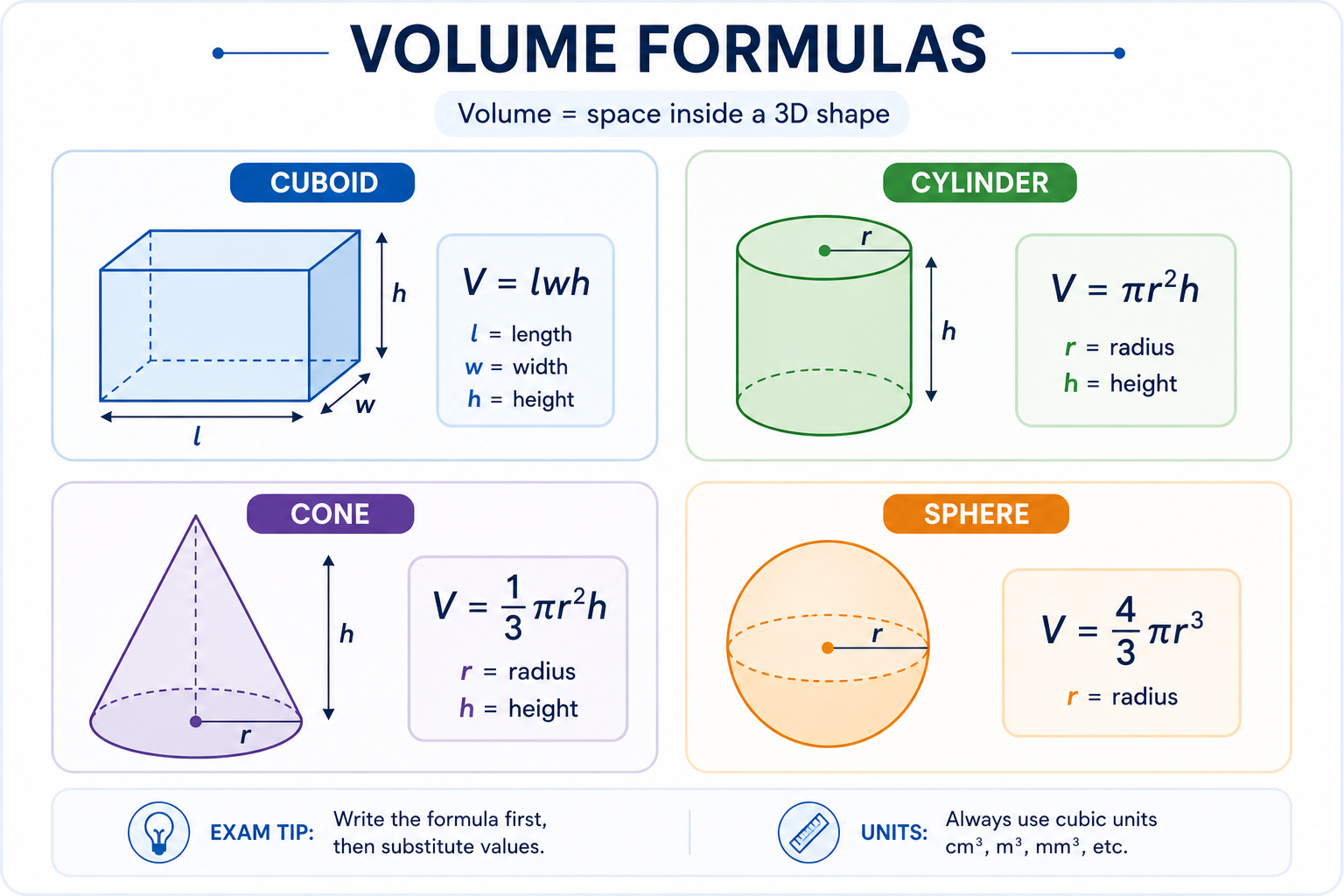
Multiply 3 dimensions
Cross-section × length
Circle × height
Use \(\frac{1}{3}\)
Same cross-section throughout.
Exam-style questions focusing on volume of cuboids and cubes.
A cuboid has dimensions 6 cm, 4 cm and 3 cm.
Find the volume of the cuboid.
A cube has side length 5 cm.
Find the volume of the cube.
Exam-style questions focusing on prisms and cylinders.
A prism has cross-section area 15 cm² and length 11 cm.
Find the volume of the prism.
A cylinder has radius 3 cm and height 8 cm.
Find the volume of the cylinder in terms of π.
Exam-style questions focusing on cones, spheres and formula-based solids.
A cone has radius 4 cm and height 9 cm.
Find the volume of the cone in terms of π.
A sphere has diameter 10 cm.
Find the volume of the sphere in terms of π.
A solid prism has cross-section area A and length l.
Write the formula for the volume of a prism.
Identify the 3D shape correctly.
Choose the correct volume formula.
Substitute values carefully, especially radius and height.
Write the answer in cubic units.
Using the diameter instead of halving it first.
Using the cylinder formula for a cone, or forgetting the \( \frac{1}{3} \).
Writing \( \text{cm} \) or \( \text{cm}^2 \) instead of \( \text{cm}^3 \).
Confusing surface area and volume.
These are common mistakes students make when calculating volume in GCSE Maths.
A student gives the answer in \(\text{cm}^2\) instead of \(\text{cm}^3\).
Volume is measured in cubic units, such as \(\text{cm}^3\) or \(\text{m}^3\). Always include the correct units.
A student uses the full width in place of the radius.
If a diameter is given, divide by 2 to find the radius before using formulas involving \(\pi r^2\).
A student calculates volume of a cone or pyramid without dividing by 3.
The volume of cones and pyramids is \(\frac{1}{3} \times \text{base area} \times \text{height}\).
A student uses surface area formulas instead of volume.
Volume measures the space inside a shape, while surface area measures the outside covering. Use the correct formula.
A student rounds too early or inconsistently.
Keep \(\pi\) in your calculations until the final step, then round to the required accuracy.
Practise calculating the volume of 3D shapes.
Calculate volume of cubes, cuboids and simple prisms.
Find the volume of the cube.
Find the volume of a cuboid with length 6 cm, width 4 cm and height 3 cm.
Find the volume of the cuboid.
A cube has side length 7 cm. Find its volume.
Which formula is correct for volume of a cuboid?
Find the volume of a prism with cross-sectional area 12 cm² and length 8 cm.
Find the volume of the triangular prism.
A cuboid has volume 150 cm³ and base area 30 cm². Find its height.
What are the units for volume?
Find the volume of a cuboid with dimensions 8 cm, 3 cm and 2 cm.
Calculate volumes of cylinders, cones, spheres and compound solids.
Find the volume of the cylinder in terms of π.
Find the volume of a cylinder with radius 3 cm and height 8 cm in terms of π.
Find the volume of the cone.
Find the volume of a sphere with radius 3 cm in terms of π.
A cube has volume 125 cm³. Find the side length.
A cylinder has volume 200π cm³ and height 10 cm. Find its radius.
Which formula gives the volume of a sphere?
A cone has volume 100 cm³ and height 6 cm. Find its base area.
A sphere has radius doubled. What happens to its volume?
Find the volume of a cuboid with dimensions 2 m, 3 m and 4 m.
Practise calculating the volume of cubes, cuboids and prisms.
The space inside a 3D shape.
Cubic units like cm³.
Forgetting to cube units.