Which of the following is a vector?
A vector has direction and magnitude.
(3, 2) represents a movement in x and y directions.

Vectors describe movement using direction and magnitude. They are used in geometry and link closely to coordinates and transformations.
A vector tells you both size and direction.
In GCSE Maths, vectors are often used to describe movement from one point to another.
This vector means move 3 units to the right and 2 units up.
Unlike normal lengths, vectors include direction as well as distance.
A quantity with both size and direction.
A quantity with size only, such as length or mass.
The size or length of a vector.
The way the vector points.
A vector written vertically in brackets.
A line showing both distance and direction from one point to another.
Positive means right, negative means left.
Positive means up, negative means down.
Add the top numbers together and the bottom numbers together.
Subtract top from top and bottom from bottom.
4 right
2 left
5 up
3 down
A column vector shows horizontal and vertical movement.
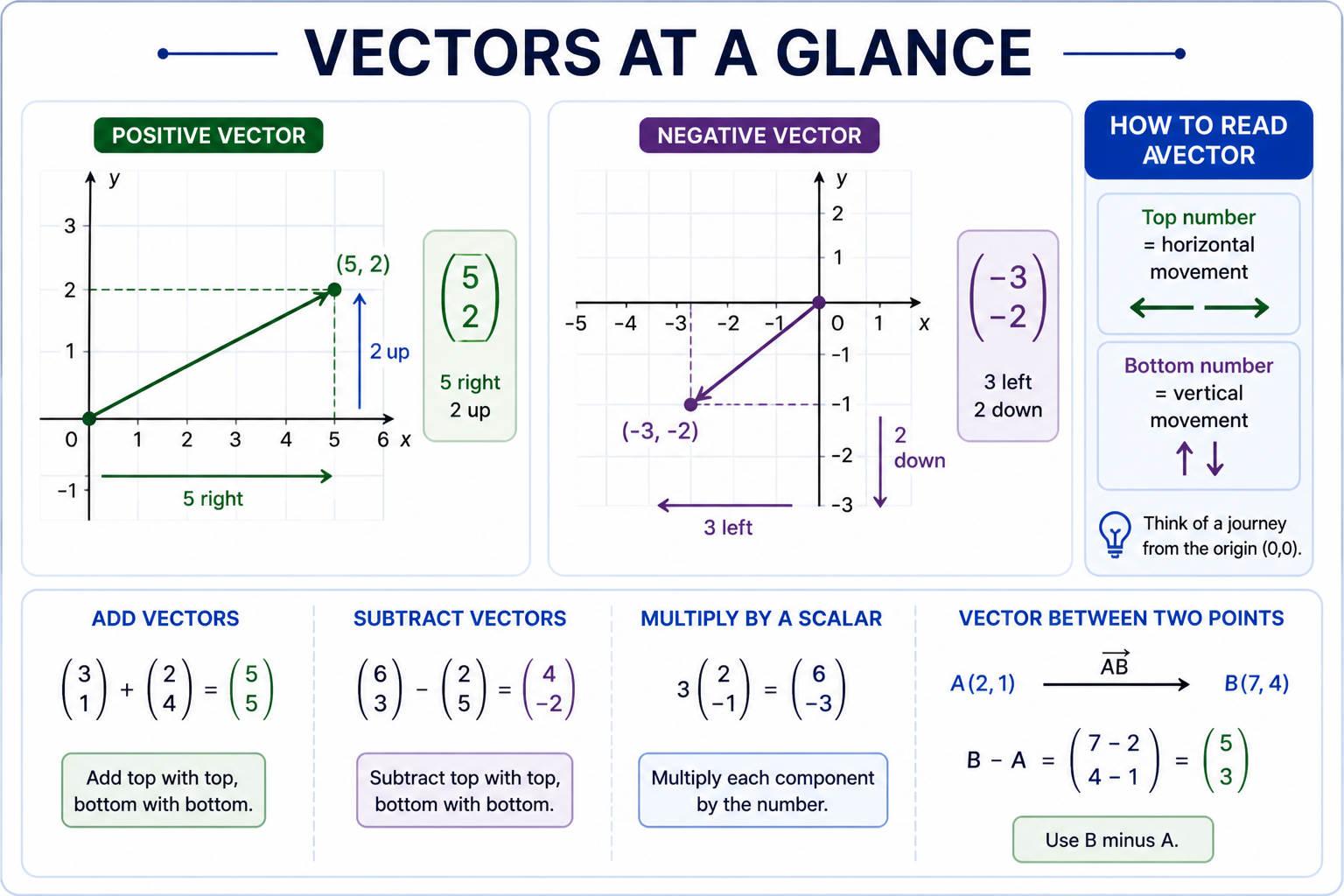
Use B − A.
Exam-style questions focusing on reading column vectors as movements.
The vector \( \begin{pmatrix} 2 \\ 5 \end{pmatrix} \) is shown on the grid.
Describe the movement.
The vector \( \begin{pmatrix} -4 \\ 1 \end{pmatrix} \) is shown on the grid.
Describe the movement.
Exam-style questions focusing on adding and subtracting column vectors.
Work out \( \begin{pmatrix} 3 \\ 2 \end{pmatrix} + \begin{pmatrix} 1 \\ 4 \end{pmatrix} \).
Work out \( \begin{pmatrix} 6 \\ 1 \end{pmatrix} - \begin{pmatrix} 2 \\ 3 \end{pmatrix} \).
Exam-style questions focusing on vectors between points and describing translations.
Point A has coordinates (1, 2) and point B has coordinates (5, 7).
Find the vector from A to B.
Point P is moved by vector \( \begin{pmatrix} -3 \\ 4 \end{pmatrix} \).
Describe the movement.
A shape is translated by \( \begin{pmatrix} 4 \\ -2 \end{pmatrix} \).
Describe the translation.
Check which part is horizontal and which is vertical.
Watch the signs carefully.
Add or subtract the matching numbers only.
If working between points, subtract coordinates in the correct order.
Positive and negative movements mixed up.
Top and bottom parts confused.
Subtracting the coordinates in reverse.
Treating a vector like a plotted point rather than a movement.
These are common mistakes students make when working with vectors in GCSE Maths.
A student swaps the x and y components of a vector.
Vectors are written as \(\begin{pmatrix} x \\ y \end{pmatrix}\), where x is horizontal movement and y is vertical movement.
A student ignores the direction of negative components.
Negative values show direction: negative x is left, negative y is down.
A student reverses the subtraction when finding a vector.
To find the vector from A to B, calculate \(B - A\), not \(A - B\).
A student reads a vector as a point on a grid.
A vector represents movement, not position. It shows how far and in what direction to move.
A student makes mistakes when adding or subtracting vectors.
Add and subtract vectors component-wise and check calculations carefully.
Practise solving problems involving vectors.
Understand vector notation, directions and simple vector addition/subtraction.
Which of the following is a vector?
Add the vectors (2, 3) + (4, 1).
What is the vector from A to B?
Find (5, 7) − (2, 3).
What is 2 × (3, 4)?
Find the vector from (1, 2) to (5, 6).
Which vector is opposite to (4, -3)?
Find (2, 5) + (−3, 4).
What does the vector (0, 5) represent?
Find the midpoint of (2, 2) and (6, 6).
Solve vector proofs, algebraic vectors and geometric vector problems.
Find the vector AB if A = (2, 3) and B = (7, 11).
If a = (2, 1) and b = (4, 3), what is a + b?
If a = (3, 2) and b = (1, 4), find 2a − b.
Points A, B and C are collinear. AB = (2, 3) and BC = (4, 6). What can you say?
Find the midpoint of A(1, 5) and B(7, 9).
Which expression represents the midpoint of vectors a and b?
If a = (4, 6), find a vector in the same direction but half the length.
If AB = (3, 5), what is BA?
Find the vector from (−2, 4) to (3, −1).
Which condition proves two vectors are equal?
Practise describing, adding and interpreting vectors.
A quantity with direction and magnitude.
As column vectors or with arrows.
Combining movements.