A class has 12 boys and 8 girls. What is the total number of students?
Add boys and girls.
12 + 8 = 20 students.

Two way tables organise data into rows and columns to show relationships between variables. They are useful for calculating probabilities and are often used in conditional probability questions, building on basic probability.
A two way table organises information using rows and columns.
It is useful when data is split into two categories at the same time.
You need to be able to read values, complete missing values, and use the table to find probabilities.
A table that sorts data by two different categories.
A horizontal line of values in the table.
A vertical line of values in the table.
The total for one full row.
The total for one full column.
The total number of all values in the table.
Use row values to find the row total.
Use column values to find the column total.
Missing value = total − known values.
\( \frac{\text{number wanted}}{\text{total}} \)
Make sure you are reading the correct row and column.
Each person or object belongs in one correct place.
Row totals and column totals should agree with the grand total.
Probability questions often come directly from one part of the table.
A two-way table organises information using two categories at the same time.
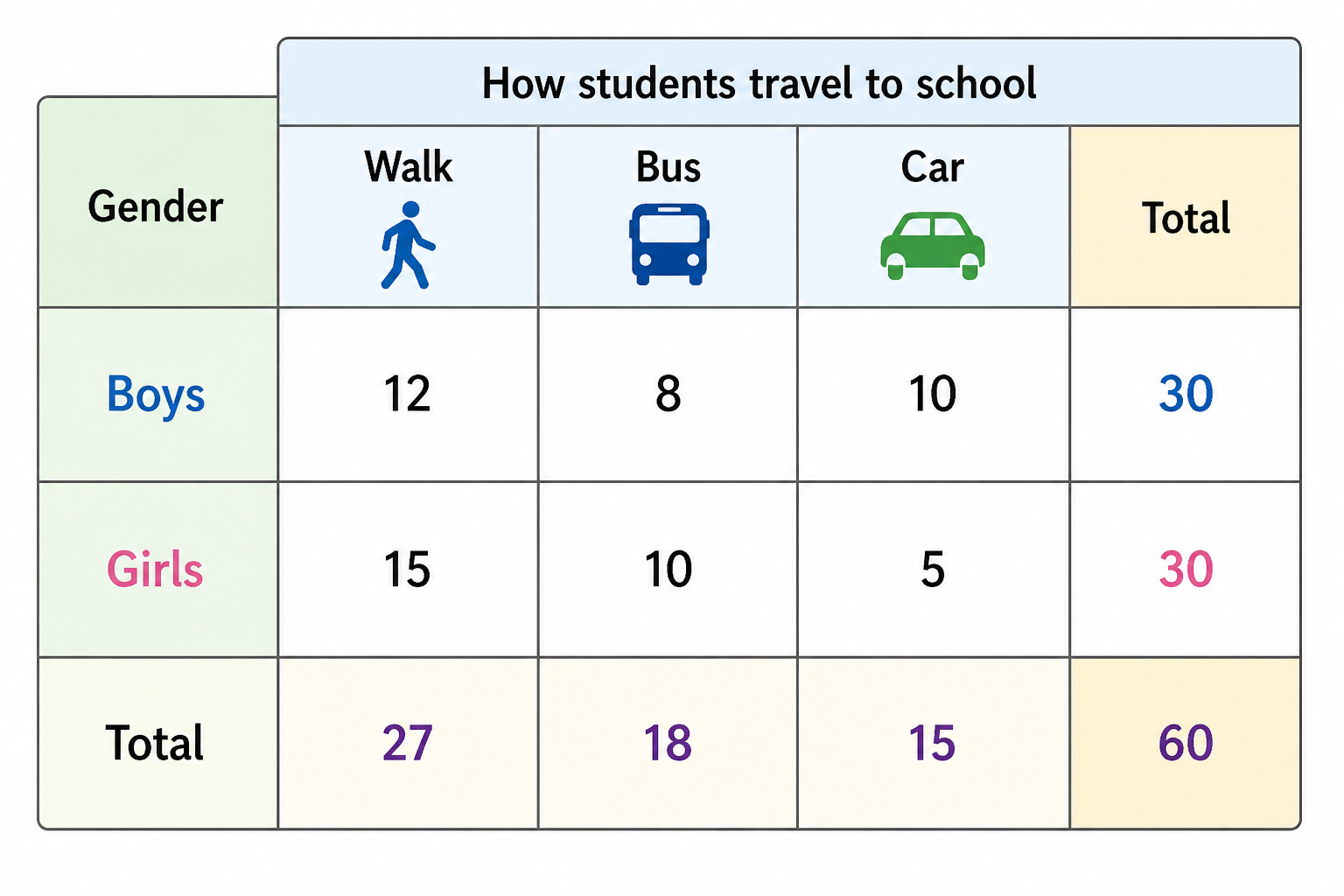
Each cell belongs to both its row and its column.
Use totals and subtraction to complete missing parts.
Choose the correct value from the table, then divide by the total.
Use a row total or column total.
Use the cell where row and column meet.
Use totals and subtraction.
Wanted value over total outcomes.
Exam-style questions inspired by Edexcel GCSE Mathematics, focusing on completing and interpreting two-way tables.
The table shows information about 40 students.
| Play sport | Do not play sport | Total | |
|---|---|---|---|
| Boy | 12 | 20 | |
| Girl | 10 | 20 | |
| Total | 18 | 40 |
Complete the two-way table.
The table shows information about students in a class.
| Like Maths | Do not like Maths | Total | |
|---|---|---|---|
| Boy | 8 | 7 | 15 |
| Girl | 10 | 5 | 15 |
| Total | 18 | 12 | 30 |
Find the probability that a randomly chosen student likes Maths.
Exam-style questions based on the AQA GCSE Mathematics specification, focusing on probability from two-way tables.
The table shows information about 50 people.
| Own a car | Do not own a car | Total | |
|---|---|---|---|
| Over 18 | 20 | 5 | 25 |
| Under 18 | 10 | 15 | 25 |
| Total | 30 | 20 | 50 |
Find the probability that a randomly chosen person owns a car.
Using the table above, find the probability that a person owns a car given that they are over 18.
A student says, "The probability of choosing someone under 18 is 0.6."
Tick one box. Correct ☐ Incorrect ☐
Give a reason for your answer.
Exam-style questions aligned with OCR GCSE Mathematics, emphasising conditional probability from two-way tables.
The table shows information about 60 students.
| Study French | Do not study French | Total | |
|---|---|---|---|
| Boy | 15 | 10 | 25 |
| Girl | 20 | 15 | 35 |
| Total | 35 | 25 | 60 |
Find the probability that a randomly chosen student studies French.
Find the probability that a student studies French given that the student is a girl.
Read the row and column headings carefully.
Use addition to find totals.
Use subtraction to fill in missing values.
For probability, use wanted value over total value.
Using the wrong category from the table.
Adding or subtracting incorrectly.
Using the wrong denominator.
Using a row total when the question asks for one cell only.
These are common mistakes students make when working with two-way tables in GCSE Maths.
A student selects values from the incorrect part of the table.
Carefully match the row and column labels to the question before choosing a value.
A student makes errors when calculating row or column totals.
Add values carefully and check that row and column totals are consistent.
A student uses a row or column total instead of the overall total.
For overall probability, use the grand total unless the question restricts the sample space.
A student uses a row or column total when a single cell value is required.
Check whether the question is asking for a specific group or a total before selecting the value.
A student does not verify that totals match.
Row totals and column totals should agree with the grand total. Always check for consistency.
Practise interpreting and completing two-way tables.
Read and complete two-way tables.
A class has 12 boys and 8 girls. What is the total number of students?
In a table, there are 15 students who like football and 10 who like tennis. How many students are there in total?
A table shows 7 boys like maths and 5 boys do not. How many boys are there in total?
There are 20 students in total. 8 are girls. How many are boys?
A table shows 10 students like pizza and 15 like pasta. What is the total?
There are 18 students. 7 like chocolate. How many do not?
A student forgets to include the total row. What is the problem?
There are 30 students. 12 are boys. How many are girls?
A table has 9 in one cell and 6 in another. What is their combined total?
There are 25 students in total. 10 are in one category. How many are in the other?
Complete two-way tables and use them to calculate probabilities.
A table shows 20 students. 8 are boys who like maths. 5 boys do not like maths. How many boys are there?
There are 40 students. 15 are boys. 10 girls like maths. How many girls are there?
A table shows 30 students. 12 like football. What is the probability a student chosen at random likes football?
A table shows 50 students. 20 are boys. What is the probability of selecting a boy?
A table shows 40 students. 18 are girls. What is the probability of selecting a girl?
A table shows 60 students. 24 like maths. Find the probability of not liking maths.
A student uses column totals instead of overall total when calculating probability. What is wrong?
A table shows 45 students. 15 are boys who like sport. What is the probability of selecting one of these boys?
A table has 80 students. 32 are girls who like music. What is the probability of selecting one?
A table shows 100 people. 60 like tea. Find the probability of not liking tea.
Learn how to read, complete and interpret two-way tables.
Tables showing two variables.
Checking calculations.
Probabilities and frequencies.