Triangles and Quadrilaterals
Triangles and quadrilaterals have specific properties involving sides, angles and symmetry. Understanding these properties is essential for solving geometry problems and links closely to angle rules, polygons and Pythagoras’ theorem.
Overview
Triangles have 3 sides and quadrilaterals have 4 sides.
In GCSE Maths, you need to recognise common types and know their properties.
Questions often ask you to identify shapes from their properties or use those properties to find missing angles, equal sides or lines of symmetry.
What you should understand after this topic
Key Definitions
Triangle
A 3-sided polygon.
Quadrilateral
A 4-sided polygon.
Isosceles Triangle
A triangle with two equal sides and two equal angles.
Equilateral Triangle
A triangle with three equal sides and three equal angles of \(60^\circ\).
Scalene Triangle
A triangle with all sides of different lengths.
Right-Angled Triangle
A triangle with one angle of \(90^\circ\).
Parallelogram
A quadrilateral with two pairs of parallel sides.
Rectangle
A parallelogram with four right angles.
Square
A rectangle with all four sides equal.
Rhombus
A parallelogram with all four sides equal.
Trapezium
A quadrilateral with one pair of parallel sides.
Kite
A quadrilateral with two pairs of adjacent equal sides.
Key Rules
Triangle angles
They add up to \(180^\circ\).
Quadrilateral angles
They add up to \(360^\circ\).
Isosceles triangle
Two equal sides means two equal angles.
Equilateral triangle
All angles are \(60^\circ\).
Rectangle
Opposite sides are equal and all angles are \(90^\circ\).
Square
All sides equal and all angles are \(90^\circ\).
Parallelogram
Opposite sides are equal and parallel.
Trapezium
One pair of parallel sides.
Quick Family Groups
Triangles by sides
Equilateral, isosceles, scalene.
Triangles by angles
Acute, right-angled, obtuse.
Quadrilaterals with parallel sides
Parallelogram, rectangle, square, rhombus, trapezium.
Quadrilaterals with equal sides
Square, rhombus, kite.
How to Solve
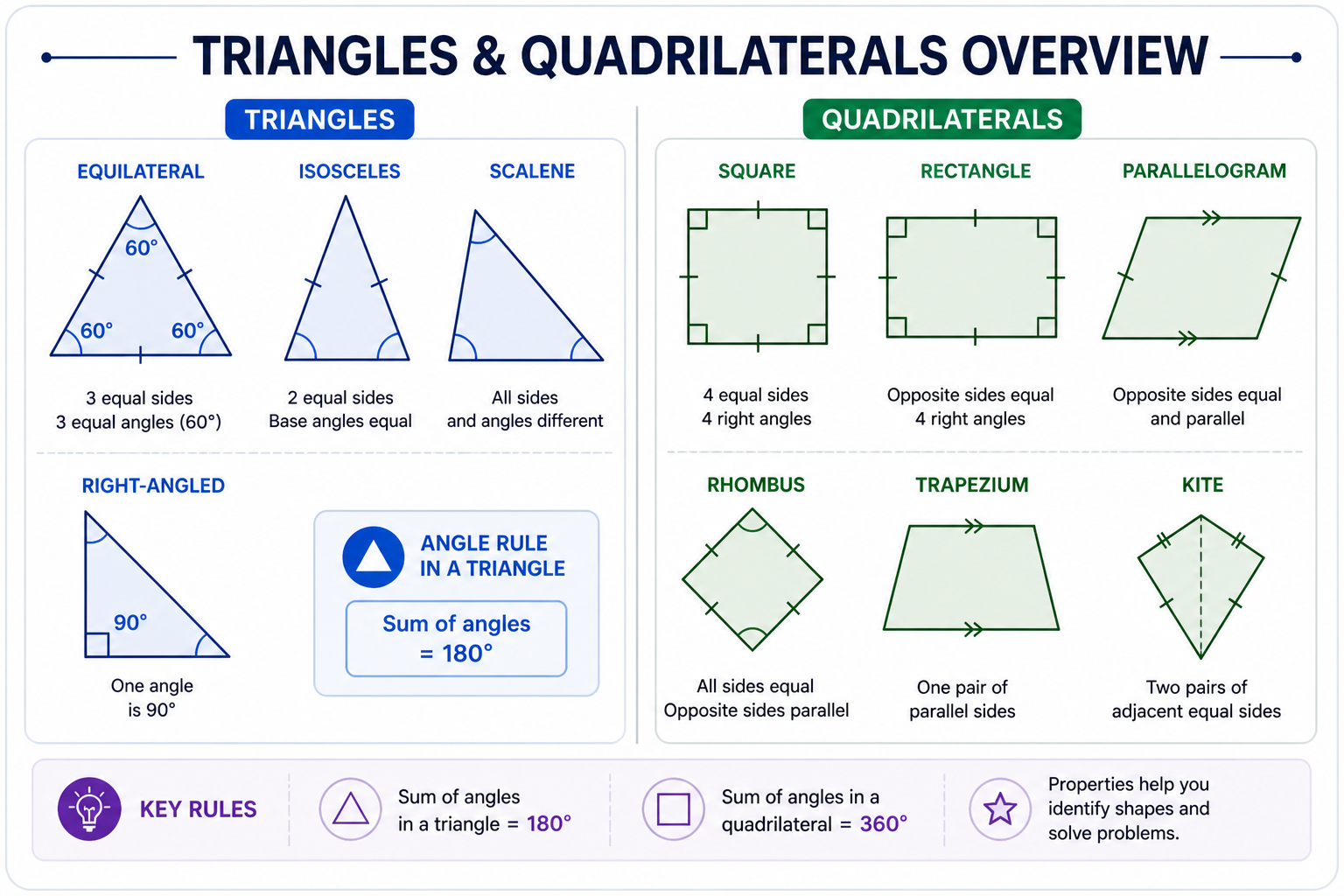
Step 1: Identify the shape type
Start by looking at side lengths, angles and parallel sides. Shapes are identified by their properties.
Step 2: Identify triangle types
Equilateral
3 equal sides, 3 equal angles (\(60^\circ\)).
Isosceles
2 equal sides, base angles equal.
Scalene
All sides and angles different.
Right-angled
One angle is \(90^\circ\).
Step 3: Triangle angle rules
Step 4: Identify quadrilateral types
Square
4 equal sides, 4 right angles.
Rectangle
Opposite sides equal, 4 right angles.
Parallelogram
Opposite sides equal and parallel.
Rhombus
All sides equal.
Trapezium
One pair of parallel sides.
Kite
Two pairs of adjacent equal sides.
Step 5: Quadrilateral angle rules
Step 6: Parallel side rules
Step 7: Shape relationships
Step 8: Symmetry and diagonals
Square
4 lines symmetry, diagonals equal & perpendicular.
Rectangle
2 lines symmetry, diagonals equal.
Rhombus
Diagonals perpendicular.
Kite
1 line symmetry, diagonals perpendicular.
Example Questions
Edexcel
Exam-style questions focusing on recognising triangles and quadrilaterals from their properties.
The triangle shown has three equal sides.
What type of triangle is it?
The quadrilateral shown has four equal sides and four right angles.
Name the quadrilateral.
AQA
Exam-style questions focusing on angle facts in triangles and quadrilaterals.
An isosceles triangle has a top angle of 50°.
Find the other two angles.
A quadrilateral has angles 95°, 85°, 100° and x.
Find the value of x.
OCR
Exam-style questions focusing on reasoning with quadrilateral properties.
The shape shown is a square.
Explain why every square is also a rectangle.
The quadrilateral shown has all sides equal, but it does not have to have four right angles.
Name the quadrilateral.
A parallelogram has opposite angles that are equal.
State one angle property of a parallelogram.
Exam Checklist
Step 1
Check the number of sides first.
Step 2
Look for equal sides, equal angles and right angles.
Step 3
Look for parallel sides.
Step 4
Use angle totals if the question includes missing angles.
Most common exam mistakes
Triangle confusion
Forgetting that a triangle can be both isosceles and right-angled.
Quadrilateral confusion
Mixing up square, rectangle and rhombus.
Parallel sides
Missing that a trapezium only has one pair of parallel sides.
Angle totals
Using \(180^\circ\) instead of \(360^\circ\) for quadrilaterals.
Common Mistakes
These are common mistakes students make when working with triangles and quadrilaterals in GCSE Maths.
Assuming all quadrilaterals are rectangles or squares
A student classifies any four-sided shape as a rectangle or square.
Quadrilaterals include many types such as trapeziums, parallelograms, rhombuses and kites. Check properties before naming the shape.
Forgetting properties of isosceles triangles
A student treats all angles as different.
In an isosceles triangle, the base angles are equal. Use this property when solving problems.
Confusing rhombus and parallelogram
A student mixes up their properties.
A rhombus has all sides equal, while a parallelogram has opposite sides equal. Know the differences clearly.
Misunderstanding trapezium properties
A student thinks a trapezium must have two pairs of parallel sides.
A trapezium has at least one pair of parallel sides, not necessarily two.
Using incorrect angle totals
A student applies the wrong total for angles.
Angles in a triangle add to \(180^\circ\), and angles in a quadrilateral add to \(360^\circ\).
Try It Yourself
Practise this topic step by step.
Foundation Practice
Questions coming soon.
Higher Practice
Questions coming soon.
Games
Practise recognising triangle and quadrilateral properties, angle facts and missing angles.
Frequently Asked Questions
What is a regular polygon?
A shape with equal sides and angles.
What makes a triangle isosceles?
Two equal sides and two equal angles.
What is special about a square?
All sides equal and all angles 90 degrees.