A coin is flipped twice. What is the probability of getting HH?
Multiply probabilities along the branch.
1/2 × 1/2 = 1/4.

Tree diagrams are used to represent possible outcomes in multi-step events. They help organise information clearly and calculate probabilities accurately, building on listing outcomes and supporting ideas in conditional probability.
A tree diagram shows all the possible outcomes of a multi-step probability experiment.
Each branch shows one possible path, and the probabilities are written on the branches.
Tree diagrams are especially useful for questions with two or more stages, such as tossing two coins, choosing counters, or repeated events.
A branching diagram that shows all possible outcomes in order.
A line showing one possible option at a stage.
A final result at the end of a path, such as HH or RB.
A route through the tree from start to end.
The item is put back, so probabilities stay the same for the next step.
The item is not put back, so probabilities can change for the next step.
To find the probability of one path, multiply the branch probabilities.
If more than one outcome works, add those path probabilities.
At each split, the probabilities should add up to 1.
With replacement = same probabilities. Without replacement = changed probabilities.
<span class='tree-tag'>Multiply</span>
<span class='tree-tag'>Add</span>
Probabilities stay the same.
Probabilities may change.
A tree diagram shows all possible outcomes for events that happen in stages.
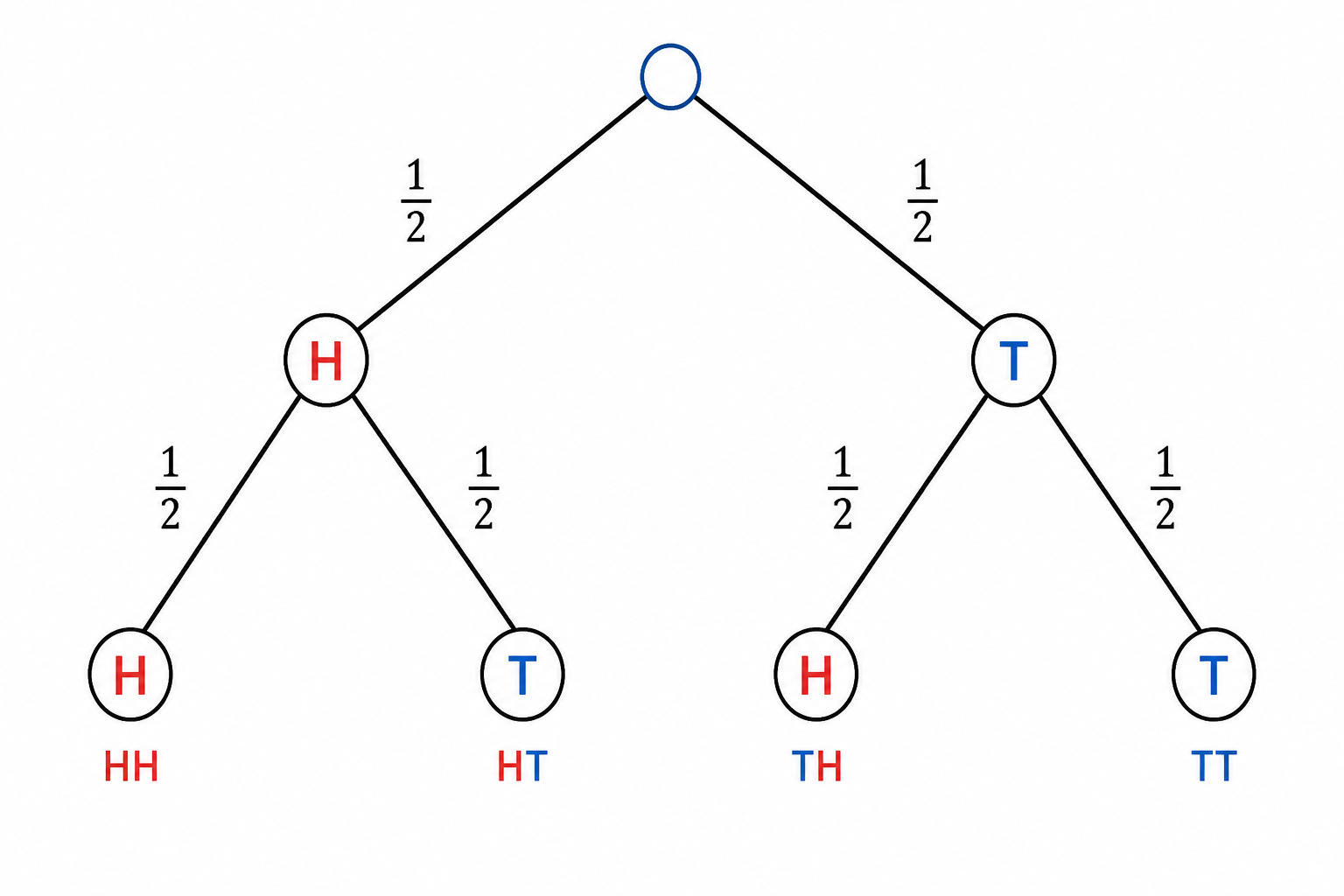
To find the probability of one complete outcome, multiply along the branches.
If more than one outcome works, add the path probabilities.
If the item is put back, the probabilities stay the same.
If the item is not put back, the probabilities change.
Every branch should be labelled.
Each branch needs a probability.
Probabilities at each split should add to 1.
Each route should represent one outcome.
Exam-style questions inspired by Edexcel GCSE Mathematics, focusing on completing and using probability tree diagrams.
A biased coin is flipped twice. The probability of getting heads on each flip is 0.6.
Complete a probability tree diagram for this information.
A biased coin is flipped twice. The probability of getting heads on each flip is 0.6.
Find the probability of getting two heads.
A biased coin is flipped twice. The probability of getting heads on each flip is 0.6.
Find the probability of getting exactly one head.
Exam-style questions based on the AQA GCSE Mathematics specification, focusing on tree diagrams for events without replacement.
A bag contains 5 red counters and 3 blue counters. A counter is taken at random and not replaced. A second counter is then taken at random.
Complete a probability tree diagram for this information.
A bag contains 5 red counters and 3 blue counters. A counter is taken at random and not replaced. A second counter is then taken at random.
Find the probability that both counters are red.
A bag contains 5 red counters and 3 blue counters. A counter is taken at random and not replaced. A second counter is then taken at random.
Find the probability that the two counters are different colours.
Exam-style questions aligned with OCR GCSE Mathematics, emphasising multiplication along branches and addition of different successful outcomes.
There are 4 green counters and 6 yellow counters in a bag. Two counters are taken at random without replacement.
Find the probability that both counters are yellow.
There are 4 green counters and 6 yellow counters in a bag. Two counters are taken at random without replacement.
Find the probability that one counter is green and one counter is yellow.
There are 4 green counters and 6 yellow counters in a bag. Two counters are taken at random without replacement.
Explain why the probabilities on the second set of branches are different from the first set of branches.
Draw every possible branch clearly.
Write the correct probability on each branch.
Multiply along a path for one full outcome.
Add the successful path probabilities if needed.
Adding along a path instead of multiplying.
Using the wrong second-stage probabilities.
Forgetting one of the successful outcomes.
Not checking that probabilities at each split add to 1.
These are common mistakes students make when working with tree diagrams in GCSE Maths.
A student adds probabilities along a path.
When following a path in a tree diagram, multiply the probabilities along the branches.
A student finds only one path when multiple outcomes are required.
If more than one path leads to the desired outcome, add those probabilities together at the end.
A student keeps the same probabilities for the second stage.
In without-replacement questions, probabilities change after the first selection. Update totals and remaining outcomes.
A student writes probabilities that do not add up correctly.
At each split, the probabilities must add up to 1. Check each stage carefully.
A student does not include all possible paths.
Ensure all possible outcomes are represented in the tree diagram before calculating probabilities.
Practise solving probability problems using tree diagrams.
Use tree diagrams to calculate probabilities of combined events.
A coin is flipped twice. What is the probability of getting HH?
A coin is flipped twice. Find the probability of HT.
A bag has 1 red and 1 blue ball. One is picked, then replaced, then picked again. What is the probability of red then red?
A fair die is rolled twice. What is the probability of getting a 3 both times?
What do you do when moving along a branch in a tree diagram?
A coin is flipped twice. Find the probability of getting one head and one tail (HT or TH).
When finding total probability from multiple outcomes, what do you do?
A spinner has 2 equal sections: A and B. It is spun twice. Find the probability of AA.
A student adds probabilities along a branch. What is wrong?
A die is rolled twice. Find the probability of getting a 6 then a 6.
Solve tree diagram problems with and without replacement.
A bag has 3 red and 2 blue balls. One is picked, not replaced, then another is picked. What is the probability of red then red?
A bag has 4 red and 1 blue ball. One is picked, not replaced. Find probability of red then blue.
What changes when there is no replacement?
A bag has 2 red and 3 blue balls. One is picked, replaced, then picked again. Find probability of blue then blue.
A bag has 5 balls: 2 red, 3 blue. What is P(red then blue, no replacement)?
A bag has 3 red and 2 blue balls. Find probability of at least one red in two picks with replacement.
Why is complement useful in tree diagrams?
A bag has 4 red and 6 blue balls. One is picked, not replaced. Find probability of blue then blue.
A student uses the same probability after removing a ball. What is wrong?
A bag has 2 red and 1 blue ball. One is picked, not replaced. Find probability of getting one red and one blue (any order).
Practise reading probability tree diagrams, completing missing probabilities and finding probabilities of different outcomes.
Showing sequences of events.
Multiply along branches.
They organise complex problems.