What is the theoretical probability of getting heads on a fair coin?
Two equal outcomes.
1 favourable outcome out of 2 → 1/2.

Theoretical probability is calculated using known outcomes, while experimental probability is based on results from trials. It builds on basic probability and connects directly to relative frequency.
Theoretical probability is based on all possible equally likely outcomes.
Experimental probability is based on actual results from an experiment.
The two values can be different, especially when the number of trials is small.
With many trials, the experimental probability often gets closer to the theoretical probability.
\( \frac{\text{favourable outcomes}}{\text{total possible outcomes}} \)
\( \frac{\text{times event happened}}{\text{number of trials}} \)
A probability based on what should happen from known possible outcomes.
A probability based on actual experiment results.
Another name for experimental probability.
One repeat of an experiment.
A result of an experiment.
The number of trials carried out.
\( \frac{\text{favourable}}{\text{possible}} \)
\( \frac{\text{frequency}}{\text{trials}} \)
Can give results quite different from theory.
Usually give results closer to theoretical probability.
Use when predicting what should happen.
Use when analysing what actually happened.
Theoretical probability of rolling a 6 is \( \frac{1}{6} \).
If a 6 appears 9 times in 40 rolls, experimental probability is \( \frac{9}{40} \).
Theoretical probability is based on what should happen when outcomes are equally likely.
Experimental probability is based on what actually happens in an experiment.
What should happen.
What actually happened.
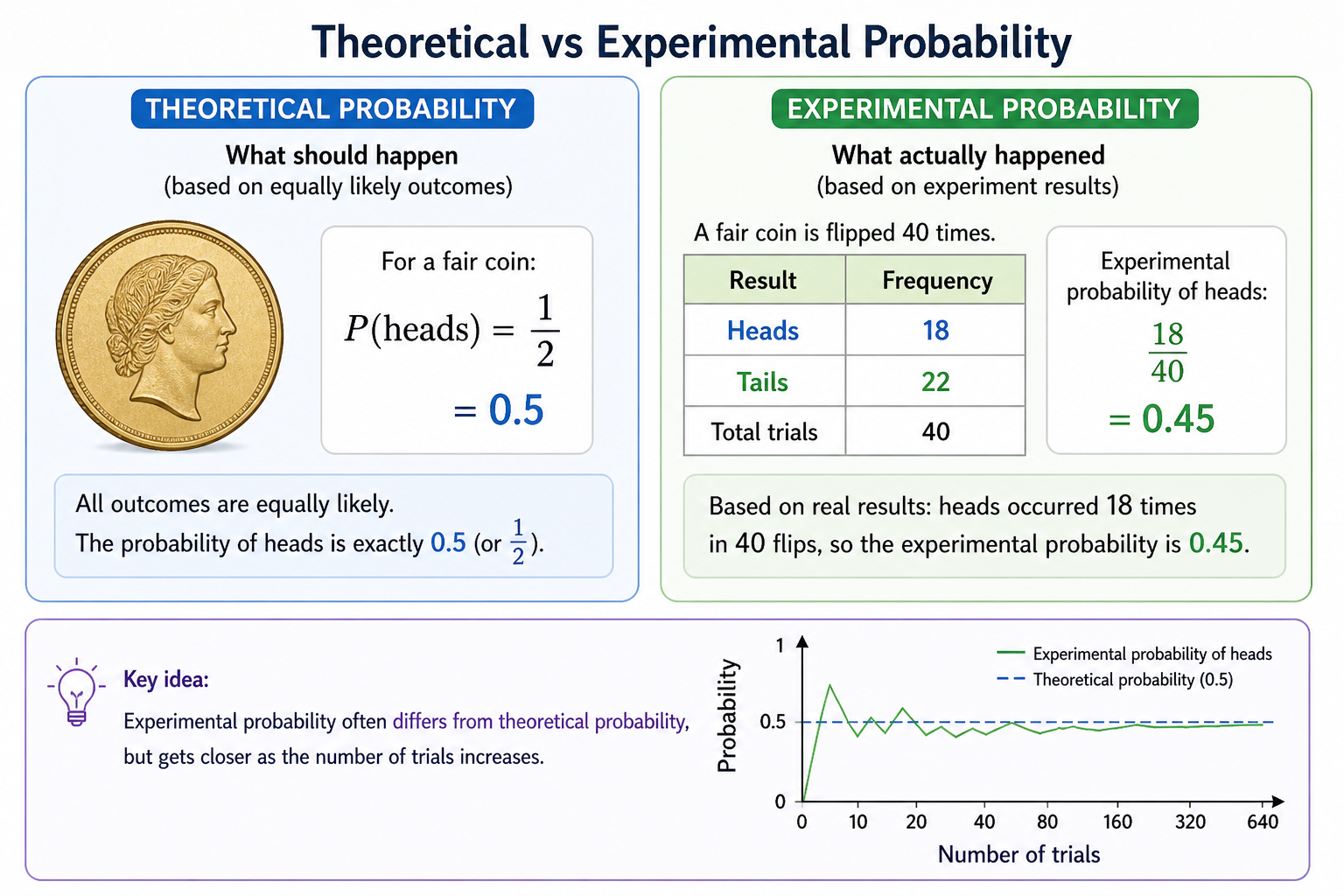
Experimental probability can vary because real results do not always match the expected result exactly.
You can use experimental probability to estimate future outcomes.
When all possible outcomes are known and equally likely.
When real experiment results are given.
These are common mistakes students make when working with theoretical and experimental probability in GCSE Maths.
A student uses the wrong formula for the situation.
Theoretical probability is based on equally likely outcomes: \(\frac{\text{favourable outcomes}}{\text{total outcomes}}\). Experimental probability is based on data: \(\frac{\text{number of successes}}{\text{number of trials}}\).
A student uses experimental data when theoretical probability is required, or vice versa.
Read the question carefully to determine whether you should use known outcomes (theoretical) or collected data (experimental).
A student assumes both probabilities must be the same.
Experimental probability is an estimate and may differ from theoretical probability, especially with small samples.
A student treats all experimental results as equally reliable.
Larger sample sizes give more reliable experimental probabilities, as results tend to get closer to the theoretical value.
A student applies theoretical probability when outcomes are not equally likely.
Theoretical probability assumes equally likely outcomes. If this is not true, the method may not be appropriate.
Practise comparing theoretical and experimental probabilities.
Compare theoretical and experimental probabilities.
What is the theoretical probability of getting heads on a fair coin?
A coin is flipped 10 times and lands on heads 7 times. What is the experimental probability of heads?
Why might experimental probability differ from theoretical probability?
A die is rolled 20 times and a 6 appears 4 times. Find the experimental probability.
What is the theoretical probability of rolling a 6 on a fair die?
A spinner lands on red 12 times out of 30 spins. Find the experimental probability.
Which is always exact?
A coin is flipped 50 times and lands heads 28 times. Find the experimental probability.
What happens as the number of trials increases?
A die is rolled 60 times and a 3 appears 15 times. Find the experimental probability.
Analyse and compare theoretical and experimental probabilities.
A coin is flipped 100 times and lands heads 55 times. Which statement is correct?
A die is rolled 200 times and a 6 appears 40 times. Find the experimental probability.
A spinner is fair with 4 equal sections. Experimental probability of A is 0.35. What does this suggest?
A coin is flipped 400 times and lands heads 210 times. Estimate probability of heads.
Which factor improves reliability of experimental probability?
A machine produces 500 items. 25 are faulty. Estimate probability of fault.
If experimental probability is very different from theoretical, what might be true?
A die is rolled 600 times and a 6 appears 90 times. Estimate probability of rolling a 6.
A student claims experimental probability is always correct. Why is this wrong?
A spinner lands on blue 48 times out of 120 spins. Estimate probability of blue.
Compare theoretical probability with experimental probability from real results.
Based on expected outcomes.
Based on actual results.
To understand real-world variation.