Simplify the ratio 10 : 5.
Divide both numbers by 5.
10 : 5 → divide by 5 → 2 : 1.

Simplifying ratios involves dividing each part by a common factor to express the relationship in its simplest form. This builds on ratio and uses ideas from factors and multiples to make comparisons clearer and easier to work with.
Simplifying a ratio means writing it in its smallest whole-number form.
You do this by dividing every part of the ratio by the same number.
The simplified ratio still means exactly the same thing.
It is just written more neatly and more efficiently.
Write something in its smallest equivalent form.
A comparison between quantities.
A ratio with the same value but written differently.
The largest number that divides all parts exactly.
A simplified ratio is usually written using whole numbers.
The same measurement unit used before simplifying.
Every part of the ratio must be divided by the same number.
This gives the simplest whole-number form in one step.
Only the size changes, not the order.
Do not simplify cm and m together without converting.
\(10:15 = 2:3\)
\(6:9:12 = 2:3:4\)
\(3:5\) cannot be simplified further.
\(2m:50cm = 200:50 = 4:1\)
Simplifying a ratio means writing it in the smallest possible whole numbers while keeping the same comparison.
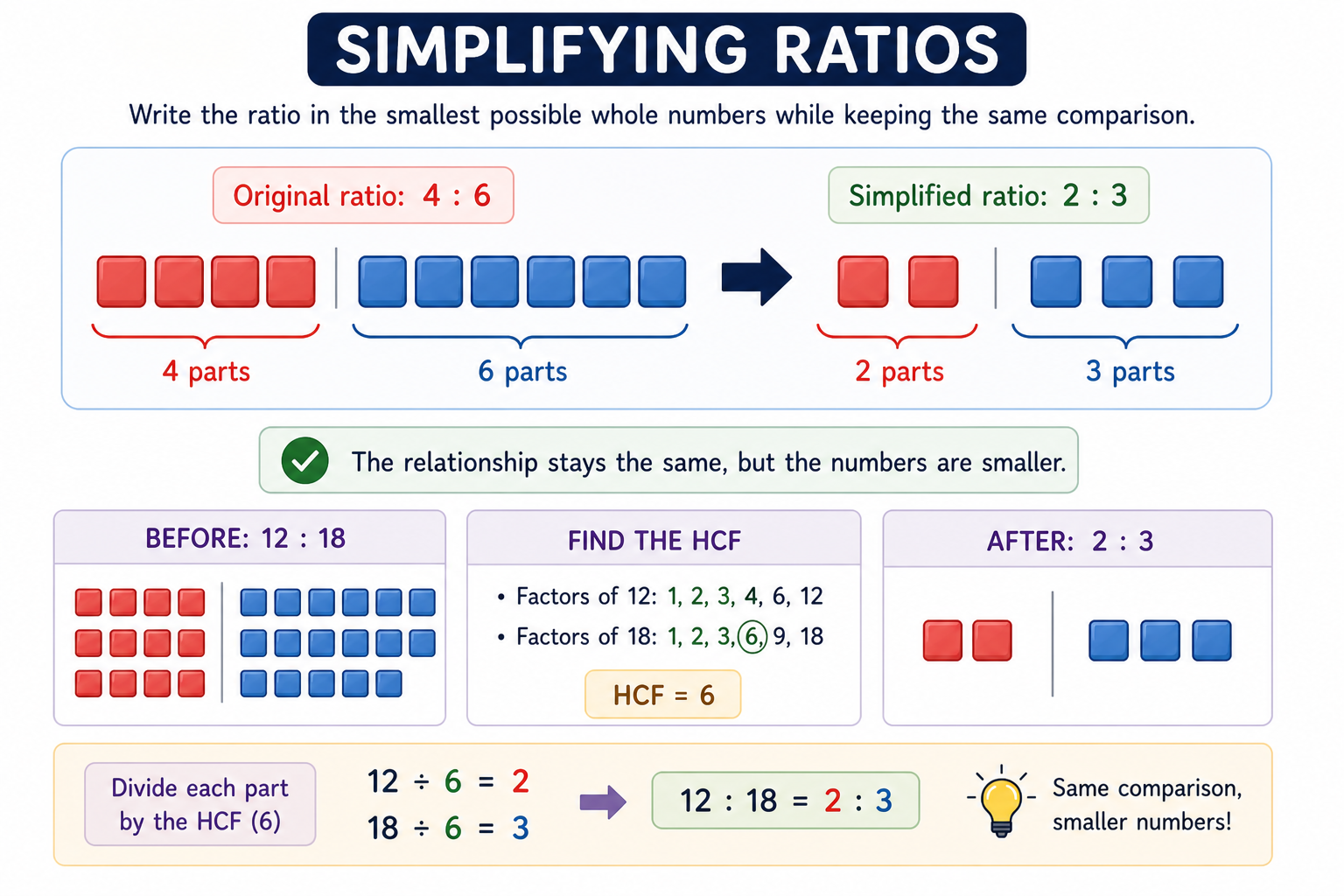
All parts must be in the same unit before simplifying using units and conversions.
Exam-style questions inspired by Edexcel GCSE Mathematics, focusing on simplifying ratios using common factors.
Simplify the ratio \( 12:18 \).
Simplify the ratio \( 20:35 \).
Simplify the ratio \( 45:60 \).
Simplify the ratio \( 2.5:5 \).
Simplify the ratio \( 0.8:1.2 \).
Exam-style questions based on the AQA GCSE Mathematics specification, focusing on simplifying ratios involving units and decimals.
Simplify the ratio \( 18:27 \).
Simplify the ratio \( 0.6:1.2 \).
Simplify the ratio \( 150\text{ cm} : 2\text{ m} \).
Simplify the ratio \( £3 : 75\text{ p} \).
Simplify the ratio \( 3.5:0.5 \).
Exam-style questions aligned with OCR GCSE Mathematics, emphasising unit conversion, reasoning, and problem-solving.
Simplify the ratio \( 84:126 \).
Simplify the ratio \( 3\text{ kg} : 750\text{ g} \).
Simplify the ratio \( 2\text{ hours} : 30\text{ minutes} \).
Simplify the ratio \( 1.2\text{ m} : 30\text{ cm} \).
Explain why quantities must be expressed in the same units before simplifying a ratio.
Make sure all values are in the same unit.
Find the highest common factor of all parts.
Divide every part by that factor.
Check whether the result can be simplified any further.
Using a factor that is not the highest common factor.
Trying to simplify mixed units without converting first.
Dividing two parts of a 3-part ratio but forgetting the third.
Leaving the answer partly simplified instead of fully simplified.
These are common mistakes students make when simplifying ratios in GCSE Maths.
A student simplifies one number but not the other.
You must divide all parts of the ratio by the same number to keep the proportion correct.
A student simplifies but does not fully reduce the ratio.
Always divide by the highest common factor (HCF) to write the ratio in its simplest form.
A student reverses the ratio while simplifying.
The order must stay the same. Simplifying does not change the meaning or order of the ratio.
A student simplifies values with different units.
Convert all quantities into the same unit before simplifying the ratio.
A student stops simplifying when further reduction is possible.
Continue simplifying until no common factors remain.
Practise simplifying ratios into their simplest form.
Simplify ratios using common factors.
Simplify the ratio 10 : 5.
Simplify the ratio 12 : 8.
Which is the simplest form of 9 : 3?
Simplify 15 : 25.
Simplify the ratio 18 : 12.
Simplify 20 : 30.
A student simplifies 8 : 12 to 4 : 6. What should they do next?
Simplify 14 : 21.
Which ratio is already in its simplest form?
Simplify 16 : 24.
Simplify ratios with decimals, fractions and units.
Simplify 0.4 : 0.6.
Simplify 1.2 : 0.8.
Simplify 3/5 : 6/10.
Simplify 0.25 : 0.5.
Simplify 200 g : 1 kg.
Simplify 45 minutes : 2 hours.
Simplify 0.75 : 0.5.
Simplify 5/6 : 15/18.
A student simplifies 0.3 : 0.9 to 3 : 9. What is the correct final answer?
Simplify 150 : 0.5.
Practise simplifying ratios, recognising equivalent ratios and solving real-life ratio problems.