A coin is flipped 20 times and lands on heads 12 times. What is the relative frequency of heads?
Frequency ÷ total trials.
Relative frequency = 12 ÷ 20.

Relative frequency estimates probability based on experimental results. It builds on basic probability and links theoretical probability with real-world data.
Relative frequency is an estimate of probability based on actual results from an experiment.
It is sometimes called experimental probability.
Instead of using what should happen in theory, you use what actually happened.
An estimate of probability based on experimental results.
Another name for relative frequency.
The probability expected from known equally likely outcomes.
One repeat of an experiment.
The result of a trial.
A value based on observed data, not exact certainty.
\( \frac{\text{successes}}{\text{total trials}} \)
Relative frequency comes from results, not theory.
Usually give a more reliable estimate.
You can use relative frequency to estimate later outcomes.
Relative frequency estimates probability using experimental results.
Read the question carefully to find the event and the total number of trials.
Uses expected outcomes, such as \(\frac{1}{2}\) for heads on a fair coin. See probability basics.
Uses actual experimental results.
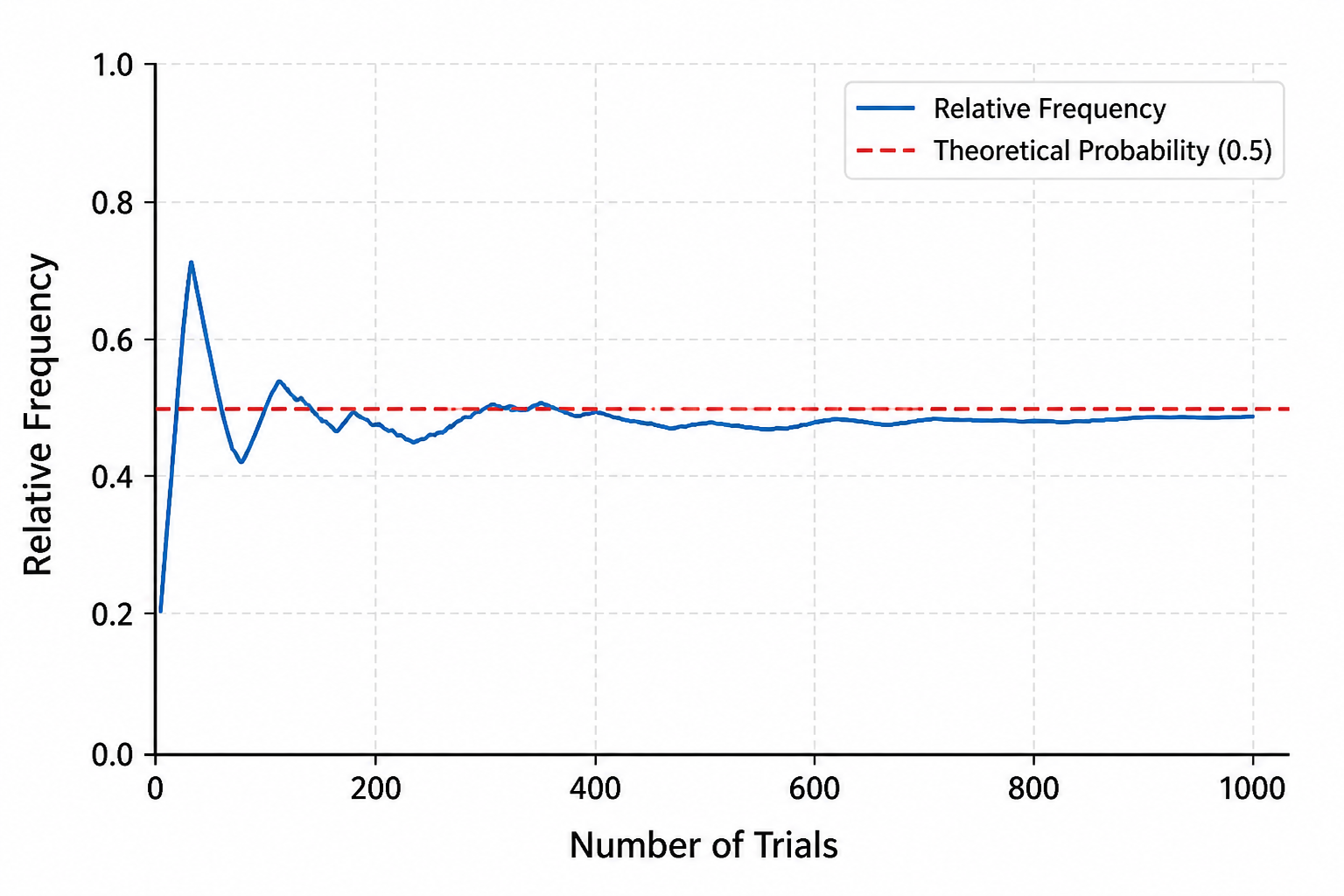
With more trials, relative frequency usually becomes a better estimate.
Use relative frequency to estimate future results.
Exam-style questions inspired by Edexcel GCSE Mathematics, focusing on calculating relative frequency from experiments.
A coin is flipped 40 times. It lands on heads 17 times.
Find the relative frequency of heads.
A spinner is spun 30 times. It lands on blue 9 times.
Estimate the probability of landing on blue.
A dice is rolled 80 times. An even number occurs 46 times.
Find the relative frequency of getting an even number.
Exam-style questions based on the AQA GCSE Mathematics specification, focusing on using relative frequency to make predictions.
A biased coin is flipped 90 times. It lands on tails 63 times.
Estimate how many times it will land on tails in 300 flips.
A machine produces bolts. In a test, 12 out of 50 bolts are faulty.
Estimate how many faulty bolts there will be in a batch of 200.
A student records the results of an experiment.
They say the relative frequency is a good estimate of probability.
Tick one box. Always ☐ Sometimes ☐ Never ☐
Give a reason for your answer.
Exam-style questions aligned with OCR GCSE Mathematics, emphasising interpretation and reliability of relative frequency.
An experiment is repeated many times. The relative frequency of an event is 0.35.
Estimate how many times the event will occur in 120 trials.
Two experiments are carried out.
Experiment A uses 10 trials. Experiment B uses 1000 trials.
Which experiment is likely to give a more reliable estimate of probability?
Explain why relative frequency tends to get closer to the true probability as the number of trials increases.
Find the number of times the event happened.
Find the total number of trials.
Use frequency ÷ total trials.
If predicting future outcomes, multiply the relative frequency by the new number of trials.
Writing total ÷ frequency instead of frequency ÷ total.
Using theoretical probability when the question wants relative frequency.
Forgetting to multiply by the new number of trials.
Not recognising that larger samples are usually more reliable.
These are common mistakes students make when working with relative frequency in GCSE Maths.
A student writes total ÷ frequency instead of frequency ÷ total.
Relative frequency is calculated as \(\frac{\text{number of successes}}{\text{total number of trials}}\).
A student ignores the data and uses expected probabilities.
Relative frequency must be based on experimental results given in the question, not theoretical probabilities.
A student uses the relative frequency directly without adjusting for a new number of trials.
To predict outcomes, multiply the relative frequency by the new total number of trials.
A student selects an incorrect frequency from a table or chart.
Carefully identify the correct category and corresponding frequency before calculating.
A student assumes relative frequency must match theoretical probability exactly.
Relative frequency is an estimate. It approaches the theoretical probability as the number of trials increases.
Practise estimating probabilities using relative frequency.
Estimate probabilities using relative frequency.
A coin is flipped 20 times and lands on heads 12 times. What is the relative frequency of heads?
A die is rolled 50 times. A 6 appears 10 times. Estimate the probability of rolling a 6.
What is relative frequency?
A spinner is spun 40 times and lands on A 16 times. Estimate probability of A.
If the number of trials increases, what happens to relative frequency?
A coin is flipped 100 times and lands on heads 55 times. Estimate probability of heads.
A student says relative frequency is always exactly equal to theoretical probability. What is wrong?
A die is rolled 30 times. A 4 appears 6 times. Estimate probability of rolling a 4.
Which value is a relative frequency?
A spinner lands on blue 25 times out of 50. Estimate probability of blue.
Use relative frequency to make predictions and compare probabilities.
A biased coin is flipped 200 times and lands on heads 120 times. Estimate probability of heads.
A spinner is spun 80 times and lands on red 20 times. Estimate probability of red.
A student uses 5 trials to estimate probability. What is the issue?
A die is rolled 120 times and a 6 appears 18 times. Estimate probability of 6.
What happens to relative frequency as trials approach infinity?
A spinner lands on green 45 times out of 150 spins. Estimate probability.
A relative frequency is 0.48 after many trials. What does this suggest?
A machine produces defective items. 12 out of 300 are defective. Estimate probability of defect.
Why might relative frequency differ from theoretical probability?
A coin is flipped 500 times and lands heads 260 times. Estimate probability of heads.
Practise calculating relative frequency from experiments and using it to make predictions.
Experimental probability.
Number of successes divided by trials.
It approaches theoretical probability.