A recipe uses 200 g of flour for 4 people. How much flour is needed for 8 people?
Double the recipe.
8 is double 4, so 200 g × 2 = 400 g.

Scaling involves adjusting quantities proportionally, often in contexts such as recipes. This topic builds on ratio to solve real-life problems accurately.
Scaling means making all amounts bigger or smaller by the same multiplier.
In recipe questions, this lets you adjust ingredients for a different number of people.
If the number of servings doubles, the ingredients also double.
If the number of servings halves, the ingredients also halve.
Changing all values by the same multiplier.
The number you multiply by to make values bigger or smaller.
A ratio with the same relationship between parts.
The number of people a recipe is for.
The amount of each ingredient in a recipe.
When all quantities change by the same multiplier.
\( \text{scale factor} = \frac{\text{new servings}}{\text{old servings}} \)
All ingredients must change by the same factor.
The ratio stays the same.
Scale down using a factor less than 1.
Multiply by 2
Multiply by \( \frac{1}{2} \)
Multiply by 3
Use \( \frac{\text{new}}{\text{old}} \)
Scaling means multiplying all quantities by the same number so the proportions stay the same.
Use one scale factor for every ingredient.
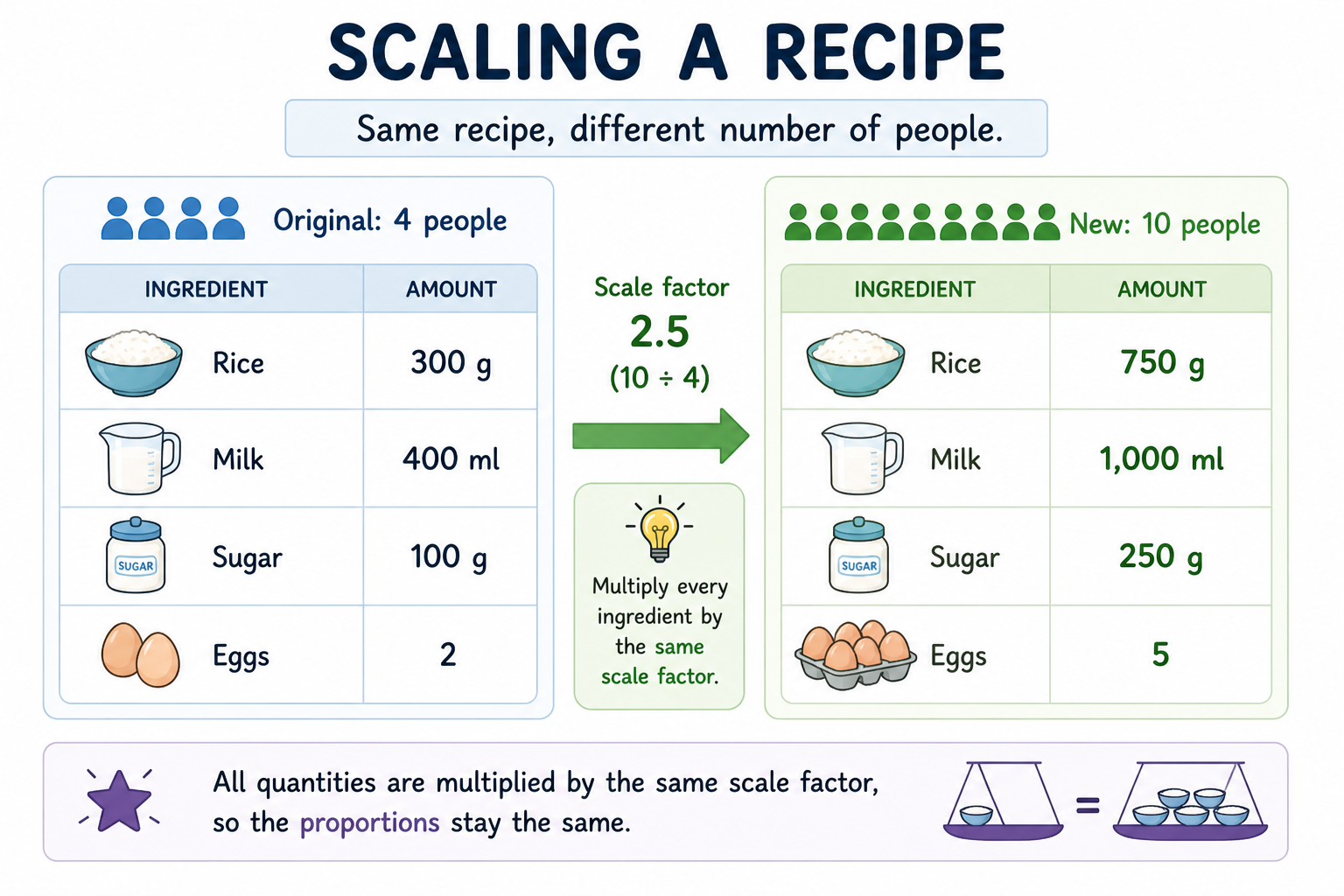
Divide the new number of people by the original number using ideas from fractions.
Multiply each ingredient by the scale factor.
You can also find the amount for one person first, then scale up.
All ingredients must use the same scale factor.
Use new ÷ original, not the other way round.
Always include g, ml, etc.
Exam-style questions inspired by Edexcel GCSE Mathematics, focusing on scaling recipes proportionally.
A recipe uses 200g of flour to make 8 pancakes. How much flour is needed to make 20 pancakes?
A soup recipe requires 750ml of stock to serve 6 people. How much stock is needed to serve 10 people?
A cake recipe uses 120g of sugar for 12 cupcakes. Find the amount of sugar needed for 30 cupcakes.
A smoothie recipe uses 3 bananas to make 5 servings. How many bananas are needed to make 15 servings?
A recipe uses 400g of pasta for 4 people. How much pasta is required for 7 people?
Exam-style questions based on the AQA GCSE Mathematics specification, emphasising scaling up and down in real-life contexts.
A bread recipe requires 500g of flour to make 10 rolls. How much flour is needed to make 16 rolls?
A recipe uses 2.5 litres of juice to serve 20 people. How much juice is needed for 8 people?
A sauce recipe requires 3 tablespoons of oil for 6 portions. How much oil is needed for 15 portions?
A recipe uses 180g of butter to bake 9 biscuits. How much butter is needed to bake 15 biscuits?
Explain how to scale a recipe correctly when increasing or decreasing the number of servings.
Exam-style questions aligned with OCR GCSE Mathematics, focusing on proportional reasoning, unit conversions, and multi-step problems.
A recipe uses 250g of flour and 150g of sugar to make 10 muffins. Calculate the quantities required to make 18 muffins.
A recipe for 4 people requires 0.6 litres of milk. How much milk is needed for 15 people?
A recipe needs 3 eggs to serve 8 people. How many eggs are required to serve 20 people?
A drink mixture uses 2 litres of water and 500ml of syrup for 10 servings. Find the quantities needed for 25 servings.
A recipe for 12 cookies requires 300g of chocolate. How much chocolate is needed for 30 cookies?
Find the old number of servings and the new number of servings.
Work out the scale factor.
Multiply every ingredient by the same factor.
Check whether the answer makes sense for a bigger or smaller recipe.
Using the wrong fraction for the scale factor.
Adding instead of multiplying.
Changing one ingredient but forgetting the others.
Making values bigger when the recipe should be smaller, or vice versa.
These are common mistakes students make when scaling recipes in GCSE Maths.
A student chooses an incorrect multiplier for the new quantity.
Find the scale factor by comparing the new amount to the original. For example, doubling a recipe uses a scale factor of 2.
A student adjusts one value but leaves others unchanged.
All ingredients must be scaled by the same factor to keep the proportions correct.
A student adds a fixed amount instead of scaling proportionally.
Scaling uses multiplication, not addition. Multiply each quantity by the scale factor.
A student uses a number greater than 1 when reducing a recipe.
Scaling up uses a factor greater than 1, while scaling down uses a factor between 0 and 1.
A student makes errors when working with fractional quantities.
Simplify fractions carefully and convert between mixed numbers and improper fractions when needed.
Practise scaling recipes using proportional reasoning.
Scale recipes up and down using simple multiplication and division.
A recipe uses 200 g of flour for 4 people. How much flour is needed for 8 people?
A recipe uses 300 ml of milk for 3 people. How much milk is needed for 6 people?
A recipe uses 500 g of sugar for 10 cakes. How much is needed for 5 cakes?
A recipe uses 4 eggs for 8 people. How many eggs are needed for 4 people?
A recipe for 2 people uses 100 g of butter. How much is needed for 6 people?
A recipe for 5 people uses 250 g of flour. How much is needed for 10 people?
A student doubles the number of people but forgets to change the ingredients. What is wrong?
A recipe uses 600 ml of water for 12 people. How much is needed for 6 people?
A recipe for 4 people uses 80 g of sugar. How much is needed for 1 person?
A recipe uses 3 eggs for 6 people. How many eggs are needed for 12 people?
Solve multi-step scaling problems including fractions and non-integer scaling.
A recipe for 6 people uses 300 g of flour. How much is needed for 9 people?
A recipe for 4 people uses 200 ml of milk. How much is needed for 7 people?
A recipe uses 500 g of flour for 10 people. You only have 300 g. For how many people can you make the recipe?
A recipe for 8 people uses 4 eggs. How many eggs are needed for 14 people?
A recipe for 5 people uses 250 g of sugar. How much is needed for 3 people?
A recipe for 12 people uses 600 ml of milk. How much is needed for 5 people?
A student multiplies all ingredients by 2 when increasing from 4 people to 6 people. What is wrong?
A recipe for 3 people uses 180 g of flour. How much is needed for 10 people?
A recipe for 4 people uses 2 eggs. Which expression gives eggs needed for n people?
A recipe for 6 people uses 300 g of sugar. How much is needed for 2 people?
Practise scaling recipes up and down using proportion and unit values.