What is the purpose of a questionnaire?
Think data collection.
Questionnaires are used to collect data.

Questionnaires are used to collect data through carefully designed questions. Avoiding bias is important for producing reliable results.
A questionnaire is a set of questions used to collect data from people.
In statistics, it is important that the questions are clear, fair and useful.
A badly designed questionnaire can produce unreliable results, even if lots of people answer it.
A list of questions used to collect data.
A question written in a way that pushes people toward a certain answer.
A question with fixed answer choices.
A question that allows a free response.
One of the possible answers given in a questionnaire.
Unclear or open to more than one meaning.
People should understand exactly what is being asked.
The wording should not push people toward one answer.
Answer choices should cover all realistic possibilities.
Only ask questions that help collect the data you need.
Clear, neutral, easy to answer and useful.
Leading, confusing, vague or missing suitable options.
A questionnaire is used to collect data from people about opinions, habits or choices.
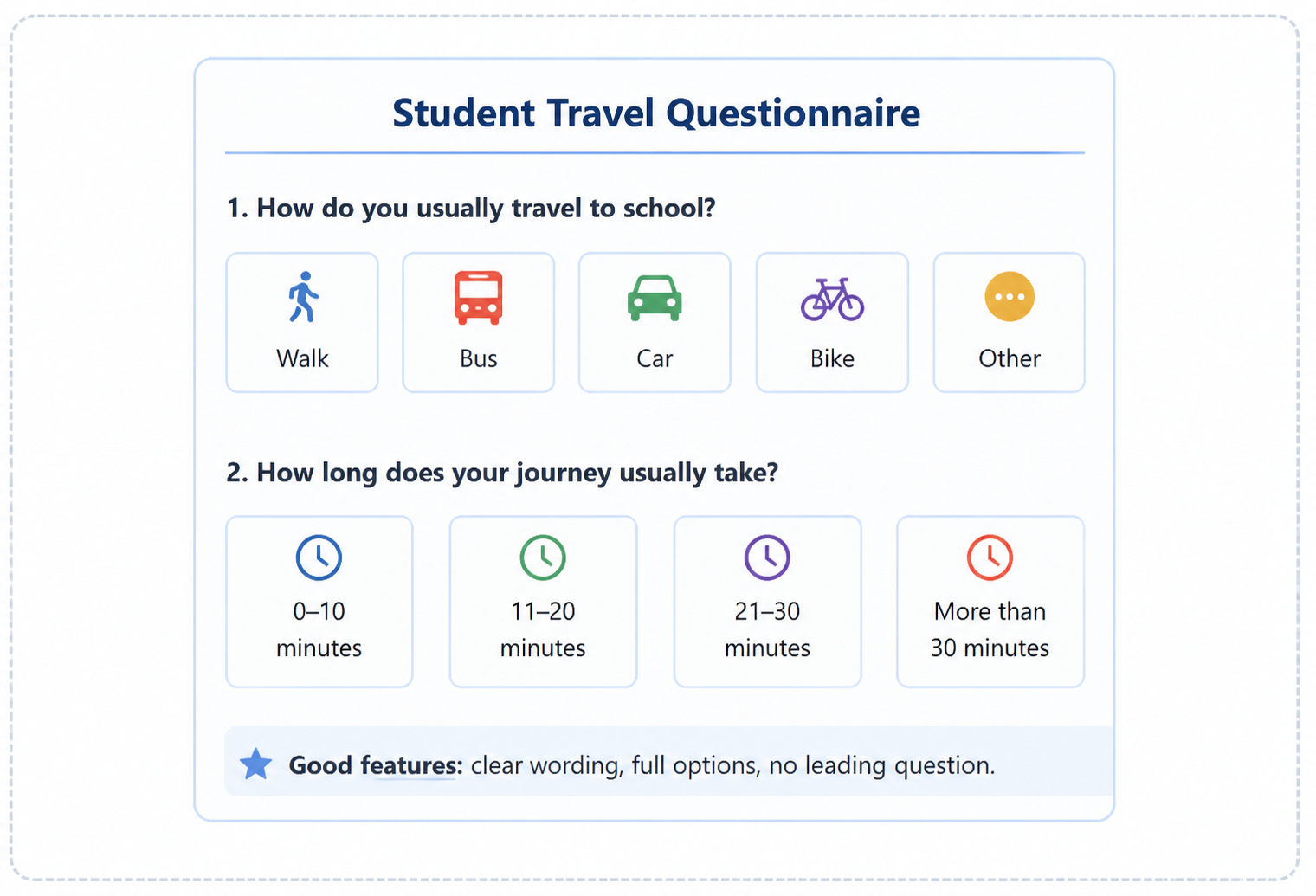
Easy to understand.
Links to the aim of the survey.
Includes all possible options.
Does not lead the respondent.
Fixed answers (e.g. Bus / Walk / Car).
Easy to analyse.
Free response.
More detail but harder to analyse.
Biased questions influence the answer.
Push respondents toward an answer.
Unclear or vague wording.
Missing possible answers.
People may not finish it.
Exam-style questions inspired by Edexcel GCSE Mathematics, focusing on understanding questionnaires and identifying bias.
A questionnaire is used to collect information from people.
State one reason why questionnaires are useful.
A question asks, “Don’t you agree that homework club is a great idea?”
Explain why this question is biased.
A question in a survey is:
How do you travel to school?
Bus ☐ Car ☐
Explain why this question may not give useful results.
Exam-style questions based on the AQA GCSE Mathematics specification, focusing on improving questionnaire design.
A question in a questionnaire is:
Do you exercise a lot?
Yes ☐ No ☐
Suggest one improvement to this question.
Explain why closed questions are often easier to analyse than open questions.
Give one example of a closed question that could be used in a questionnaire about hobbies.
Exam-style questions aligned with OCR GCSE Mathematics, emphasising evaluating and designing questionnaires.
A survey is carried out to find out how students travel to school.
Explain why it is important that the answer options cover all possible responses.
A questionnaire asks only students in one class about school facilities.
Explain why this may not be representative of the whole school.
Design one suitable question for a questionnaire about screen time.
Check whether the questions are clear and specific.
Look for bias or leading language.
Check whether the answer choices are complete.
Suggest an improved version if needed.
Not noticing that the question leads people toward one answer.
Accepting an unclear question without improvement.
Not checking whether all possible answers are included.
Changing the wording but not actually making the question fairer or clearer.
These are common mistakes students make when designing questionnaires in GCSE Maths.
A student writes a question that suggests a particular answer.
Questions should be neutral. Avoid wording that influences the response, such as “Don’t you agree that…”.
A student writes questions that are unclear or open to interpretation.
Make questions specific and precise so all respondents understand them in the same way.
A student gives answer choices that do not cover all possibilities.
Include all reasonable options, and where appropriate add choices such as “Other” or “Prefer not to say”.
A student includes too many questions, leading to poor responses.
Keep questionnaires concise to encourage accurate and thoughtful answers.
A student designs questions that produce unstructured or inconsistent answers.
Use clear categories or closed questions where possible so the data can be organised and analysed easily.
Practise designing and interpreting questionnaires for data collection.
Understand how to design clear and unbiased questionnaires.
What is the purpose of a questionnaire?
A question that suggests an answer is called a ______ question.
Which question is unbiased?
A questionnaire given only to friends may be ______.
Why should questions be clear?
Questions with fixed options are called ______ questions.
Which is a closed question?
Questions that allow any answer are called ______ questions.
Which is a good questionnaire feature?
A question with unclear meaning is called ______.
Evaluate and improve questionnaires for reliability and fairness.
Which question is biased?
A question that is unclear or can be interpreted in different ways is ______.
Why are open questions useful?
A survey given only online may exclude some groups. This is called ______.
Which improves reliability?
A question like 'How often do you exercise?' should include ______.
Why avoid leading questions?
A questionnaire should represent the whole population. This is called ______.
Which is the best improvement?
A good questionnaire avoids bias and is easy to ______.
Practise identifying good questionnaire design and spotting biased or unclear questions.
Clear and unbiased wording.
Leading questions.
To test questions first.