
Probability Basics and Scale
Probability measures how likely an event is, from impossible to certain. This topic forms the foundation for all probability calculations in GCSE Maths and leads into topics like listing outcomes and mutually exclusive events.
Overview
Key Definitions
Probability
A measure of how likely an event is to happen.
Event
Something that may happen, such as rolling a 6 on a dice.
Impossible
An event that cannot happen. Its probability is 0.
Certain
An event that must happen. Its probability is 1.
Even Chance
An event that is equally likely to happen or not happen. Its probability is \( \frac{1}{2} \).
Probability Scale
A line from 0 to 1 used to show how likely an event is.
Key Rules
How to Solve
Step 1: Understand probability
Probability tells us how likely something is to happen.
Step 2: Use the probability scale
The probability scale runs from 0 to 1 and shows how likely an event is.
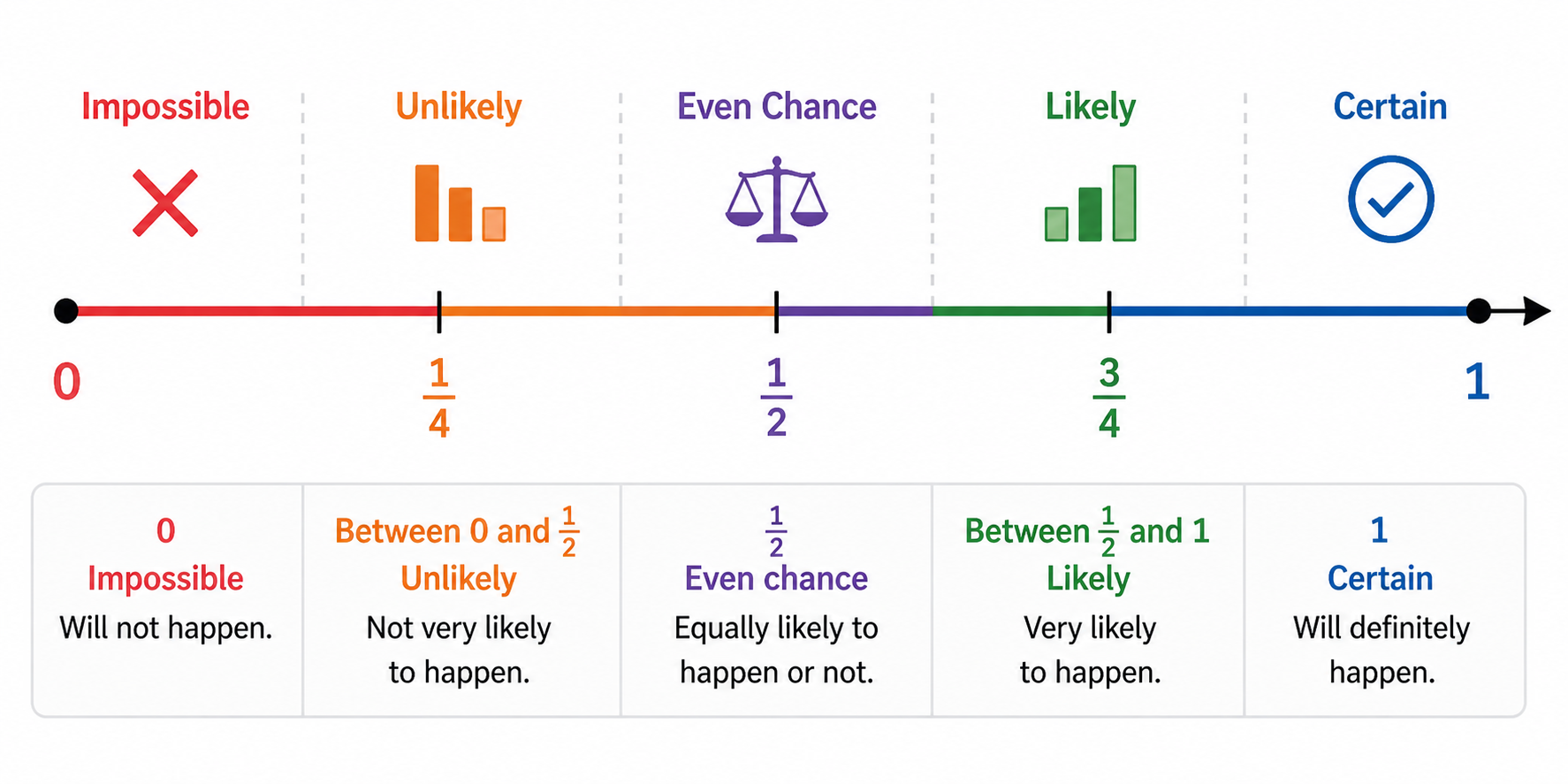
Step 3: Know probability words
Impossible
Probability 0
Unlikely
Between 0 and \(\frac{1}{2}\)
Even chance
Probability \(\frac{1}{2}\)
Likely
Between \(\frac{1}{2}\) and 1
Certain
Probability 1
Step 4: Check if a probability is valid
A probability must be between 0 and 1 inclusive.
Valid
\(0\), \(0.3\), \(\frac{1}{2}\), \(1\)
Not valid
\(-0.2\), \(1.4\), \(150\%\)
Step 5: Find simple probabilities
For equally likely outcomes, count favourable outcomes and total outcomes.
Step 6: Exam method summary
- Check the total number of outcomes.
- Count the outcomes that match the event.
- Write the probability as a fraction, decimal or percentage.
- Check the answer is between 0 and 1.
- Use probability words if the question asks for likelihood.
Example Questions
Edexcel
Exam-style questions inspired by Edexcel GCSE Mathematics, focusing on interpreting the probability scale.
Write down the probability of an event that is certain to happen.
Write down the probability of an event that is impossible.
A weather forecast gives the probability of rain as 0.8.
Describe how likely it is to rain.
A probability is shown on the scale below.
\( 0 \quad \underline{\hspace{1cm}} \quad 0.5 \quad \underline{\hspace{1cm}} \quad 1 \)
Write the word impossible, unlikely, even chance, likely or certain in the correct position for a probability of 0.25.
AQA
Exam-style questions based on the AQA GCSE Mathematics specification, focusing on valid probabilities and probability language.
Which of these could be a probability?
\( -0.2,\; 0,\; 0.6,\; 1.4 \)
A student says that the probability of an event is 1.2.
Tick one box. Possible ☐ Not possible ☐
Give a reason for your answer.
An event has probability 0.5.
Choose the best description: impossible, unlikely, even chance, likely or certain.
The probability that a train is late is 0.15.
Is the train more likely to be late or on time? Give a reason for your answer.
OCR
Exam-style questions aligned with OCR GCSE Mathematics, emphasising probability notation, comparison and reasoning from the probability scale.
Put these probabilities in order, starting with the least likely.
\( 0.7,\; \frac{1}{4},\; 0.05,\; \frac{3}{5} \)
A spinner has a probability of \( \frac{3}{4} \) of landing on blue.
Describe how likely it is that the spinner lands on blue.
Explain why \( \frac{7}{6} \) cannot be the probability of an event.
The probability that a school bus arrives before 8:30 am is 0.92.
Write a sentence interpreting this probability.
Exam Checklist
Step 1
Check that the value is between 0 and 1.
Step 2
Compare it with 0, \( \frac{1}{2} \) and 1.
Step 3
Decide whether the event is impossible, unlikely, even chance, likely or certain.
Step 4
Use the correct probability language in your answer.
Most common exam mistakes
Value error
Accepting numbers bigger than 1 or less than 0.
Language error
Confusing impossible with unlikely.
Scale error
Forgetting that \(0.5\) means even chance.
Interpretation error
Not noticing that values close to 1 mean very likely.
Common Mistakes
These are common mistakes students make when working with basic probability and the probability scale in GCSE Maths.
Using values outside the probability range
A student writes probabilities less than 0 or greater than 1.
Probability must always be between 0 and 1 inclusive. Values outside this range are not valid probabilities.
Confusing unlikely with impossible
A student treats unlikely events as impossible.
An unlikely event has a probability greater than 0 but less than 0.5. An impossible event has probability exactly 0.
Misunderstanding an even chance
A student does not recognise that \(\frac{1}{2}\) represents an equal chance.
A probability of \(\frac{1}{2}\) means the event is equally likely to happen or not happen.
Misinterpreting 0 on the scale
A student thinks 0 means unlikely.
A probability of 0 means the event is impossible. It cannot happen at all.
Misinterpreting 1 on the scale
A student does not recognise what a probability of 1 represents.
A probability of 1 means the event is certain. It will definitely happen.
Try It Yourself
Practise this topic step by step.
Foundation Practice
Questions coming soon.
Higher Practice
Questions coming soon.
Games
Understand probability using the probability scale and simple events.
Frequently Asked Questions
What is probability?
The likelihood of an event.
What is the scale?
From 0 (impossible) to 1 (certain).
What is 0.5?
An even chance.