A price increases from £50 to £60. What is the percentage increase?
Increase ÷ original × 100.
Increase = 10 → 10 ÷ 50 × 100 = 20%.

Percentage change measures how a value increases or decreases compared to its original amount. It builds on percentages and leads into growth and decay for repeated change in financial maths and real-world problems.
Percentage change measures how much a value has increased or decreased compared with the original value.
Always divide by the original value, not the new value, when calculating percentage change.
The starting value before the change happened.
The value after the change happened.
The difference between the new value and the original value.
When the new value is bigger than the original value.
When the new value is smaller than the original value.
The size of the change written as a percentage of the original value.
\( \text{Change} = \text{new} - \text{original} \)
Always divide by the original, not the new value.
Convert the decimal to a percentage.
Decide whether the value went up or down.
Percentage increase
Percentage decrease
0% change
The percentage is always based on the original value.
Percentage change compares how much a value has changed relative to the original value. It builds on ideas from percentages.
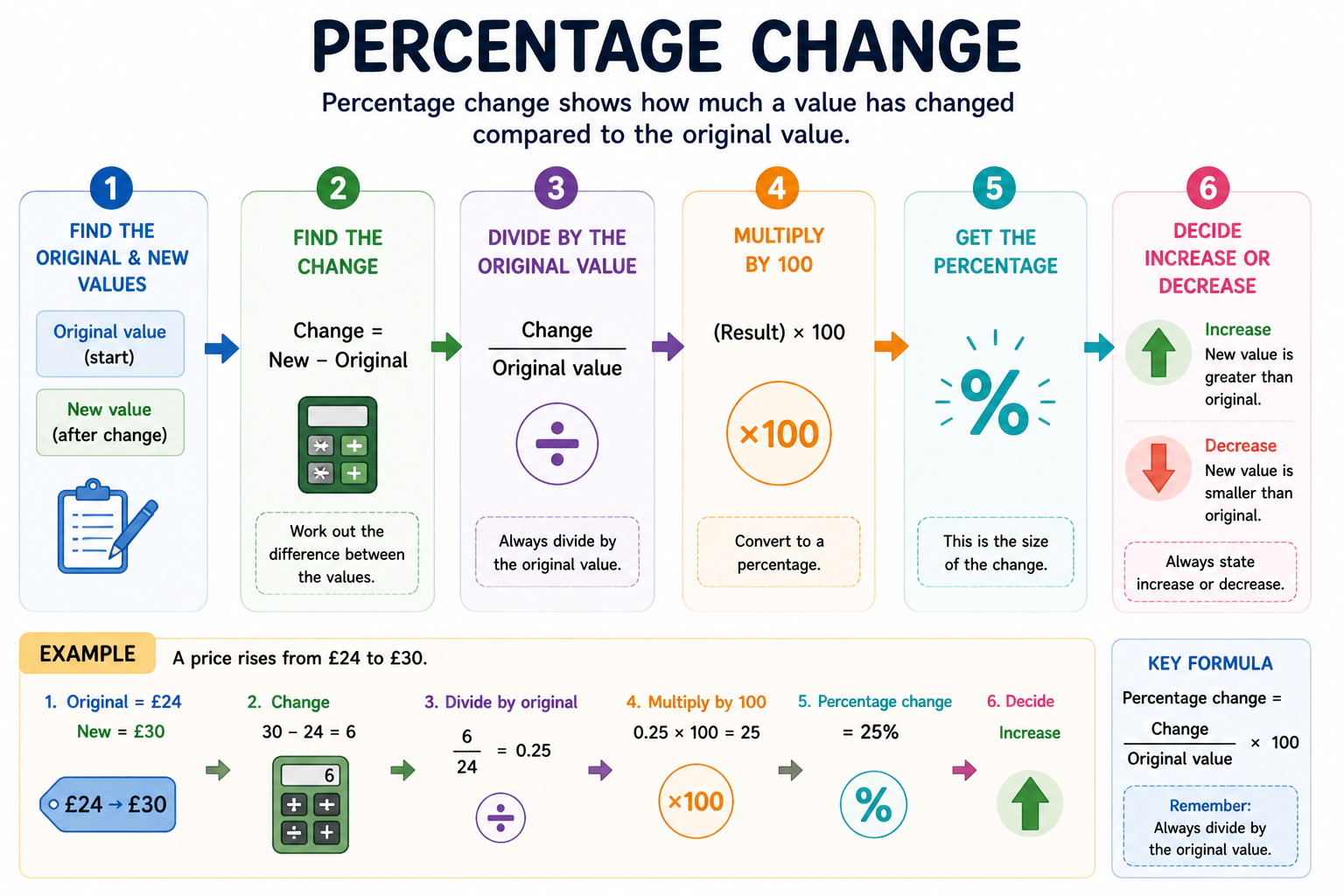
The starting value.
The final value after change.
Work out the difference between the values.
New value is greater than original.
New value is smaller than original.
Exam-style questions inspired by Edexcel GCSE Mathematics, focusing on calculating percentage increase and decrease.
A jacket increases in price from £40 to £50. Calculate the percentage increase.
The price of a phone decreases from £600 to £540. Calculate the percentage decrease.
A town's population rises from 18,000 to 19,260. Find the percentage increase.
The number of students in a college falls from 1,200 to 1,050. Calculate the percentage decrease.
A car's value increases from £8,000 to £8,640. Find the percentage increase.
Exam-style questions based on the AQA GCSE Mathematics specification, emphasising reverse percentage change and real-life contexts.
After a 20% increase, the price of a bicycle is £360. Find the original price.
A television is reduced by 15% to £425. Find the original price.
A worker's salary increases by 4% from £25,000. Calculate the new salary.
The number of visitors to a museum rises by 12% from 45,000. Find the new number of visitors.
A shop reduces its prices by 30%. If an item originally costs £80, find the sale price.
Exam-style questions aligned with OCR GCSE Mathematics, focusing on reasoning, multi-step problems, and interpreting percentage change.
The population of a city increases from 250,000 to 287,500. Calculate the percentage increase.
The price of petrol rises from £1.40 per litre to £1.54 per litre. Calculate the percentage increase.
A laptop is reduced from £900 to £765 in a sale. Calculate the percentage decrease.
A company's profit falls from £120,000 to £102,000. Calculate the percentage decrease.
Explain how to calculate percentage change and state the formula used.
Identify the original value clearly.
Work out the amount of change.
Divide by the original value, not the new value.
Multiply by 100 and state increase or decrease.
Using the new value instead of the original value.
Leaving the answer as a decimal instead of a percentage.
Forgetting to say whether it is increase or decrease.
Subtracting in the wrong order or using the wrong numbers.
These are common mistakes students make when calculating percentage change in GCSE Maths.
A student divides by the new value instead of the original value.
Percentage change is always based on the original value. Use \(\frac{\text{change}}{\text{original}} \times 100\).
A student leaves the answer as a decimal.
After finding the fraction or decimal, multiply by 100 to convert it into a percentage.
A student gives a number without saying whether it increased or decreased.
Always state whether the change is an increase or a decrease, as this is part of the final answer.
A student subtracts in the wrong order or uses incorrect values.
Change is found by subtracting the original value from the new value. Be careful with the order.
A student calculates a percentage of a number instead of the change.
Percentage change compares two values. It is different from finding a percentage of a single amount.
Practise calculating percentage increases and decreases.
Calculate percentage increases and decreases.
A price increases from £50 to £60. What is the percentage increase?
A value increases from 80 to 100. Find the percentage increase.
A price decreases from £40 to £30. What is the percentage decrease?
A value decreases from 90 to 72. Find the percentage decrease.
A student divides by the new value instead of the original. What is wrong?
A price increases from £20 to £25. Find the percentage increase.
A value changes from 100 to 90. What is the percentage change?
A value increases from 200 to 260. Find the percentage increase.
Which formula finds percentage change?
A value decreases from 120 to 96. Find the percentage decrease.
Solve percentage change and reverse percentage problems.
A price increases by 20% to £120. What was the original price?
A value increases by 25% to 150. Find the original value.
A price decreases by 10% to £90. What was the original price?
A value decreases by 20% to 64. Find the original value.
A value increases from 50 to 75. What is the percentage increase?
A value decreases from 200 to 150. Find the percentage decrease.
A student calculates percentage change using the new value. Why is this incorrect?
A price increases by 15% to £230. Find the original price.
A value halves. What is the percentage decrease?
A value increases by 10% to 330. Find the original value.
Practise calculating percentage increases and decreases in a range of GCSE-style questions.