What does 'mutually exclusive' mean?
Think: no overlap.
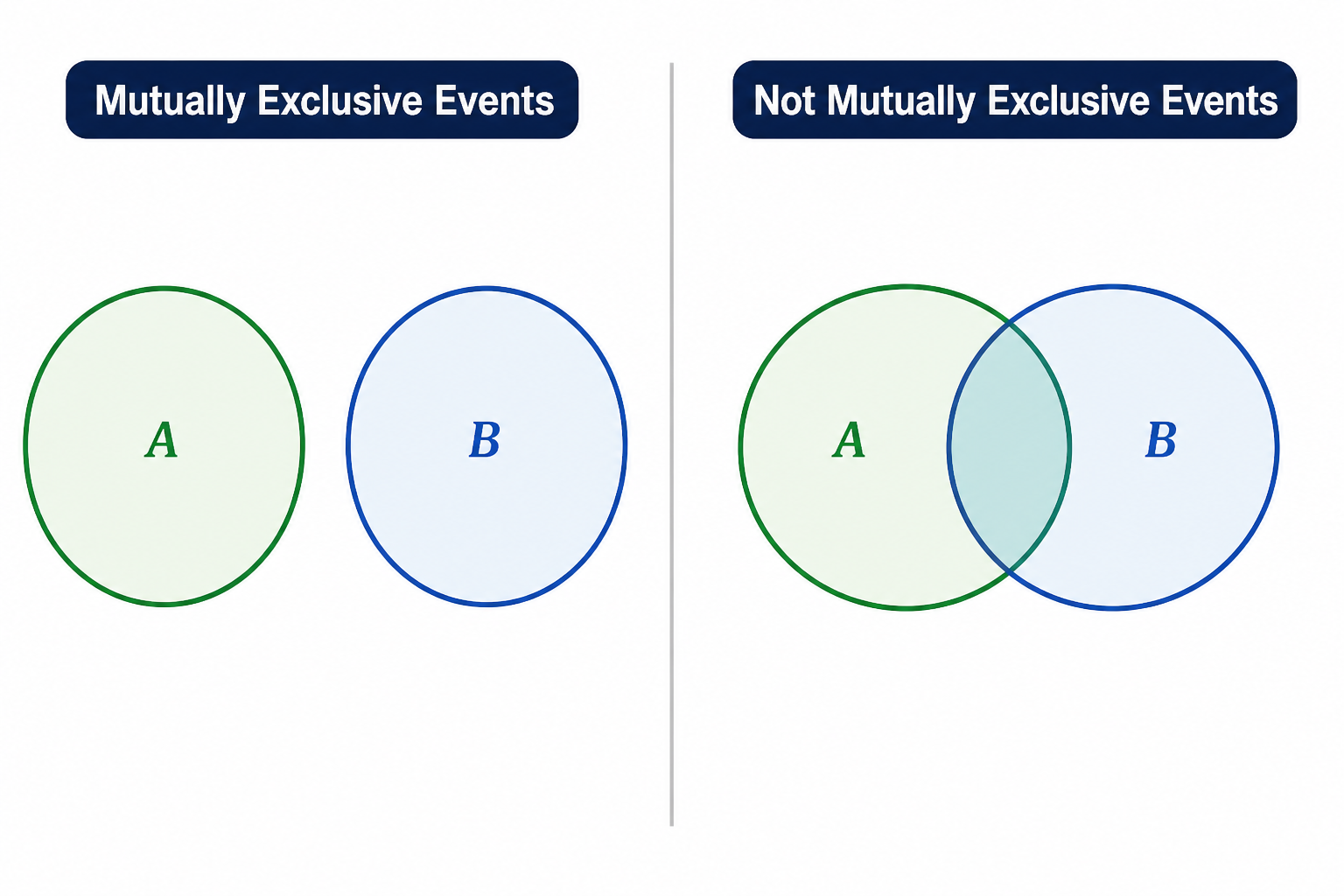
Mutually exclusive events cannot happen at the same time.

Mutually exclusive events cannot happen at the same time. This builds on basic probability and helps when calculating combined probabilities, especially in conditional probability.
Two events are mutually exclusive if they cannot happen at the same time.
If one event occurs, the other cannot occur in the same trial.
The key step is deciding whether events can happen together before choosing the correct probability rule.
A possible result or outcome in probability.
Two events that cannot happen at the same time.
A situation where two events can happen together.
The probability that event A happens, or event B happens, or both.
For mutually exclusive events, add the probabilities.
One experiment, such as one coin toss or one dice roll.
Then the events are mutually exclusive.
Then they are not mutually exclusive.
\( P(A \text{ or } B) = P(A) + P(B) \)
Ask whether both events could happen in the same trial.
Rolling a 2 and rolling a 5 on one dice roll.
Choosing a card that is red and also a king.
Getting heads or tails on one coin toss.
A student liking maths and liking science.
Two events are mutually exclusive if they cannot happen at the same time. In a single trial, only one of the events can occur.
Rolling a 2 and a 5 at the same time is impossible.
Getting heads and tails together is impossible.
A card can be red AND a king.
If events are mutually exclusive, add their probabilities.
If events can happen together, you must subtract the overlap.
Mutually exclusive events do not overlap, while other events can overlap.
Exam-style questions inspired by Edexcel GCSE Mathematics, focusing on identifying mutually exclusive events and adding probabilities.
A fair dice is rolled once.
Find the probability of rolling a 2 or rolling a 5.
A fair spinner has 8 equal sections numbered 1 to 8.
Find the probability that the spinner lands on 1 or 3 or 7.
A card is chosen at random from a standard pack of 52 cards.
Explain why choosing a heart and choosing a club are mutually exclusive events.
Exam-style questions based on the AQA GCSE Mathematics specification, focusing on deciding whether events can happen at the same time.
A fair dice is rolled once. A student says, "Rolling an even number and rolling a 4 are mutually exclusive events."
Tick one box. True ☐ False ☐
Give a reason for your answer.
A fair dice is rolled once. Find the probability of rolling a number less than 3 or a number greater than 4.
A counter is chosen at random from a bag containing 5 red counters, 3 blue counters and 2 green counters.
Find the probability that the counter is blue or green.
Exam-style questions aligned with OCR GCSE Mathematics, emphasising reasoning with mutually exclusive and non-mutually exclusive events.
A card is chosen at random from a standard pack of 52 cards.
Are the events "choosing a red card" and "choosing a king" mutually exclusive? Give a reason for your answer.
Events A and B are mutually exclusive.
\( P(A)=0.35 \quad \text{and} \quad P(B)=0.28 \)
Find \( P(A \text{ or } B) \).
Events C and D are mutually exclusive.
\( P(C)=\frac{2}{5} \quad \text{and} \quad P(C \text{ or } D)=\frac{7}{10} \)
Find \( P(D) \).
These are common mistakes students make when working with mutually exclusive events in GCSE Maths.
A student thinks two different events must be mutually exclusive.
Events are only mutually exclusive if they cannot happen at the same time. Different events can still occur together.
A student adds probabilities of events that can happen together.
You can only add probabilities directly if the events are mutually exclusive. If they overlap, you must account for the intersection.
A student assumes events are mutually exclusive without checking the context.
Check whether the situation involves one trial or multiple trials. For example, getting heads and tails is mutually exclusive in one toss, but not across multiple tosses.
A student mixes up addition and multiplication rules.
“Or” usually means add probabilities (for mutually exclusive events). “And” means multiply probabilities.
A student fails to identify obvious cases.
Events like heads or tails in a single coin toss are mutually exclusive because only one outcome can occur at a time.
Practise calculating probabilities of mutually exclusive events.
Understand mutually exclusive events and calculate probabilities.
What does 'mutually exclusive' mean?
A die is rolled. What is the probability of getting a 2 or a 5?
A card is picked from a standard deck. What is the probability of getting a king or a queen?
A spinner has 4 equal sections: A, B, C, D. What is the probability of landing on A or B?
Which pair of events is mutually exclusive?
A die is rolled. What is the probability of getting a 1 or a 6?
If events are mutually exclusive, what happens to their probabilities when finding 'A or B'?
A bag has 3 red, 2 blue, 5 green balls. Find P(red or blue).
A student multiplies probabilities for mutually exclusive events. What is wrong?
A spinner has 5 equal sections. What is the probability of landing on section 1 or 2?
Use addition rules and identify when events are not mutually exclusive.
Which formula applies to mutually exclusive events?
A die is rolled. Find P(getting a number less than 3 or greater than 5).
Which pair is NOT mutually exclusive?
A card is chosen. Find P(king or heart).
Why must overlap be subtracted when events are not mutually exclusive?
A bag has 5 red, 3 blue, 2 striped (both red and blue counted once). Find P(red or blue).
A student assumes all events are mutually exclusive. What is the danger?
A die is rolled. Find P(odd or even).
Which statement is true for mutually exclusive events?
A spinner has 8 equal sections. Find P(section 1 or 2 or 3).
Practise recognising mutually exclusive events and calculating probabilities using the addition rule.
Events that cannot happen together.
Add them.
Getting heads or tails in one coin toss.