What is the locus of points exactly 4 cm from point P?
All points are the same distance from P.
The locus is a circle centred at P with radius 4 cm.

Loci describe sets of points that satisfy specific conditions, while constructions use accurate ruler-and-compass drawing. This topic links closely to angle rules, bearings and shading regions.
A construction is an accurate drawing made using a ruler and compass.
A locus is the path traced by a point that follows a rule.
You need to be able to construct perpendicular bisectors, angle bisectors and accurate triangles, and recognise loci such as points equidistant from two points or two lines.
An accurate diagram drawn using geometrical tools such as a ruler and compass.
The path of a point that follows a particular rule.
A tool used to draw arcs and circles.
A line that cuts a segment into two equal parts at \(90^\circ\).
A line that splits an angle into two equal angles.
The same distance from two points, lines or objects.
An area that satisfies one or more locus conditions.
A curved part of a circle used during compass constructions.
Do not estimate by eye when a construction is required.
Construction marks usually need to remain on the page.
The wording tells you exactly what path to draw.
Some questions ask for the full locus, others ask for a valid area.
The perpendicular bisector of the segment joining the points.
The angle bisector between the lines.
A circle centred at that point.
A line parallel to the original line.
Constructions are accurate diagrams made using a ruler and compass. A locus is a path or region of points that follow a rule.
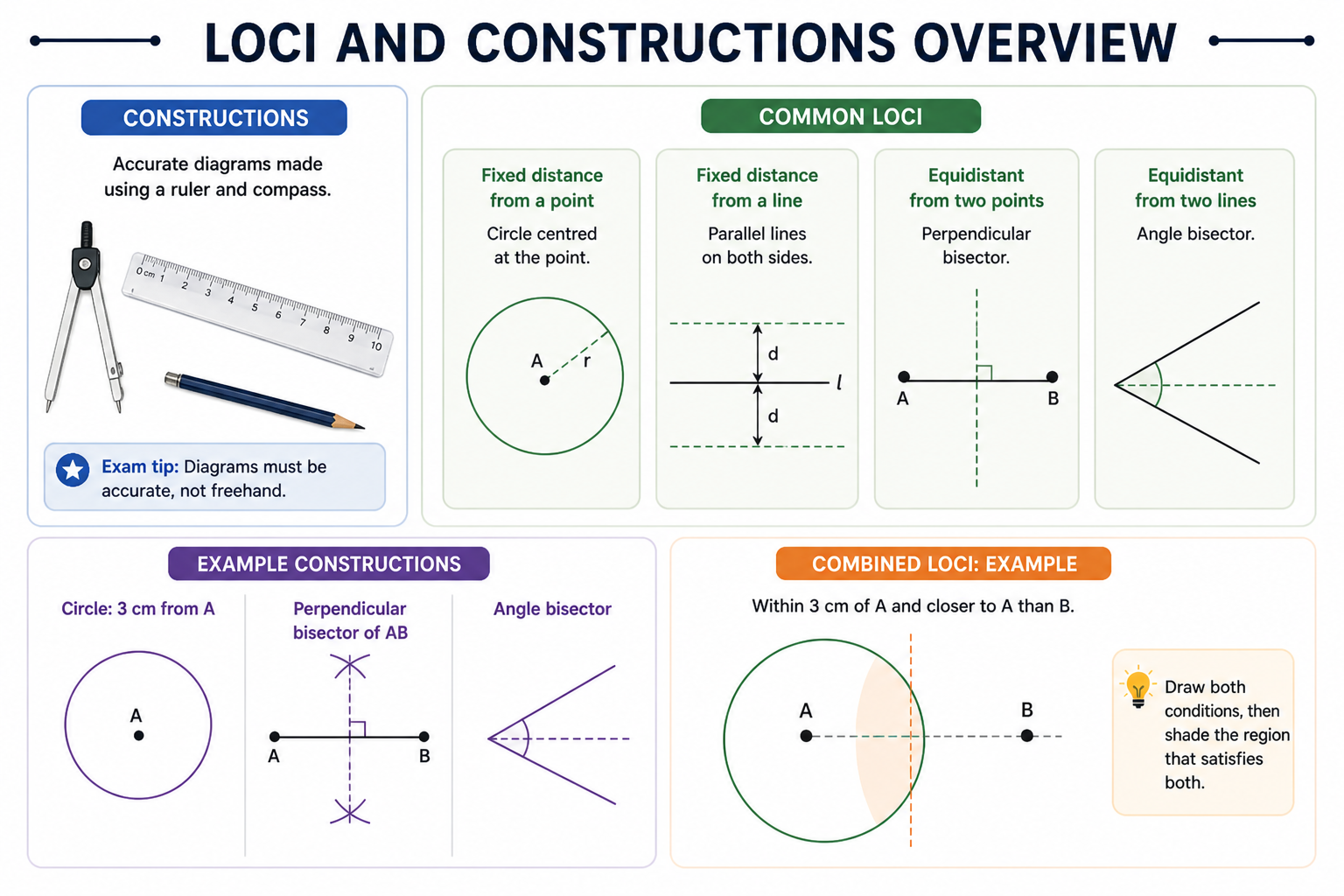
Circle centred at the point.
Parallel lines on both sides.
Perpendicular bisector.
Angle bisector.
A perpendicular bisector finds points equidistant from two points.
An angle bisector finds points equidistant from two lines.
Use ruler and compass arcs to locate vertices accurately.
Many exam questions involve more than one condition.
Draw only the boundary line or curve.
Shade inside the boundary.
Shade outside the boundary.
Use a bisector.
Exam-style questions focusing on simple loci around points and between two points.
The locus is 5 cm from point P.
Describe the locus.
Points A and B are shown.
What is the locus of points equidistant from A and B?
Exam-style questions focusing on angle bisectors and regions within a distance.
Two lines intersect.
What is the locus of points equidistant from the two intersecting lines?
A point must be less than 4 cm from P.
What region should be shown?
Exam-style questions focusing on construction reasoning and combined locus regions.
The perpendicular bisector of AB is constructed using equal-radius arcs.
Explain why the perpendicular bisector shows points equidistant from A and B.
A point must be within 3 cm of P and closer to P than to Q.
What two boundaries are needed?
A point must be nearer to line A than line B.
Describe the boundary and the correct region.
Read the exact wording of the construction or locus rule.
Choose the correct construction method or locus shape.
Leave clear compass arcs and accurate lines.
If needed, shade only the region that satisfies all conditions.
Using an angle bisector instead of a perpendicular bisector, or the other way round.
Rubbing out the construction evidence.
Drawing the line or circle but forgetting the region inside or outside.
Shading a part that does not satisfy every condition.
These are common mistakes students make when working with loci and constructions in GCSE Maths.
A student removes the compass arcs after drawing the final line.
Construction arcs must be left visible as part of the method. Marks are awarded for showing how the construction was done.
A student sketches lines without using a ruler or compass.
Constructions must be accurate. Always use a compass and ruler rather than drawing freehand.
A student draws a perpendicular bisector when an angle bisector is required.
Read the question carefully and identify the correct construction. A perpendicular bisector splits a line into two equal parts at 90°, while an angle bisector splits an angle into two equal angles.
A student draws the line or curve but does not show the required region.
If the question asks for a region, you must indicate it clearly, often by shading the correct side of the boundary.
A student shades outside the valid area or misses the overlap.
When multiple conditions are given, only shade the region that satisfies all of them. This is usually the overlapping area.
Practise constructing loci and geometric constructions accurately.
Recognise simple loci and standard construction rules.
What is the locus of points exactly 4 cm from point P?
What is the locus of points equidistant from two points A and B?
Which construction is shown?
The locus of points equidistant from two intersecting lines is called the angle ______.
Which line is the angle bisector?
A path must stay 3 m from a straight wall. What shape is the locus?
Which construction is needed to draw a 60° angle accurately?
A point must be less than 5 cm from point A. The region is inside a circle of radius how many cm?
What does a construction arc usually show?
What equipment is normally used for accurate constructions?
Use combined loci and construction reasoning to identify exact regions.
Which shaded region shows points less than 4 cm from A and less than 4 cm from B?
A point is equidistant from A and B, and also exactly 5 cm from A. What two loci must be used?
The shaded region is inside the circle and above the line. Which description matches it?
A park must be closer to gate A than gate B. Which side of the perpendicular bisector should be shaded?
A point must be nearer to line l than line m. What construction helps divide the region?
A region is described as more than 3 cm from P. Should the region be inside or outside the circle of radius 3 cm?
Which condition describes the blue dashed line?
A safe zone must be at least 2 m from a wall. The boundary line is parallel to the wall. How far from the wall is the boundary?
A point must be exactly 6 cm from A and exactly 6 cm from B. Where could the point be?
A point is less than 4 cm from P but more than 2 cm from P. What shape is the region?
Practise loci, compass constructions and geometric constructions using interactive diagrams.
A set of points satisfying a condition.
Compass and ruler.
Marks depend on precision.