A coin is flipped once. How many possible outcomes are there?
Think: heads or tails.
Outcomes are H and T → 2 outcomes.

Listing outcomes involves writing all possible results of an event. This ensures no possibilities are missed when calculating probability and helps form a complete set of outcomes for the experiment. It builds directly on basic probability.
Listing outcomes means writing down all the possible results of an event or experiment.
This is one of the most important basic probability skills.
If outcomes are missed or repeated, the probability will be incorrect, so it is important to work systematically and stay organised.
A single possible result of an experiment.
A result or group of results that we are interested in.
An outcome that matches the event we want.
All the possible results altogether.
A list written in a clear order so nothing is missed or repeated.
The full set of all possible outcomes.
Be systematic so you do not miss any outcomes.
Each different outcome should appear once only.
\( HT \) and \( TH \) may count as different outcomes.
Use the full list to count total and favourable outcomes.
\( H, T \)
\( 1, 2, 3, 4, 5, 6 \)
\( HH, HT, TH, TT \)
List every section once.
Listing outcomes means writing every possible result of an experiment.
Decide what is happening in the question.
One coin or one dice.
Two coins or two dice.
Write outcomes in a clear pattern to avoid missing any.
Keep the first result the same while changing the second.
List all outcomes before moving on.
Each outcome should appear only once.
Count the total number of outcomes.
Identify outcomes that match the event.
In multi-step experiments, order can matter.
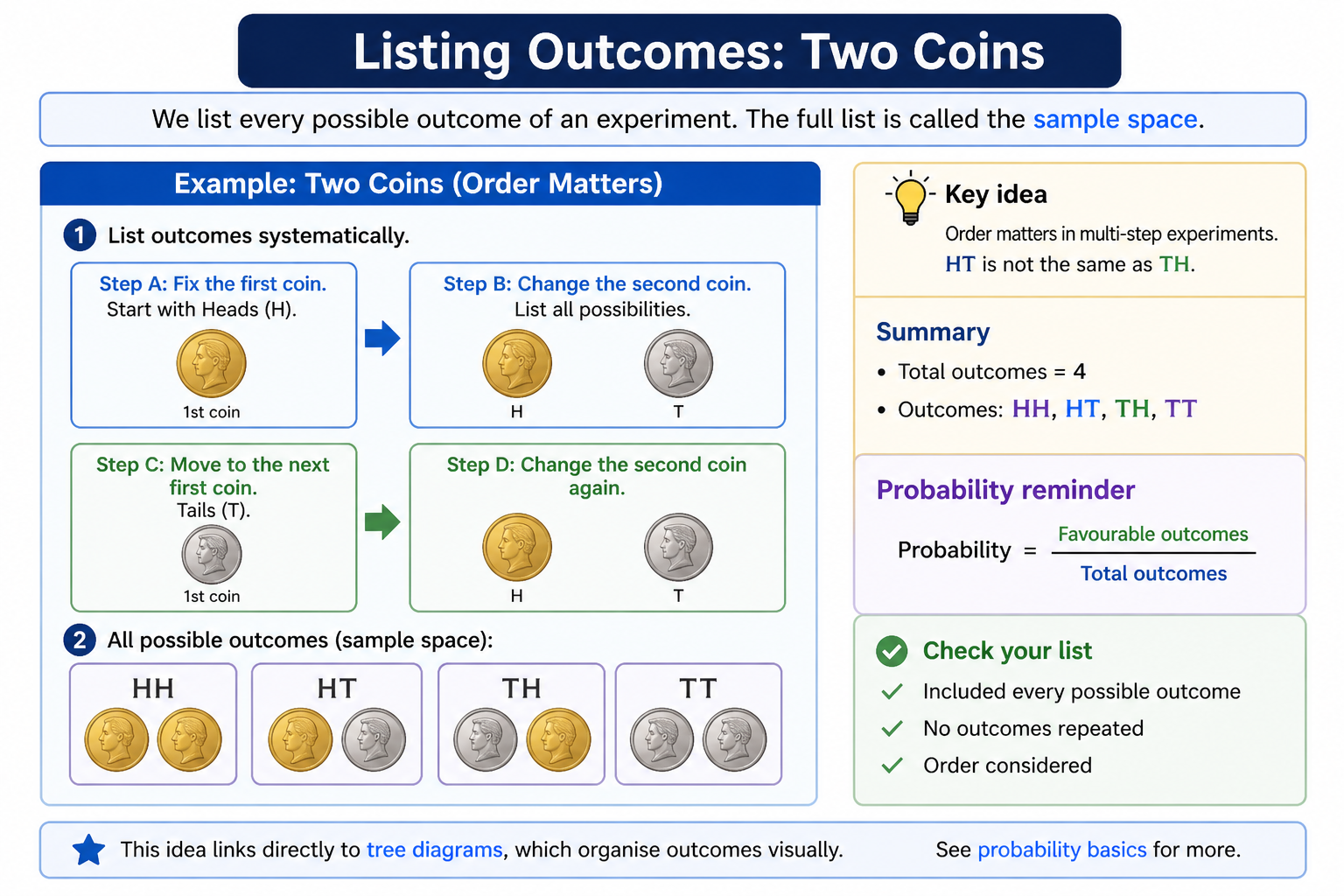
For two events, list systematically using pairs.
Exam-style questions inspired by Edexcel GCSE Mathematics, focusing on listing outcomes and using them to find probabilities.
A coin is tossed once. List all the possible outcomes.
A fair dice is rolled once. List all the possible outcomes.
A coin is tossed twice. List all the possible outcomes.
A coin is tossed twice. Find the probability of getting exactly one head.
Exam-style questions based on the AQA GCSE Mathematics specification, focusing on systematic listing and equally likely outcomes.
Sam has one red card, one blue card and one green card. He chooses one card at random. List all the possible outcomes.
A spinner has four equal sections labelled A, B, C and D. The spinner is spun once. List all the possible outcomes.
A fair dice is rolled once. Find the probability of rolling a number greater than 4.
A fair dice is rolled once. Find the probability of rolling an even number.
Exam-style questions aligned with OCR GCSE Mathematics, emphasising complete lists of outcomes and simple probability reasoning.
A coin is tossed and a fair dice is rolled. List all the possible outcomes.
A coin is tossed and a fair dice is rolled. Find the probability of getting a head and an even number.
A bag contains one red counter, one yellow counter and one blue counter. Two counters are chosen without replacement. List all the possible ordered outcomes.
Two counters are chosen without replacement from one red counter, one yellow counter and one blue counter. Find the probability that one of the counters is red.
Work out exactly what experiment is happening.
List every possible outcome in a clear order.
Count the total number of outcomes carefully.
Count how many outcomes match the event.
Not writing the full sample space.
Counting the same result more than once.
Forgetting that order can matter in multi-step events.
Counting favourable outcomes incorrectly after listing them.
These are common mistakes students make when listing outcomes in GCSE Maths.
A student does not include all possible results.
List outcomes systematically to ensure none are missed. Use a table or organised list to cover every possibility.
A student writes the same outcome more than once.
Each outcome should appear only once. Check your list carefully to avoid duplicates.
A student treats outcomes like AB and BA as the same.
If order matters, AB and BA are different outcomes. Always check whether the situation depends on order.
A student identifies the correct outcomes but counts them wrongly.
After listing outcomes, count carefully. Double-check your totals to avoid simple errors.
A student calculates probability from a partial list.
Probability depends on all possible outcomes. If the list is incomplete, the probability will be incorrect.
Practise listing outcomes systematically in probability problems.
List all possible outcomes in simple situations.
A coin is flipped once. How many possible outcomes are there?
List all outcomes when flipping a coin twice. Give as comma-separated values.
A die is rolled. How many outcomes are possible?
List all outcomes when rolling a die once.
How many outcomes are there when flipping a coin and rolling a die?
How many outcomes are there when flipping two coins?
A student lists HH, HT, TT when flipping two coins. What did they miss?
How many outcomes are there when rolling a die twice?
Which method helps ensure all outcomes are listed?
How many outcomes are there when choosing between A, B and C?
List outcomes systematically and avoid duplicates in more complex situations.
Two dice are rolled. How many total outcomes are possible?
List all outcomes when flipping a coin and rolling a die (start with H). Give as comma-separated values.
How many outcomes are there when choosing one letter from A, B, C and one number from 1, 2?
List all outcomes when choosing from A, B and 1, 2. (Letter first).
A student lists outcomes for two dice but writes (1,2) and (2,1) only once. What is wrong?
How many outcomes are there when choosing from 4 options and 3 options?
Which list is systematic?
How many outcomes are there when flipping 3 coins?
A student forgets to list some outcomes. What is the main problem?
How many outcomes are there when rolling 2 dice and flipping a coin?
Practise listing all possible outcomes using tables, organised lists and systematic methods.
Possible results.
To avoid missing cases.
Tables or diagrams.