If more workers are used to do a job, what happens to the time taken?
More workers = faster work.
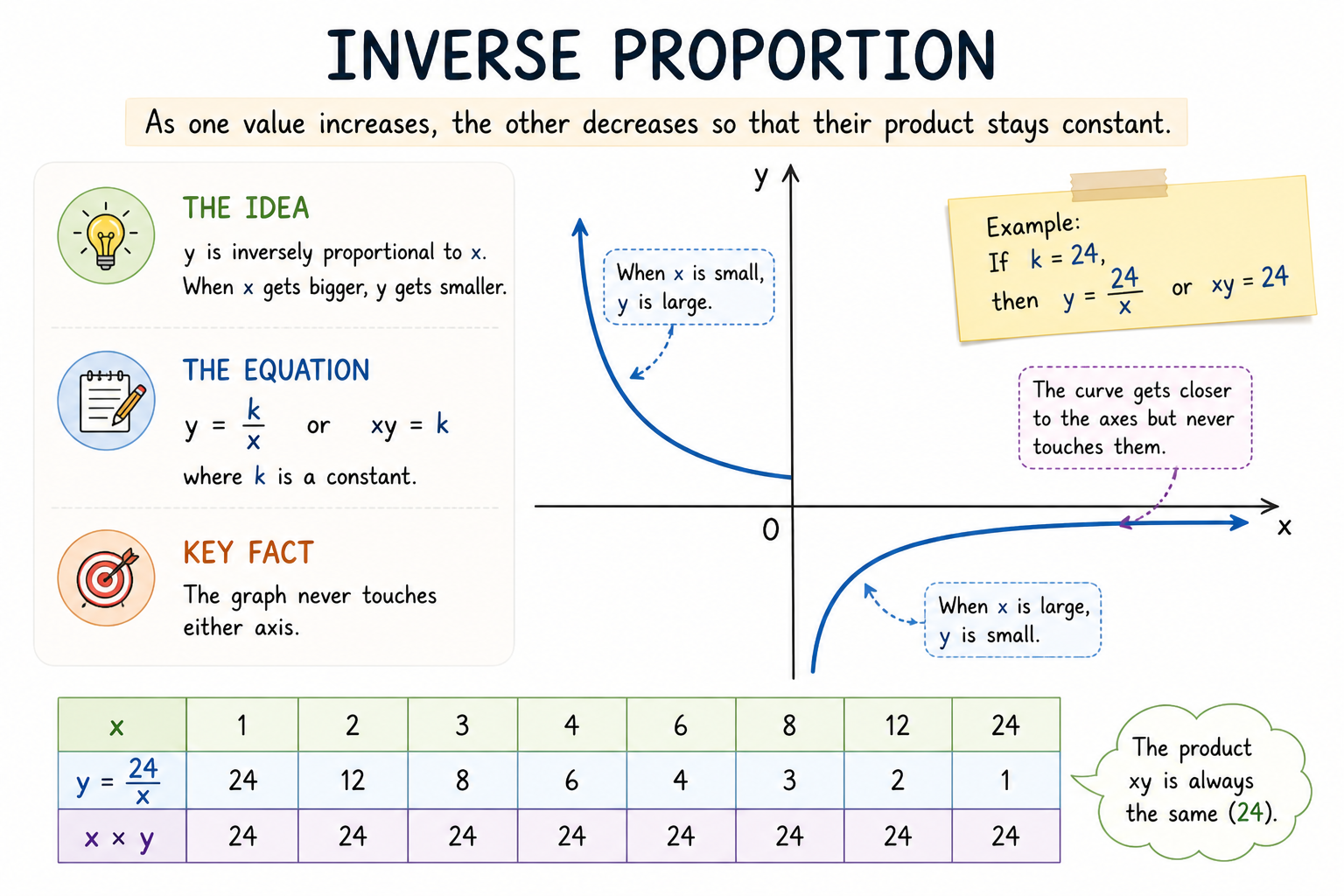
In inverse proportion, as one increases, the other decreases.

Inverse proportion describes a relationship where one quantity increases while the other decreases. It is the opposite of direct proportion and is based on ideas from ratio, with relationships often written in the form y = k/x.
Two quantities are in inverse proportion when one increases and the other decreases so that their product remains constant.
Inverse proportion often appears in problems involving time, speed, workers, pipes, area and pressure.
When one quantity increases while the other decreases so that the product stays constant.
\( y \propto \frac{1}{x} \)
The fixed value \( k \) in \( y = \frac{k}{x} \) or \( xy = k \).
The result of multiplying two values together.
One quantity is proportional to the reciprocal of the other.
The graph is a curve, not a straight line.
\( k = xy \)
\( y = \frac{k}{x} \)
That is the key pattern.
Inverse proportion makes a curve.
“is inversely proportional to”
\( y = \frac{12}{x} \)
If \( xy \) stays constant, it is inverse proportion.
A decreasing curve, not a straight line.
In inverse proportion, as one value increases, the other decreases so that their product stays constant. It is useful to compare this with direct proportion.
Convert the proportional relationship into an equation.
Use given values to calculate \(k\).
Substitute new values into the equation.
The graph is a curve that gets closer to the axes but never touches them.
The graph is not a straight line and has two branches.
Look for 'inversely proportional'.
Check if \( xy \) is constant.
Looks like \( y = \frac{k}{x} \).
More workers → less time, higher speed → less time.
Exam-style questions inspired by Edexcel GCSE Mathematics, focusing on recognising and solving problems involving inverse proportion.
State whether \( y \) is inversely proportional to \( x \) in the equation \( y = \frac{6}{x} \).
Given that \( y \propto \frac{1}{x} \) and \( y = 4 \) when \( x = 3 \), find \( y \) when \( x = 6 \).
Given that \( y \) is inversely proportional to \( x \), and \( y = 10 \) when \( x = 2 \), find the constant of proportionality.
The time taken to complete a journey is inversely proportional to the speed. If a journey takes 5 hours at 60 km/h, how long will it take at 100 km/h?
Write the relationship \( y \propto \frac{1}{x} \) as an equation using a constant of proportionality.
Exam-style questions based on the AQA GCSE Mathematics specification, focusing on forming and solving equations involving inverse proportion.
Given that \( y \propto \frac{1}{x} \) and \( y = 8 \) when \( x = 5 \), find an equation connecting \( y \) and \( x \).
If \( y \) is inversely proportional to \( x \), and \( y = 12 \) when \( x = 4 \), find \( x \) when \( y = 3 \).
The number of workers needed to complete a job is inversely proportional to the time taken. If 6 workers take 10 days, how many workers are required to complete the job in 4 days?
The pressure of a gas varies inversely with its volume. If the pressure is 200 kPa when the volume is 5 m^3, find the pressure when the volume is 8 m^3.
Explain how you recognise an inverse proportion from a table or graph.
Exam-style questions aligned with OCR GCSE Mathematics, emphasising reasoning, algebraic modelling, and graphical interpretation.
Given that \( y \propto \frac{1}{x} \), and \( y = 9 \) when \( x = 2 \), find the value of \( y \) when \( x = 6 \).
Write \( y \propto \frac{1}{x} \) as an equation involving a constant \( k \).
A fixed distance is travelled at different speeds. If it takes 3 hours at 80 km/h, how long will it take at 120 km/h?
Two variables are inversely proportional. When \( x = 4 \), \( y = 15 \). Find the value of \( y \) when \( x = 10 \).
State the key features of a graph that represents inverse proportion.
If you see “inversely proportional”, write \( y = \frac{k}{x} \).
Use known values to find \( k \) by multiplying.
Substitute the new value into the completed equation.
Check whether the answer makes sense: bigger \( x \), smaller \( y \).
Using \( y = kx \) instead of \( y = \frac{k}{x} \).
Dividing to find \( k \) when you should multiply.
Not checking whether the product stays constant.
Getting a larger answer when the question should produce a smaller one.
These are common mistakes students make when working with inverse proportion in GCSE Maths.
A student uses \(y = kx\) instead of \(y = \frac{k}{x}\).
Inverse proportion follows \(y = \frac{k}{x}\) or \(xy = k\). This is different from direct proportion, which uses \(y = kx\).
A student divides instead of multiplying to find k.
For inverse proportion, use \(k = x \times y\), not division. Multiply the values to find the constant.
A student assumes inverse proportion just because one value increases and the other decreases.
Check that the product \(xy\) is constant. This confirms inverse proportion.
A student uses the method for direct proportion.
Direct proportion uses \(y = kx\), while inverse proportion uses \(y = \frac{k}{x}\). Always identify the relationship first.
A student draws a straight line graph.
Inverse proportion graphs are curves (hyperbolas), not straight lines. They approach the axes but do not touch them.
Practise solving problems involving inverse proportional relationships.
Understand inverse proportion and solve simple problems.
If more workers are used to do a job, what happens to the time taken?
4 workers take 12 hours to complete a job. How long would 2 workers take?
6 machines take 10 hours. How long do 3 machines take?
If speed doubles, what happens to time taken for a fixed journey? (Give answer as 'halves' or 'doubles')
Which situation shows inverse proportion?
8 workers take 6 hours. How long do 4 workers take?
A student says: 'If x doubles, y doubles in inverse proportion.' What is wrong?
10 workers take 4 hours. How long do 5 workers take?
If x increases, what happens to y in inverse proportion?
3 taps fill a tank in 9 hours. How long do 9 taps take?
Solve inverse proportion problems using equations and constant k.
y is inversely proportional to x. When x = 2, y = 12. Find y when x = 6.
y ∝ 1/x. When x = 4, y = 10. Find y when x = 5.
y ∝ 1/x. If y = 6 when x = 3, what is k?
y ∝ 1/x. When x = 8, y = 3. Find y when x = 2.
Which equation represents inverse proportion?
y ∝ 1/x. When x = 10, y = 2. Find x when y = 5.
A student says y = 1/x + 3 is inverse proportion. Why is this wrong?
y ∝ 1/x. When x = 5, y = 6. Find y when x = 15.
If x is multiplied by 4, what happens to y in inverse proportion?
y ∝ 1/x. When x = 12, y = 5. Find x when y = 20.
Practise recognising and solving inverse proportion problems using tables, constant products and real-life situations.