What is the gradient of the line \(y = 3x + 2\)?
The gradient is the number in front of x.
In \(y = mx + c\), the gradient is m. Here, m = 3.

Linear graphs are straight lines that show relationships between variables. Understanding gradient and intercepts is essential for interpreting graphs in GCSE Maths.
A linear function produces a straight-line graph.
These graphs are usually written in the form y = mx + c.
In this form, m represents the gradient and c represents the y-intercept.
A function whose graph is a straight line.
How steep the line is.
The point where the line crosses the y-axis.
The point where the line crosses the x-axis.
A point written as \( (x,y) \).
A table used to generate points for a graph.
Lines with the same gradient.
A rule that describes every point on the line.
It tells you how much \(y\) changes when \(x\) increases by 1.
It tells you where the line crosses the y-axis.
The line rises from left to right.
The line falls from left to right.
Gradient 2, y-intercept 3.
Gradient -1, y-intercept 4.
Horizontal line.
Parallel lines never meet.
A linear graph is a straight line with a constant rate of change. This means \(y\) increases or decreases by the same amount each time \(x\) increases by 1. These graphs come from equations such as linear equations.
The equation \( y = mx + c \) tells you everything about the line.
Controls steepness and direction.
Line goes up to the right.
Line goes down to the right.
Where the line crosses the y-axis.
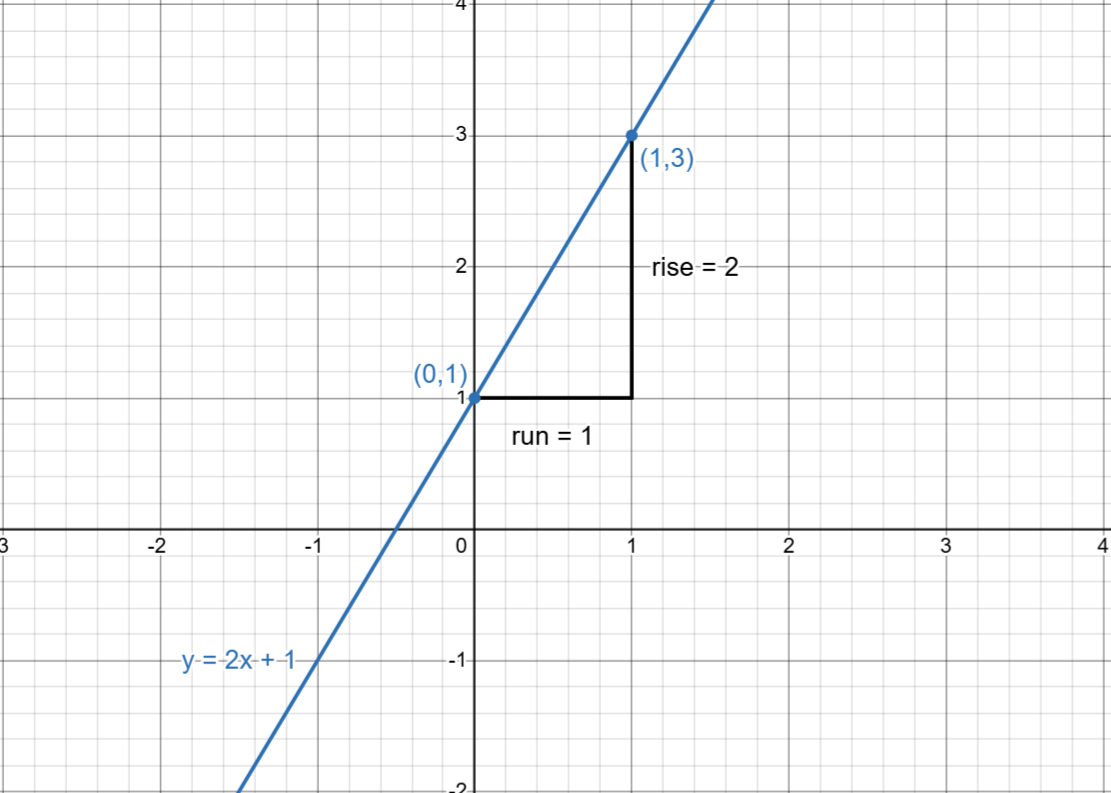
The fastest method is to plot the intercept, then use the gradient.
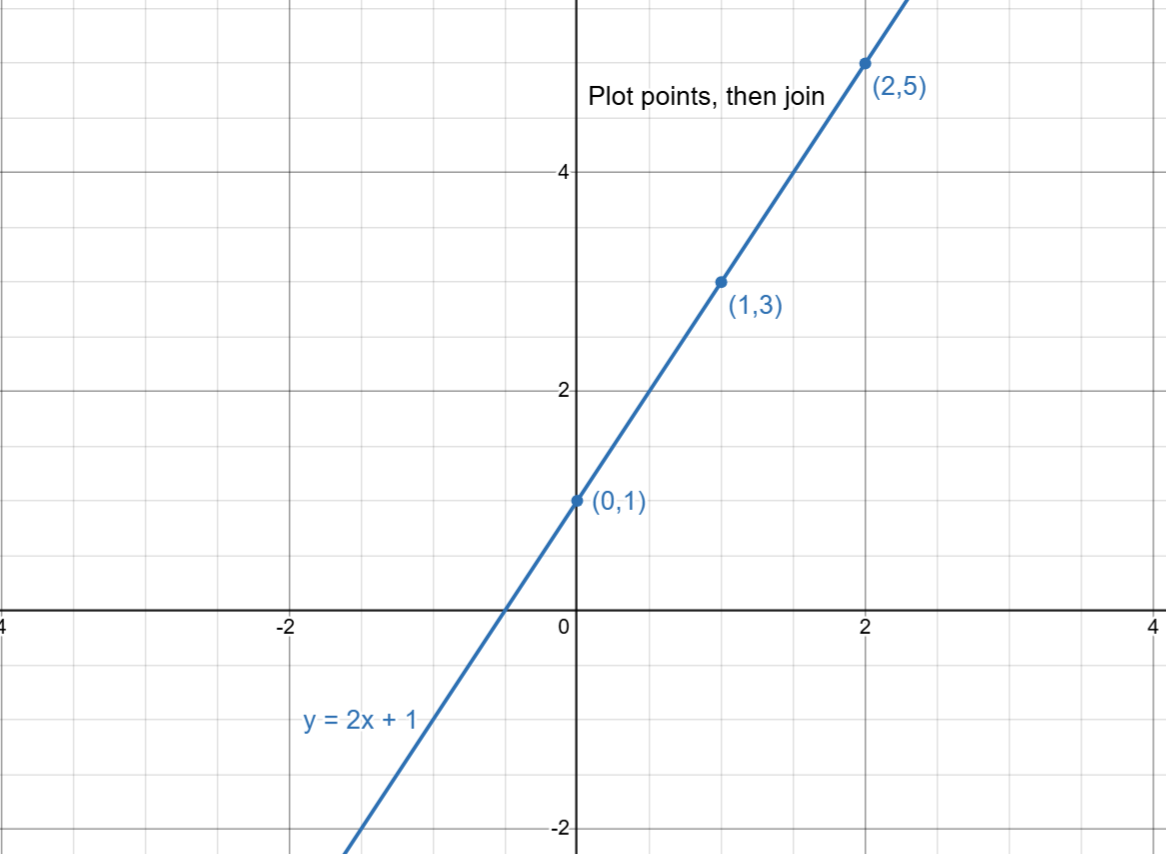
You can also create a table of values.
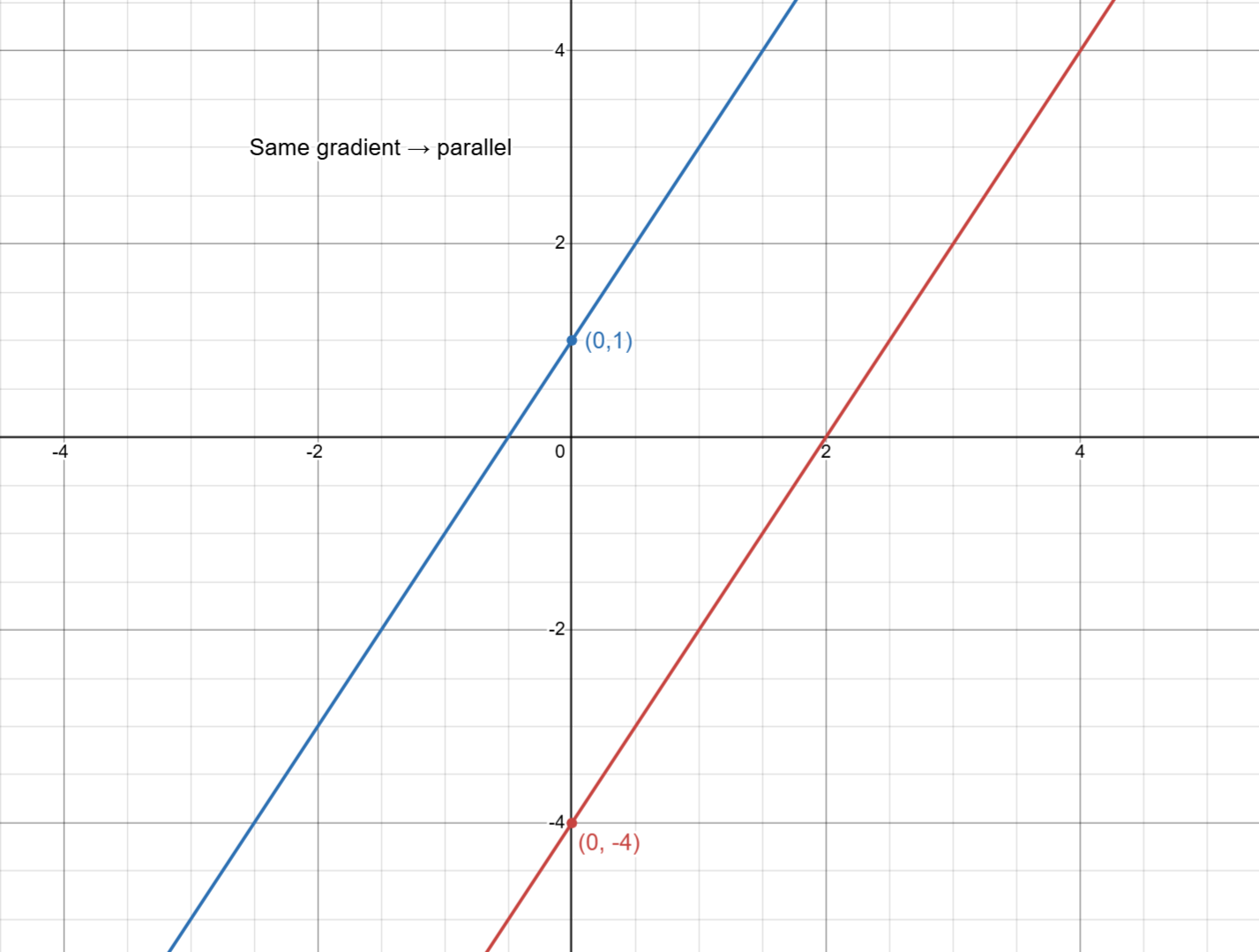
Parallel lines have the same gradient.
You may need to find the equation from a graph or points. This builds directly on solving linear equations.
\( y = 4 \) means the graph is flat.
If \( c = 0 \), the line passes through \( (0,0) \).
Exam-style questions inspired by Edexcel GCSE Mathematics.
Complete the table of values for \( y = 2x + 1 \) when \( x = -1, 0, 1, 2 \).
Write down the gradient of the line \( y = 3x - 4 \).
Write down the y-intercept of the line \( y = -2x + 5 \).
Determine whether the point \( (2, 7) \) lies on the line \( y = 3x + 1 \).
Find the equation of the line with gradient 4 and y-intercept \( -3 \).
Exam-style questions based on the AQA GCSE Mathematics specification, focusing on interpretation and forming equations of straight lines.
Find the gradient of the line passing through the points \( (1, 2) \) and \( (5, 10) \).
Find the equation of the line passing through \( (0, 3) \) and \( (2, 7) \).
Find the equation of the line parallel to \( y = 2x - 1 \) that passes through the point \( (0, 4) \).
Find the equation of the line perpendicular to \( y = \frac{1}{2}x + 3 \).
Explain how the gradient and y-intercept can be identified from the equation of a straight line.
Exam-style questions aligned with OCR GCSE Mathematics, emphasising reasoning, interpretation, and real-life applications.
A taxi fare is given by the formula \( C = 3 + 2x \), where \( x \) is the distance in miles. Interpret the gradient and the intercept.
Find the coordinates of the point where the line \( y = 4x - 2 \) crosses the y-axis.
Find the coordinates of the point where the line \( y = 5 - x \) crosses the x-axis.
Determine whether the lines \( y = 2x + 3 \) and \( y = 2x - 5 \) are parallel. Give a reason for your answer.
The cost of producing items is given by \( C = 50 + 4x \). Explain what the gradient and intercept represent in this context.
Check whether the equation is in the form \( y = mx + c \).
Identify the gradient and y-intercept carefully.
If needed, make a table of values and plot accurate points.
Draw a straight line through the points.
Reading the coefficient of \( x \) incorrectly.
Using the wrong sign for the constant term.
Plotting inaccurate points from the table.
Forgetting that parallel lines must have the same gradient.
These are common mistakes students make when working with graphs of linear functions in GCSE Maths.
A student confuses the gradient with the y-intercept in \(y = mx + c\).
In \(y = mx + c\), m is the gradient (slope of the line) and c is the y-intercept (where the line crosses the y-axis).
A student makes errors when plotting coordinates from a table.
Plot each point carefully by moving along the x-axis first, then up or down the y-axis. Check each coordinate before drawing the line.
A student joins points with uneven or curved lines.
Linear functions produce straight lines. Use a ruler to draw a single straight line through the points.
A student draws a line increasing when the gradient is negative.
A negative gradient means the line goes down from left to right. Always check the direction of the slope.
A student thinks parallel lines can have different gradients.
Parallel lines have the same gradient but different y-intercepts. If the gradients differ, the lines will intersect.
Practise plotting and interpreting straight-line graphs.
Understand gradients and intercepts of straight lines.
What is the gradient of the line \(y = 3x + 2\)?
What is the y-intercept of \(y = 4x + 1\)?
Which equation has gradient 5?
Write the equation of a line with gradient 2 and intercept 3.
Which graph is horizontal?
What is the gradient of \(y = -2x + 5\)?
Which equation passes through (0, 4)?
Write the equation of a line with gradient -3 and intercept 2.
A student says the gradient of \(y = 2x + 5\) is 5. What is the mistake?
What is the y-intercept of \(y = -x + 6\)?
Find equations, gradients between points and interpret graphs.
Find the gradient between (1, 2) and (3, 6).
Find the gradient between (2, 5) and (6, 13).
Find the equation of a line with gradient 3 passing through (0, 2).
Find the equation of a line with gradient 4 and passing through (0, -1).
Which line is parallel to \(y = 2x + 3\)?
Find the gradient of a line passing through (3, 7) and (5, 11).
Find the equation of a line through (0, 5) with gradient -2.
Find the equation of a line with gradient 1 passing through (0, 4).
A student says two lines are parallel if they have the same intercept. What is wrong?
Find the equation of a horizontal line passing through y = 7.
Practise interpreting graphs of straight-line functions.
It shows how steep the line is.
The point where the line crosses the y-axis.
Use a table of values or identify gradient and intercept.