If 1 apple costs £2, how much do 4 apples cost?
Multiply by 4.
Cost increases directly. 2 × 4 = £8.

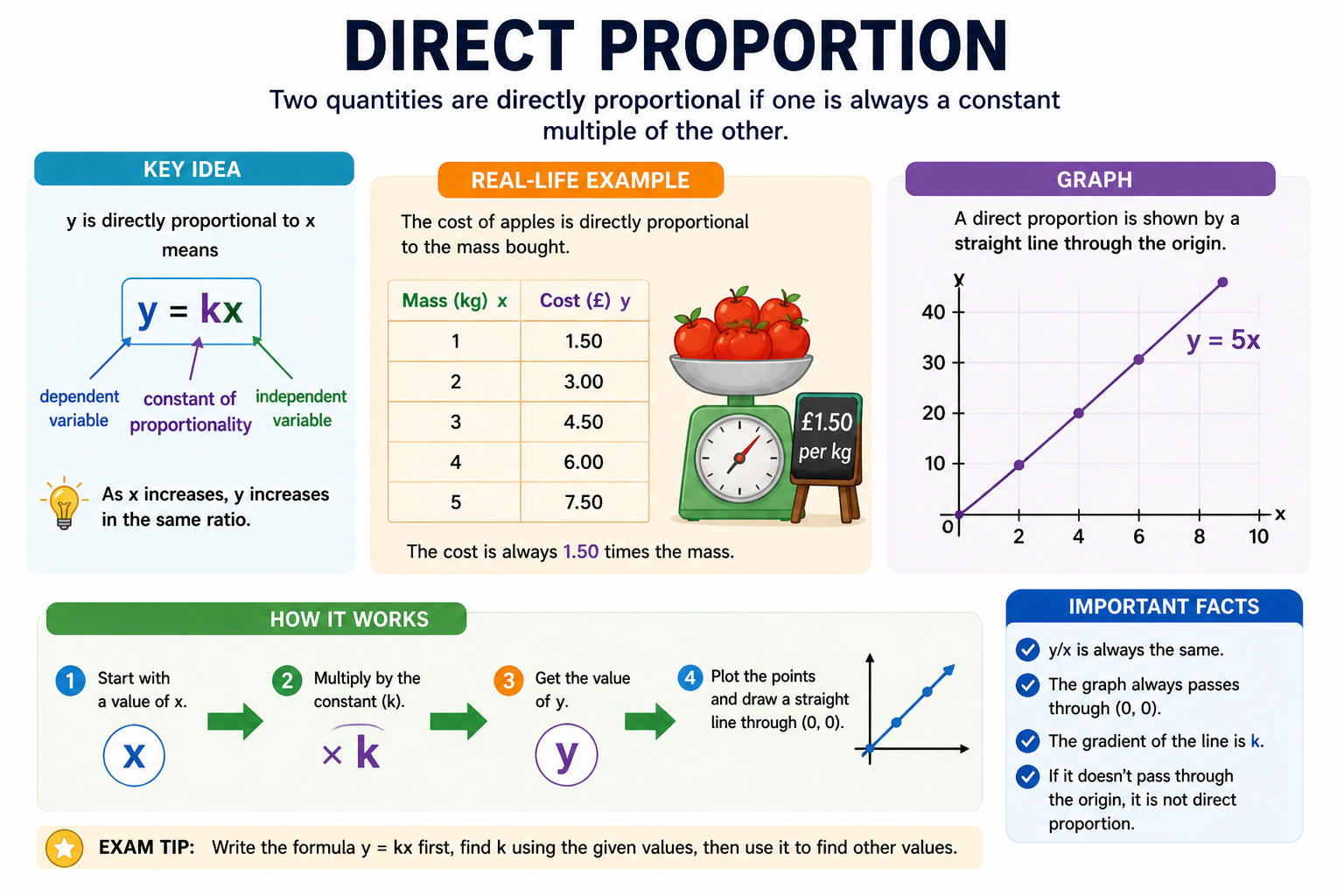
Direct proportion describes a relationship where two quantities increase or decrease together at the same rate. This is often written in the form y = kx.
Two quantities are in direct proportion when they increase or decrease in the same ratio.
If one value doubles, the other also doubles. If one triples, the other also triples.
The constant k is called the constant of proportionality. This topic appears in tables, recipes, cost problems, speed-style contexts and algebra questions.
Two quantities change in the same ratio.
The symbol \( \propto \) means “is proportional to”.
The fixed number \(k\) in the equation \( y = kx \).
The number used to scale one quantity to another.
The amount for 1 unit, often used to solve proportion tables.
A direct proportion graph is a straight line that passes through \( (0,0) \).
If \(x\) doubles, \(y\) doubles.
This is the standard direct proportion equation.
\( k = \frac{y}{x} \)
A direct proportion graph goes through \( (0,0) \).
“is directly proportional to”
\( y = 4x \)
Multiply by the same scale factor each time.
Straight line through the origin.
Direct proportion means two variables are linked by a constant multiplier. It is based on ideas from ratio, where one quantity scales in proportion to another.As one increases, the other increases in the same ratio.
If a question says:
Use given values to calculate \(k\).
Once you know \(k\), substitute new values.
You can also solve direct proportion using the unitary method.
Look for “directly proportional”.
Check whether \( \frac{y}{x} \) is constant.
It must be in the form \( y = kx \).
A straight line through the origin.
Exam-style questions inspired by Edexcel GCSE Mathematics, focusing on identifying and solving problems involving direct proportion.
Identify whether \( y \) is directly proportional to \( x \) in the equation \( y = 5x \).
Given that \( y \propto x \) and \( y = 12 \) when \( x = 3 \), find \( y \) when \( x = 10 \).
Given that \( y \propto x \), and \( y = 18 \) when \( x = 6 \), find the constant of proportionality.
The cost of 4 notebooks is £10. Assuming the cost is directly proportional to the number of notebooks, find the cost of 9 notebooks.
The distance travelled is directly proportional to time. If a car travels 120 km in 2 hours, how far will it travel in 5 hours at the same speed?
Exam-style questions based on the AQA GCSE Mathematics specification, focusing on forming and solving equations involving direct proportion.
Given that \( y \propto x \), and \( y = 20 \) when \( x = 4 \), find an equation connecting \( y \) and \( x \).
If \( y \propto x \), and \( y = 15 \) when \( x = 5 \), find \( x \) when \( y = 27 \).
The mass of an object is directly proportional to its volume. If the mass is 24 kg when the volume is 3 m^3, find the mass when the volume is 7 m^3.
The circumference of a circle is directly proportional to its diameter. Given that the circumference is 31.4 cm when the diameter is 10 cm, find the circumference when the diameter is 15 cm.
Explain how you recognise a direct proportion from a table or graph.
Exam-style questions aligned with OCR GCSE Mathematics, emphasising reasoning, graphical interpretation, and algebraic modelling.
Given that \( y \propto x \), and \( y = 8 \) when \( x = 2 \), find the value of \( y \) when \( x = 9 \).
Write \( y \propto x \) as an equation using a constant of proportionality.
A worker is paid £45 for 5 hours of work. Assuming pay is directly proportional to time worked, find the pay for 8 hours.
A recipe uses 200 g of flour to make 8 pancakes. How much flour is needed to make 14 pancakes?
State the key features of a graph that represents direct proportion.
If you see “directly proportional”, write \( y = kx \).
Substitute a known pair of values to find \( k \).
Use the completed equation to find the missing value.
For graphs, check that the line passes through the origin.
Using \( y = k + x \) instead of \( y = kx \).
Not dividing correctly to find \( k \).
Thinking any straight line is direct proportion.
Forgetting to keep units sensible in money, mass or length questions.
These are common mistakes students make when working with direct proportion in GCSE Maths.
A student tries to solve the problem without writing an equation.
Always start with the form \( y = kx \), where k is the constant of proportionality.
A student adds a constant instead of multiplying by one.
In direct proportion, values are multiplied by a constant factor. The relationship must follow \( y = kx \), not \( y = x + c \).
A student divides or multiplies the wrong values when calculating k.
To find k, divide y by x using known values. For example, \( k = \frac{y}{x} \).
A student thinks all linear graphs represent direct proportion.
Only lines that pass through the origin represent direct proportion. Other straight lines follow \( y = mx + c \).
A student accepts a graph without checking if it passes through (0,0).
A key feature of direct proportion is that the graph passes through the origin. Always check this before concluding.
A student uses inverse proportion methods for a direct proportion problem.
Direct proportion has the form \( y = kx \), while inverse proportion follows \( y = \frac{k}{x} \). Make sure you identify the correct relationship.
Practise solving problems involving direct proportional relationships.
Solve direct proportion problems using scaling and simple multiplication.
If 1 apple costs £2, how much do 4 apples cost?
3 books cost £12. How much do 5 books cost?
A car travels 60 km in 1 hour. How far does it travel in 3 hours?
5 pencils cost £10. How much do 2 pencils cost?
If 2 kg of apples cost £6, how much does 6 kg cost?
8 metres of fabric cost £24. How much do 3 metres cost?
A student says if 4 items cost £8, then 8 items cost £12. What is wrong?
7 litres of fuel cost £14. How much do 10 litres cost?
If y is directly proportional to x, what happens when x doubles?
6 oranges cost £3. How much do 15 oranges cost?
Solve direct proportion problems using equations and constant k.
y is directly proportional to x. When x = 4, y = 12. Find y when x = 10.
y is directly proportional to x. When x = 5, y = 20. Find y when x = 8.
y ∝ x. If y = 18 when x = 6, what is the value of k?
y ∝ x. When x = 3, y = 15. Find y when x = 7.
A quantity y is directly proportional to x. When x increases by a factor of 4, what happens to y?
y ∝ x. When x = 2, y = 10. Find x when y = 25.
A student says y = x + 3 shows direct proportion. Why are they wrong?
y ∝ x. When x = 8, y = 24. Find x when y = 15.
Which equation represents direct proportion?
y ∝ x. When x = 6, y = 9. Find y when x = 20.
Practise recognising and solving direct proportion problems using tables, unit values and real-life situations.