A bag has 3 red and 2 blue balls. One red ball is removed. What is the probability the next ball is red?
Total and reds both change.
Now 2 red out of 4 total → 1/2.

Conditional probability considers how the likelihood of an event changes when another event has already occurred. It builds on ideas from basic probability and is often explored using Venn diagrams and tree diagrams.
Conditional probability is the probability of one event happening given that another event has already happened.
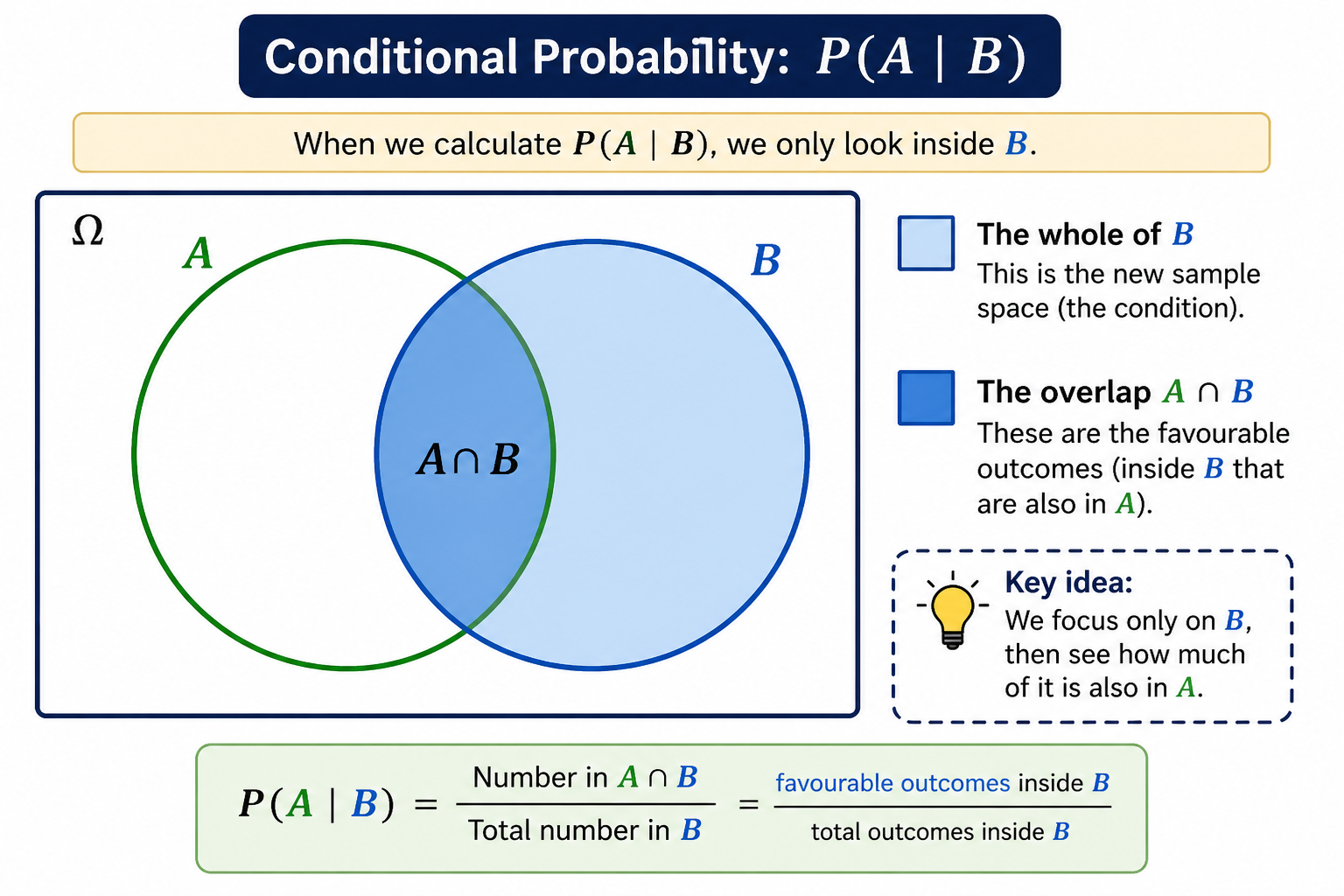
The key idea is that once you are told event B has happened, you no longer use the original whole sample space. You only work inside event B.
The probability of an event happening given that another event has already happened.
A phrase meaning you already know some extra information.
The full set of possible outcomes.
The smaller set of outcomes left after extra information is given.
\(A \cap B\) means outcomes that are in both \(A\) and \(B\).
The probability of \(A\) given \(B\).
\( P(A \mid B) = \frac{P(A \cap B)}{P(B)} \)
When given \(B\), the denominator becomes \(P(B)\), not the full sample space.
The numerator is the part where both events happen together.
If the question says “given \(B\)”, work only inside event \(B\).
Probability of both events happening.
Probability of \(A\) when you already know \(B\) happened.
The size of the restricted sample space in the denominator.
Conditional probability changes what counts as “the whole”.
In standard probability, you consider all possible outcomes. In conditional probability, you are given extra information that reduces the sample space.
Conditional probability focuses only on outcomes that satisfy the given condition.
The numerator represents outcomes where both \(A\) and \(B\) occur. The denominator represents all outcomes in event \(B\).
In a Venn diagram, conditional probability means you focus only on the region inside the condition.
Focus only on circle \(B\).
Count the overlap \(A \cap B\) within that region.
In a two-way table, the condition tells you which row or column becomes the new total.
Find the probability that a student is left-handed given that the student is male. Only the male row or column is used.
In tree diagrams, probabilities on later branches may depend on earlier outcomes. This is also conditional probability.
If a ball is taken from a bag and not replaced, the second probability depends on the first outcome.
Exam-style questions inspired by Edexcel GCSE Mathematics, focusing on conditional probability and probability without replacement.
A bag contains 7 orange sweets and 3 white sweets. A sweet is taken at random and eaten. A second sweet is then taken at random and eaten.
Find the probability that both sweets are orange.
There are only n red counters and 2 blue counters in a bag. A counter is taken at random and not replaced. A second counter is then taken at random.
Show that the probability of taking two red counters is \( \frac{n(n-1)}{(n+2)(n+1)} \).
A box contains 5 green counters, 4 yellow counters and 3 red counters. A counter is taken at random and not replaced. A second counter is then taken at random.
Given that the first counter is green, find the probability that the second counter is yellow.
Exam-style questions based on the AQA GCSE Mathematics specification, focusing on tree diagrams, dependent events and conditional probability.
There are 6 red counters and 4 blue counters in a bag. Two counters are taken at random without replacement.
Complete a probability tree diagram for this information.
There are 8 red counters and 5 yellow counters in a bag. A counter is taken at random and not replaced. A second counter is then taken at random.
Find the probability that the second counter is yellow, given that the first counter was red.
A teacher chooses 2 students at random from a class of 25 students.
Work out the number of different pairs of students that can be chosen.
A student says that choosing two students is the same as choosing one student twice with replacement.
Tick one box. Yes ☐ No ☐
Give a reason for your answer.
Exam-style questions aligned with OCR GCSE Mathematics, emphasising probability reasoning, conditional outcomes and multi-step dependent events.
There are 4 red counters, 3 yellow counters and 2 green counters in a bag. Three counters are taken at random without replacement.
Work out the probability that all three counters are yellow, red and green in any order.
There are 5 red counters, 4 blue counters and 1 green counter in a bag. Two counters are taken at random without replacement.
Given that the first counter is not green, find the probability that the second counter is blue.
A bag contains 4 red counters, 3 yellow counters and 1 blue counter. Three counters are taken at random without replacement.
Work out the probability that there are more yellow counters than red counters left in the bag.
Underline the words “given that”.
Work out the new restricted sample space.
Find the favourable outcomes inside that restricted set.
Write the fraction carefully and simplify if needed.
Using the total number of outcomes instead of the given event.
Choosing the whole event instead of the shared part.
Using the wrong row or column total.
Ignoring that probabilities change after earlier events.
These are common mistakes students make when working with conditional probability in GCSE Maths.
A student uses the full sample size even after a condition is given.
When a condition is applied, the sample space is reduced. You must use the restricted total that satisfies the condition.
A student treats intersection and conditional probability as the same.
\(P(A \cap B)\) means both events happen, while \(P(A \mid B)\) means the probability of A given that B has already occurred. The denominator changes for conditional probability.
A student selects values from the wrong part of a two-way table.
Carefully identify which condition is being applied and select the correct row or column that matches it.
A student calculates probability without adjusting for the condition.
The word “given” means the sample space has changed. Only outcomes that satisfy the condition should be considered.
A student treats events as independent when items are not replaced.
Without replacement, probabilities change after each selection. Always adjust the totals accordingly.
Practise calculating probabilities involving dependent events.
Understand conditional probability in simple contexts.
A bag has 3 red and 2 blue balls. One red ball is removed. What is the probability the next ball is red?
A bag has 4 red and 1 blue ball. One red is removed. Find the probability the next ball is red.
What does 'given that' mean in probability?
A bag has 5 balls. 2 are red. Given that one red is removed, how many balls remain?
A bag has 3 red and 3 blue balls. Given that a red ball was picked first, what is the probability the second ball is blue?
A bag has 6 balls: 2 red, 4 blue. Given that a blue was removed, find probability of picking a red next.
Why does probability change after removing an item?
A bag has 3 red and 2 blue balls. Given that a blue was picked first, how many balls are left?
If an event depends on a previous outcome, it is called:
A bag has 4 red and 4 blue balls. Given one red is removed, find probability of picking blue next.
Calculate conditional probabilities using fractions and reasoning.
A bag has 5 red and 3 blue balls. Two are picked without replacement. What is the probability both are red?
A bag has 6 balls: 3 red, 3 blue. Two are picked without replacement. Find probability of red then blue.
What is the key difference between independent and dependent events?
A bag has 4 red and 2 blue balls. Two are picked without replacement. Find probability of at least one red.
Why is the complement method useful?
A bag has 5 balls: 2 red, 3 blue. Two are picked without replacement. Find probability both are blue.
A student forgets to change probabilities after removing a ball. What is wrong?
A bag has 3 red and 2 blue balls. Two are picked without replacement. Find probability of one red and one blue (any order).
Which situation involves dependent events?
A bag has 7 balls: 4 red, 3 blue. Two are picked without replacement. Find probability both are red.
Practise conditional probability using trees, tables and real-life GCSE-style problems.
Probability given that another event has occurred.
When events are dependent.
Tree diagrams or Venn diagrams.