The direction shown is east from point O. What is the bearing?
Bearings are measured clockwise from north.
East is 90° clockwise from north, so the bearing is 090°.

Bearings describe direction using angles measured clockwise from north. They are commonly used in navigation-style GCSE Maths questions and often combine with angle rules, trigonometry and loci and constructions.
A bearing is a way of describing direction using angles.
Bearings are always measured clockwise from north.
In GCSE Maths, you need to be able to read bearings from diagrams, write them correctly, and use angle facts to solve missing bearing problems.
A direction given as an angle measured clockwise from north.
The vertical reference line from which a bearing is measured.
The same direction as the hands of a clock.
A bearing written with three digits, such as \(007^\circ\) or \(085^\circ\).
The bearing in the opposite direction.
A direction such as north, south-east or west, often linked to bearings.
Always measure the angle from the north line.
Bearings always go clockwise, never anticlockwise.
Write bearings like \(040^\circ\), not \(40^\circ\).
This helps when calculating missing or reverse bearings.
\(000^\circ\)
\(090^\circ\)
\(180^\circ\)
\(270^\circ\)
A bearing gives the direction of one point from another. It is always measured as an angle clockwise from north.
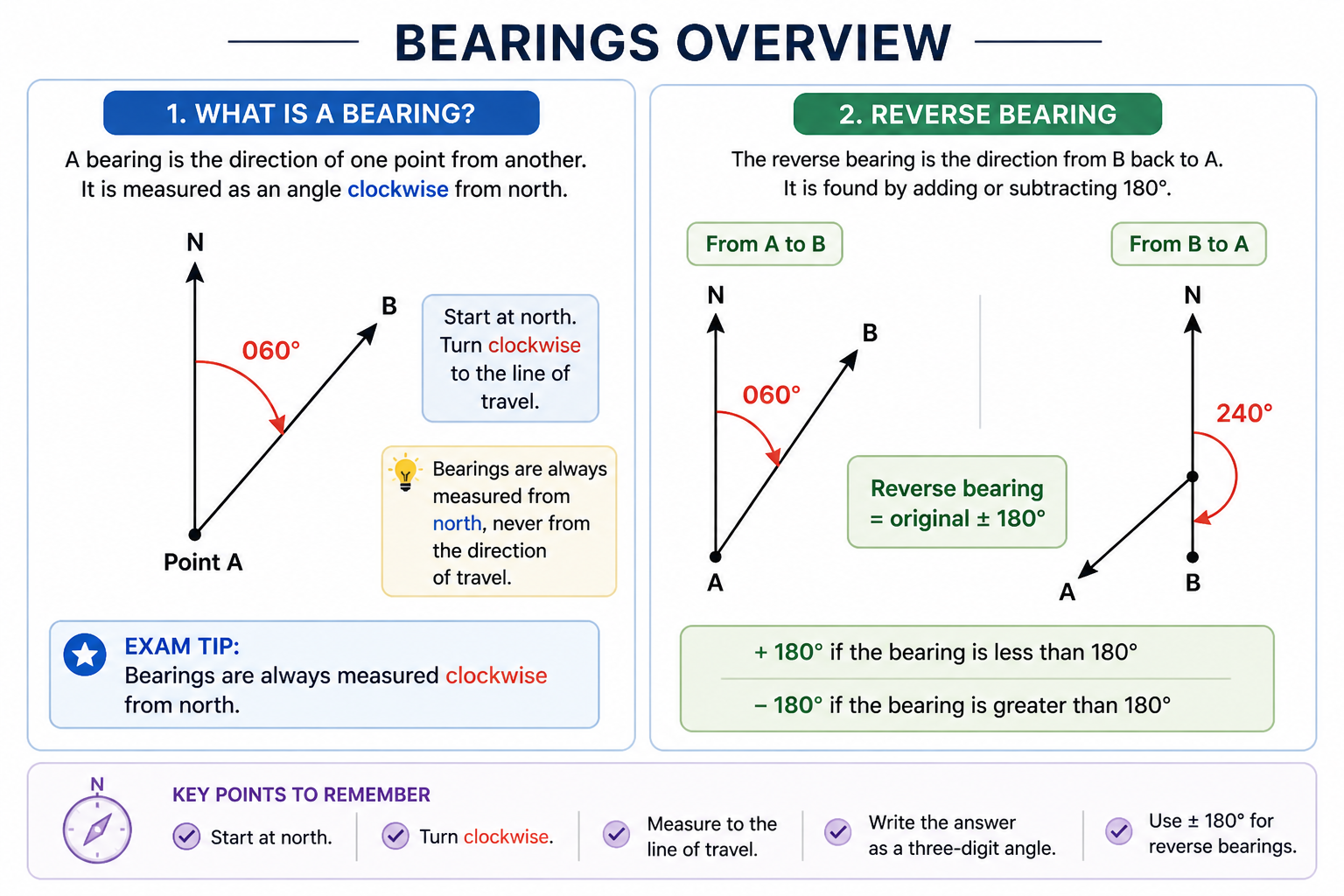
Every bearing starts from a north line. This is usually shown as a vertical line with an arrow pointing up.
From the north line, rotate clockwise until you reach the direction line. The size of this turn is the bearing.
Bearings must always be written using three digits.
\(035^\circ\), \(090^\circ\), \(275^\circ\)
\(35^\circ\), \(90^\circ\), west of north
The reverse bearing is the direction going back the opposite way.
Bearings questions often combine direction with angle rules.
Some questions require measuring bearings using a protractor, while others require calculating them using given angles.
Always draw the north line and clearly mark the clockwise angle.
Exam-style questions focusing on reading simple bearings from north.
The direction east is shown from point O.
Write the bearing for east.
A direction is 45° clockwise from north.
Write the bearing using three digits.
Exam-style questions focusing on reverse bearings.
The bearing of B from A is 120°.
Find the bearing of A from B.
The bearing of C from D is 260°.
Find the reverse bearing.
Exam-style questions focusing on reasoning with compass directions and missing bearing angles.
The direction west is shown from point O.
Explain why west is written as 270° as a bearing.
A point lies on a bearing of 145° from O.
Find the angle between the line and the south direction.
A ship travels from A on a bearing of 070°.
Explain why the bearing must be written as 070° and not 70°.
Find or draw the north line first.
Measure or calculate the angle clockwise from north.
Write the bearing with three digits.
For reverse bearings, add or subtract \(180^\circ\).
Measuring anticlockwise instead of clockwise.
Starting from the travel line instead of the north line.
Writing \(45^\circ\) instead of \(045^\circ\).
Forgetting to change the direction by \(180^\circ\).
These are common mistakes students make when working with bearings in GCSE Maths.
A student measures the angle in an anticlockwise direction.
Bearings are always measured clockwise from north. Measuring anticlockwise will give the wrong answer.
A student starts measuring the angle from the direction of travel instead of north.
Bearings must always be measured from the north line. The angle is taken clockwise from north to the direction of travel.
A student writes a bearing as \(45^\circ\) instead of \(045^\circ\).
Bearings must be written using three digits, for example \(045^\circ\), \(120^\circ\), or \(300^\circ\).
A student uses the original bearing instead of finding the reverse.
The reverse bearing differs by \(180^\circ\). Add or subtract \(180^\circ\) and ensure the result is between \(000^\circ\) and \(360^\circ\).
A student calculates angles without considering the full turn.
Angles around a point add up to \(360^\circ\). This is often needed when finding missing bearings.
Practise measuring and calculating bearings using angles and diagrams.
Read simple bearings from north and write bearings using three digits.
The direction shown is east from point O. What is the bearing?
A direction is 45° clockwise from north. Write the bearing using three digits.
What is the bearing of south from point O?
Write the bearing shown.
Which rule is correct for bearings?
A ship travels on a bearing of 070°. What angle is this clockwise from north?
Which is the correct three-digit bearing for 8° clockwise from north?
What is the three-digit bearing for 95° clockwise from north?
A bearing of 000° points in which direction?
A bearing is 135°. How many degrees is it past east?
Calculate reverse bearings and missing angles using diagrams.
The bearing of B from A is 120°. Find the bearing of A from B.
The bearing of Q from P is 045°. What is the bearing of P from Q?
The bearing of C from D is 260°. Find the reverse bearing.
The bearing of Y from X is 310°. What is the bearing of X from Y?
A point lies on a bearing of 145° from O. Find the angle between the line and the south direction.
A bearing is 235°. How many degrees west of south is this?
A bearing is 070°. Find the smaller angle between the line and east.
A student writes a bearing as 70°. What should they write instead?
The bearing of B from A is 018°. Find the bearing of A from B.
The bearing of B from A is 205°. Find the bearing of A from B.
Practise reading, drawing and calculating bearings using compass diagrams.
A direction measured clockwise from north.
As three-digit numbers.
A protractor.