Find the missing angle x.
Angles on a straight line add to 180°.
180 − 120 = 60°.

Angles are formed when two lines meet. Understanding angle rules is essential for solving problems involving shapes, geometry and algebra. This topic links directly to trigonometry and polygons.
Angles measure how much a line turns.
In GCSE Maths, you need to know the main angle facts and use them to calculate missing angles.
Most angle questions follow the same pattern: identify the rule, form an equation, and solve.
An angle less than \(90^\circ\).
An angle exactly \(90^\circ\).
An angle greater than \(90^\circ\) but less than \(180^\circ\).
An angle of \(180^\circ\).
An angle greater than \(180^\circ\) but less than \(360^\circ\).
Opposite angles formed by two intersecting lines. They are equal.
An angle inside a shape.
An angle outside a shape, formed by extending a side.
They add up to \(180^\circ\).
They add up to \(360^\circ\).
They are equal.
They add up to \(180^\circ\).
They add up to \(360^\circ\).
They are equal on parallel lines.
They are equal on parallel lines.
They add up to \(180^\circ\).
\((n - 2) \times 180^\circ\)
\(360^\circ\)
\(\frac{360^\circ}{n}\)
\(180^\circ - \text{exterior angle}\)
Before calculating anything, decide which angle rule applies. This is the most important step in solving angle problems.
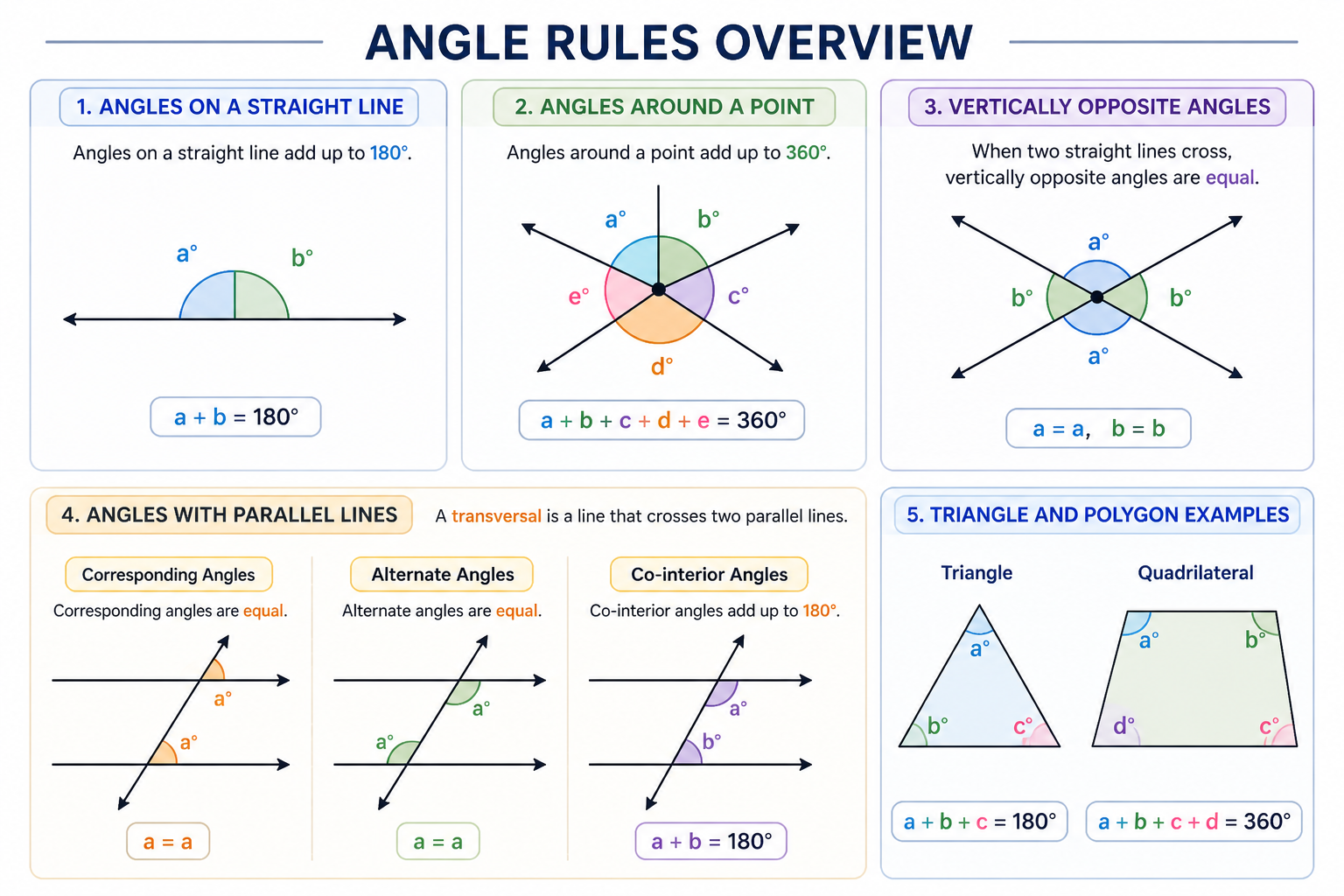
Once you recognise the diagram, write the total and form an equation to find the missing angle.
When a transversal crosses parallel lines, several angle relationships appear together.
Equal angles in matching positions.
Equal angles forming a Z-shape.
Add to \(180^\circ\) and form a C-shape.
State the rule first, then form an equation.
Basic shapes have fixed angle totals that are used in almost every exam.
Sum = \(180^\circ\)
Sum = \(360^\circ\)
For shapes with more than four sides, use a formula to find the total of the interior angles.
In a regular polygon, all sides and angles are equal.
Exam-style questions focusing on basic angle facts, straight lines and angles around a point.
Angles on a straight line are shown.
Find the value of x.
Angles around a point are shown.
Find the value of x.
Two straight lines intersect.
Find the value of x.
Exam-style questions focusing on triangles, isosceles triangles and parallel line angle facts.
The angles in a triangle are shown.
Find the value of x.
An isosceles triangle has two equal sides.
Find the value of x.
Two parallel lines are crossed by a transversal.
Find the value of x. Give a reason for your answer.
Exam-style questions focusing on polygon angle reasoning and regular polygons.
A nonagon is shown.
Find the sum of the interior angles.
A regular decagon has 10 equal exterior angles.
Find the size of each exterior angle.
A regular polygon has exterior angle 24°.
Find the number of sides.
Identify the angle fact from the diagram.
Write the correct total: \(180^\circ\), \(360^\circ\) or a polygon rule.
Build an equation carefully.
Check that your answer makes sense in the diagram.
Using straight-line angles when the question is about parallel lines or polygons.
Using \(360^\circ\) instead of \(180^\circ\), or the other way round.
Mixing up corresponding, alternate and co-interior angles.
Forgetting that interior sum uses \((n-2)\times180\).
These are common mistakes students make when solving angle problems in GCSE Maths.
A student applies a rule that does not match the diagram.
Always identify the type of angles first (e.g. alternate, corresponding, vertically opposite) before choosing a rule. Using the wrong rule leads to incorrect answers.
A student treats vertically opposite angles as different values.
Vertically opposite angles are always equal. These angles are directly opposite each other when two lines cross.
A student says co-interior angles are equal.
Corresponding angles are equal, but co-interior angles add up to \(180^\circ\). It is important to recognise which pair you are working with.
A student uses \(360^\circ\) when the angles should sum to \(180^\circ\).
Angles on a straight line add to \(180^\circ\), while angles around a point add to \(360^\circ\). Choose the correct total based on the diagram.
A student tries to find interior angles directly without using the correct method.
For regular polygons, it is often easier to find the exterior angle first using \(360^\circ \div n\), then subtract from \(180^\circ\) to find the interior angle.
Practise the main angle facts first, then move to parallel lines and polygons.
Use basic angle facts including straight lines, triangles and around a point.
Find the missing angle x.
What is the total angle around a point?
Find the missing angle x.
Which angle is a right angle?
Find x.
Angles in a triangle always add up to:
Find x.
An acute angle is:
Angles around a point are 120°, 130° and x. Find x.
A straight line angle is:
Solve angle problems involving parallel lines and polygons.
Find x.
Corresponding angles are:
Find x.
Find the sum of interior angles of a pentagon.
The exterior angles of any polygon add up to:
A regular hexagon has equal angles. Find each interior angle.
Alternate angles are formed when:
Find x if interior angle of a regular polygon is 135°.
Co-interior angles sum to:
Find x.
Practise recognising angle types, angle facts and missing angles.
180 degrees.
Angles opposite each other that are equal.
Angles in matching positions on parallel lines.