The solid shown is a cube. How many faces does it have?
Faces are the flat surfaces.
A cube has 6 square faces.
3D shapes have length, width and height, while nets show how solids unfold into flat shapes. This topic links closely to surface area, volume and perimeter and area, because understanding faces helps with later calculations.
A 3D shape is a solid object with length, width and height.
A net is a flat pattern that folds to make a 3D shape.
In exam questions, you are often asked to identify a shape, describe its properties, or decide whether a net can fold into the correct solid.
A solid shape with three dimensions: length, width and height.
A flat or curved surface on a 3D shape.
The line where two faces meet.
A corner where edges meet. The plural is vertices.
A 2D pattern that folds to make a 3D shape.
The shape made when a 3D object is cut straight through.
Faces, edges and vertices must all match the shape.
A cylinder and cone include curved surfaces.
If faces clash or leave gaps, it is not a valid net.
The base often tells you the name of the prism or pyramid.
All faces are equal squares.
All faces are rectangles, not necessarily equal.
Same cross section all the way through.
Faces meet at one top vertex.
Start by looking at the faces, edges and vertices. Ask whether the shape has square, rectangular, triangular or circular faces, and check whether it has any curved surfaces.
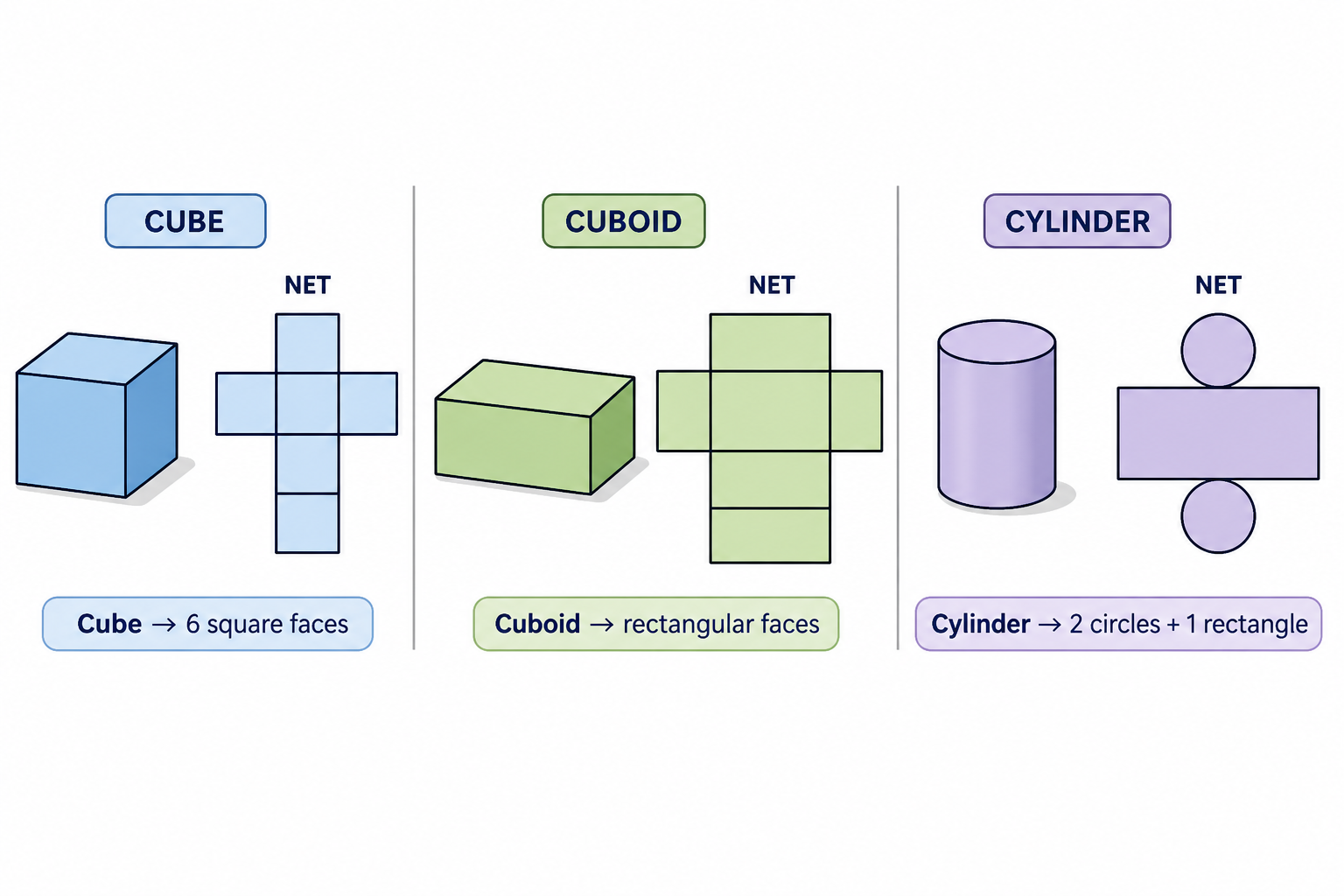
Counting faces, edges and vertices is often the quickest way to confirm the shape.
6 faces, 12 edges, 8 vertices
6 faces, 12 edges, 8 vertices
2 flat circular faces, 1 curved surface, 2 circular edges, 0 vertices
5 faces, 9 edges, 6 vertices
A net is the flat version of a 3D shape before it is folded. Each face in the net becomes a face on the final solid.
A correct net must:
Once you understand the faces of a 3D shape, it becomes easier to calculate measurements.
Add the area of every face in the net.
Find the space inside the solid.
Use 2D face calculations before moving to 3D calculations.
Exam-style questions focusing on recognising 3D shapes and counting their properties.
The solid shown is a cube.
How many faces does a cube have?
The solid shown is a cuboid.
How many vertices does a cuboid have?
Exam-style questions focusing on cylinders, cones and matching 3D shapes to their properties.
The 3D shape shown has 2 circular faces and 1 curved surface.
Name the 3D shape.
The 3D shape shown has one circular base and one vertex.
Explain why this shape is a cone.
Exam-style questions focusing on nets and whether a net folds correctly.
A net is made from 6 equal squares.
Which solid does this net form?
This net has the correct number of square faces, but it may not fold into a cube.
Why might a net with the correct faces still be wrong?
A net contains two circles and one rectangle.
Which 3D shape does this net form?
Look at the type of faces first.
Count faces, edges and vertices carefully.
For nets, check the number and shape of the faces.
Imagine folding the net to see if it overlaps or leaves a gap.
Edges are lines, vertices are corners.
Shapes like cones, cylinders and spheres include curved parts.
Not every arrangement folds into a cube.
A valid net must close properly with no overlap.
These are common mistakes students make when working with 3D shapes and nets in GCSE Maths.
A student says a cube has 8 edges.
A cube has 12 edges and 8 vertices. Edges are the line segments where faces meet, while vertices are the corner points.
A student counts the curved surface of a cylinder as a face.
Curved surfaces are not flat faces. A cylinder has 2 flat circular faces and 1 curved surface.
A student thinks any arrangement of 6 squares can fold into a cube.
Only specific arrangements of 6 squares form a valid cube net. Some layouts overlap or leave gaps when folded.
A net is accepted even though two faces overlap when folded.
A valid net must fold without any faces overlapping. Always visualise or test how the shape folds.
A student says all cuboids have equal edges like a cube.
A cube is a special type of cuboid where all edges are equal. In a general cuboid, edge lengths can be different.
Test yourself on shape names, properties and nets.
Recognise common 3D shapes, count faces, edges and vertices, and match simple nets.
The solid shown is a cube. How many faces does it have?
The solid shown is a cuboid. How many vertices does it have?
Name the 3D shape shown.
The shape shown has one circular base and one vertex. Name the shape.
Which statement describes a sphere?
How many edges does a cube have?
The net shown is made from 6 equal squares. Which solid does it form?
The triangular prism shown has 2 triangular faces and 3 rectangular faces. How many faces does it have altogether?
The solid shown is a square-based pyramid. How many vertices does it have?
A net contains two circles and one rectangle. Which 3D shape does it form?
Reason about nets, hidden faces, Euler’s formula and properties of prisms and pyramids.
A prism has a pentagonal cross-section. How many faces does it have?
A pentagonal prism has 10 vertices and 7 faces. Use Euler’s formula to find the number of edges.
Which net forms a cylinder?
The prism shown has a hexagonal cross-section. How many faces does a hexagonal prism have?
A square-based pyramid has 5 faces and 5 vertices. How many edges does it have?
A triangular prism has 5 faces and 6 vertices. Use Euler’s formula to find the number of edges.
This arrangement has 6 square faces. Why might it still fail to make a cube?
A cuboid has 6 faces and 8 vertices. Use Euler’s formula to find the number of edges.
Which statement is true for all prisms?
A prism has an octagonal cross-section. How many faces does it have?
Practise recognising 3D shapes, matching nets and deciding whether nets fold correctly.
A flat shape that folds into a 3D object.
A point where edges meet.
They help calculate surface area.